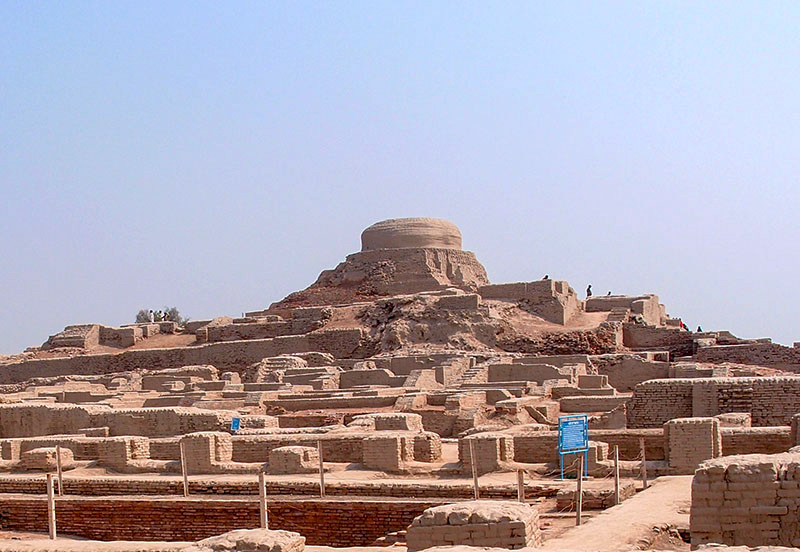
An archaeological site located in present-day Sindh, Pakistan, and dated to c. 2500 BCE. It was one of the largest settlements in the Indus Valley Civilisation. The site contains substantial evidence of urban planning, such as regular streets, uniform building sizes, supply and drainage of water and a grain storage facility. It was designated a UNESCO World Heritage Site in 1980.
More Definitions
Tondai Nadu
Historic region of southern India spanning present-day northern Tamil Nadu and southern Andhra Pradesh, bounded by the Arni and Kotallaiyar…
Nigali Sagar
Also called Nigliva, it is an archaeological site located about 20 kilometres from Lumbini, Nepal, that contains the remains of…
Bijapur
Bijapure (now Vijayapura) is a city in present-day Karnataka which was founded c. tenth century CE by the Western Chalukyas…
Taxila
An archaeological site in present-day Rawalpindi, Pakistan. Founded c. 1000 BCE, the site was located along trade routes between Central…
Darasuram
A municipality in Thanjavur, Tamil Nadu, known as the site of the Airavatesvara Temple constructed by Rajaraja Chola II in…
Ahmadnagar
A city in present day Maharashtra founded in 1494 and named after its founder, Ahmad Nizam Shah I. It was…
Pattadakal
Located in present-day Karnataka, it was a capital and coronation site of the Early Western Chalukyas. It is noted for…
Champa
Group of political territories of Cham people that encompassed modern-day central and south Vietnam between the second century CE and…