-
ChicagoDeka, Dr. Dipanjali. "The Space to Become: An Interview with Artist Seema Kohli." Impart Perspectives, September 25, 2026. https://imp-art.org/perspectives/interviews/the-space-to-become-an-interview-with-artist-seema-kohli/
-
MLADeka, Dr. Dipanjali. "The Space to Become: An Interview with Artist Seema Kohli." Impart Perspectives, Sep. 25, 2026, https://imp-art.org/perspectives/interviews/the-space-to-become-an-interview-with-artist-seema-kohli/. Accessed 15 Oct 2026.
-
HarvardDeka, D.D. (2026) The Space to Become: An Interview with Artist Seema Kohli, Impart Perspectives. Available at: https://imp-art.org/perspectives/interviews/the-space-to-become-an-interview-with-artist-seema-kohli/ (Accessed: 15 October 2026).
The Space to Become: An Interview with Artist Seema Kohli
Seema Kohli reflects on how, over four decades, her artistic journey has unfolded through explorations of the self, the feminine, and the spiritual.
By Dr. Dipanjali Deka
Link copied!
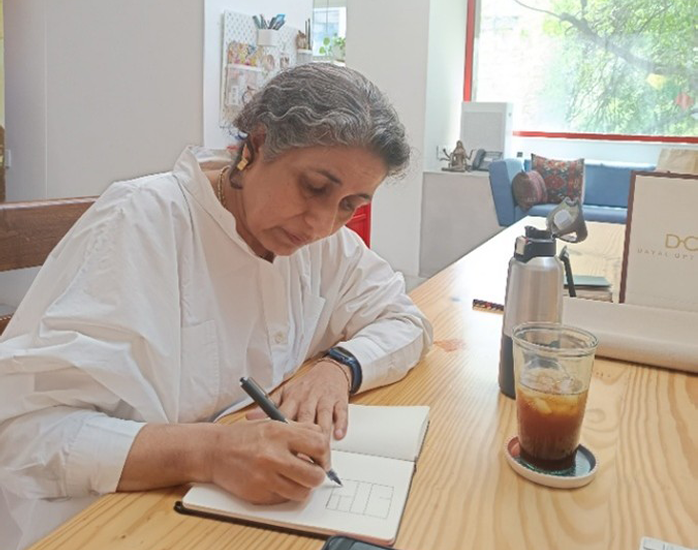
Artist Seema Kohli makes a quick sketch of her late grandfather’s room, which served as her first art studio. Courtesy the author
I am everywhere
Everything is in my womb
I expand in every thought
Every time I contract
The expansion is volcanic
Every time you believe I am not
I create a miracle
You all come from one single womb
Share the same single space
How can you despair that
I ride the mind
Holding the reins by its hair
I am a celebration!
— Seema Kohli
For over three decades, Seema Kohli has developed a visual language that traverses painting, sculpture, installation, performance, poetry, and moving images. Her densely and exuberantly layered works alchemically weaves together mythology, mysticism, Tantra, and cosmology with lived experience. During our conversation, Kohli reflected on the myriad influences that have shaped her artistic practice — from formative moments during her childhood and adult life to the philosophies and practices she keeps returning to in her work.
Speaking about how her artistic labour and material explorations intersect with her feminism and spiritual practice, she traces the ways in which art can become both a refuge and a tool for transformation.
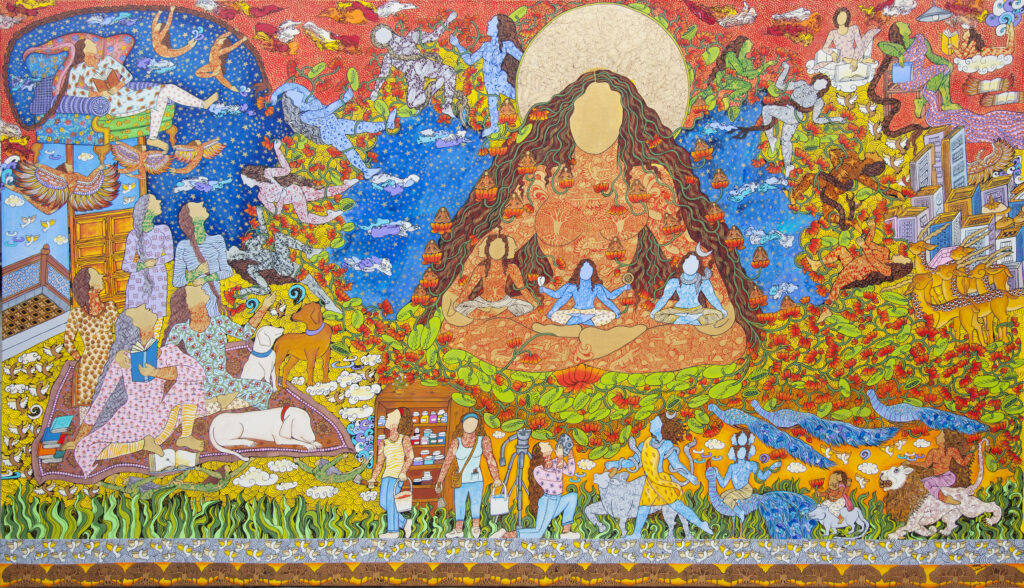
Dipanjali Deka: Which artists, writers or thinkers have influenced you?
Seema Kohli: I was never particularly influenced by anyone’s style. What inspired me were lives, not a certain aesthetic or someone’s art.
I was drawn to figures such as Descartes, Carl Jung, Vivekananda, Ramakrishna Paramahamsa, Mahavatar Babaji, and to artists like Van Gogh, Louise Bourgeois, Meera Mukherjee, Somnath Hore, Amrita Shergill. Reading Van Gogh’s letters, I was struck by the intensity of how he experienced life, by the hardships he endured, and the conviction with which he continued to paint. What inspires me is not a visual language but a way of being.
My father played a significant role in shaping me. He constantly reminded me and my siblings of the value of independence, hard work, and attention. Not in a material sense, but in the sense of honouring life itself. He was against wastage of any kind — food, time, or the opportunities that life offers us to learn and evolve. Looking back, I think that is where my energy comes from; what moves me to pursue what I must. More than any artist’s work, it was the lives of my father, my ancestors, and the people around me that shaped my journey.
Deka: Are there certain trajectories in your practice that you can identify?
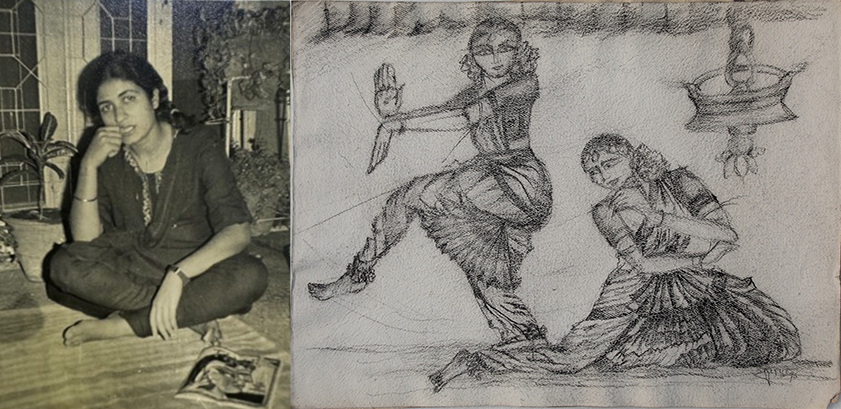
Kohli: People often ask why my work is filled with colour. Today I have an answer — because there is joy in my life. That was not always the case though. There was a time when my paintings were almost entirely monochromatic because my life felt monochromatic. I could not yet see a door or a window. There was only a burning desire to create, and I was trying to keep that flame alive. I carried a sketchbook everywhere. If I was in the hills, I painted temples. If I accompanied my daughter to a dance class, I sketched the children dancing or their gurus. I kept working because the desire itself was stronger than certainty. I wanted to paint, to think, to become. That longing has remained constant in my artistic practice.
Deka: When did you start engaging with the concept of the Divine Feminine through your art?
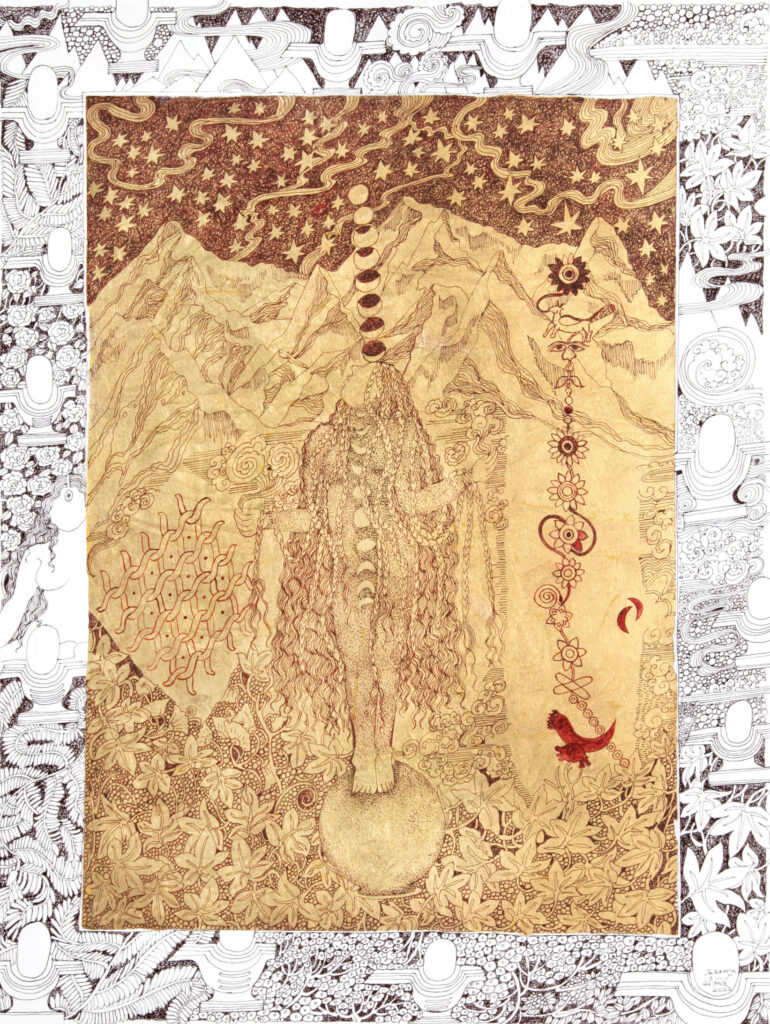
Kohli: In some ways, she was always there. As a child, I was deeply drawn to Kali. I was very young when I began praying to her and creating my own rituals. A family friend and uncle of mine guided me in aspects of Kali worship: how to sit, pray, perform a homam. He eventually gave me books from which I made drawings and paintings.
The Divine Feminine took a more defined form in my work around the time I separated from my husband. Interestingly, Kali had already begun appearing before I left. But afterwards, there was a sense of release. I felt free to paint the feminine as I wanted to. In my journey, I have steered clear of religion, though not of Tantra. Tantra, for me, is a practice of observation: of the body, breath, consciousness, and experience.
Deka: How does the body or your relationship with it shape your work?
Kohli: The body has been central to my practice. As a child, I developed a very difficult relationship with my body. I profoundly disliked it. I was overweight, disinterested in movement. And then, around the age of eight, I went on a crash diet that left me severely anaemic. It was self-rejection that had a physical manifestation.
“Body shaming” is too mild a phrase. When a person hates their body, they want to destroy it. However, at the same time, my father instilled a lot of confidence in me. That and my own self-awareness were instrumental in combatting those tendencies.
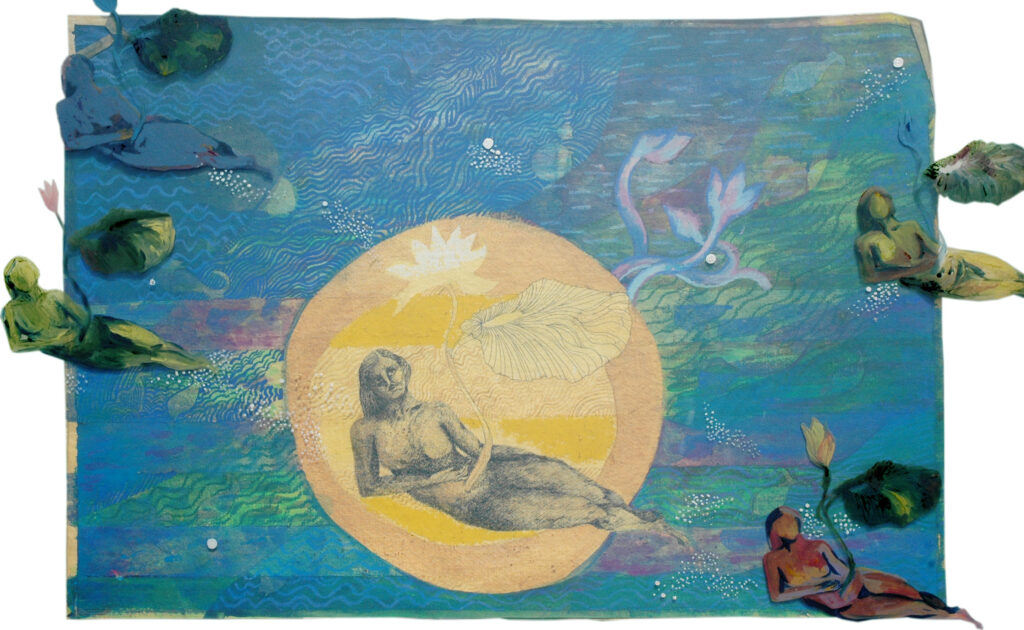
Deka: That destructive energy seems to have been transformed into something deeply creative.
Kohli: Yes. That is what creativity and art can do. They nurture your innate [positive] convictions and can transform pain into something else.
Deka: Would you say that this transformation was connected to your spiritual practice?
Kohli: Absolutely. Art has always been one of my most intimate tools of transformation. My parents gave me enormous freedom to paint. Art was not considered an important subject at school, but at home I was encouraged.
I remember how I once spotted canvas cloth (the fabric they use to make pants) being sold at the local market. I was convinced that it was what painting canvases were made of, and so I convinced my mother to buy rolls of it. She had it stitched and stretched on a frame, and I immediately began painting on it.
My grandfather’s room became my art studio. It was the first dedicated space I worked in to create art. Having that space was very important to me. More than anyone else in my family, I was assertive about my space; I wasn’t necessarily assertive with people. In fact, I often avoided social interaction. If guests came over, I would disappear or keep my eyes closed and head down. My mother found it rude. My father used to jokingly call me a bhrasht [corrupt] yogi. (laughs) I have always done things on my own terms.
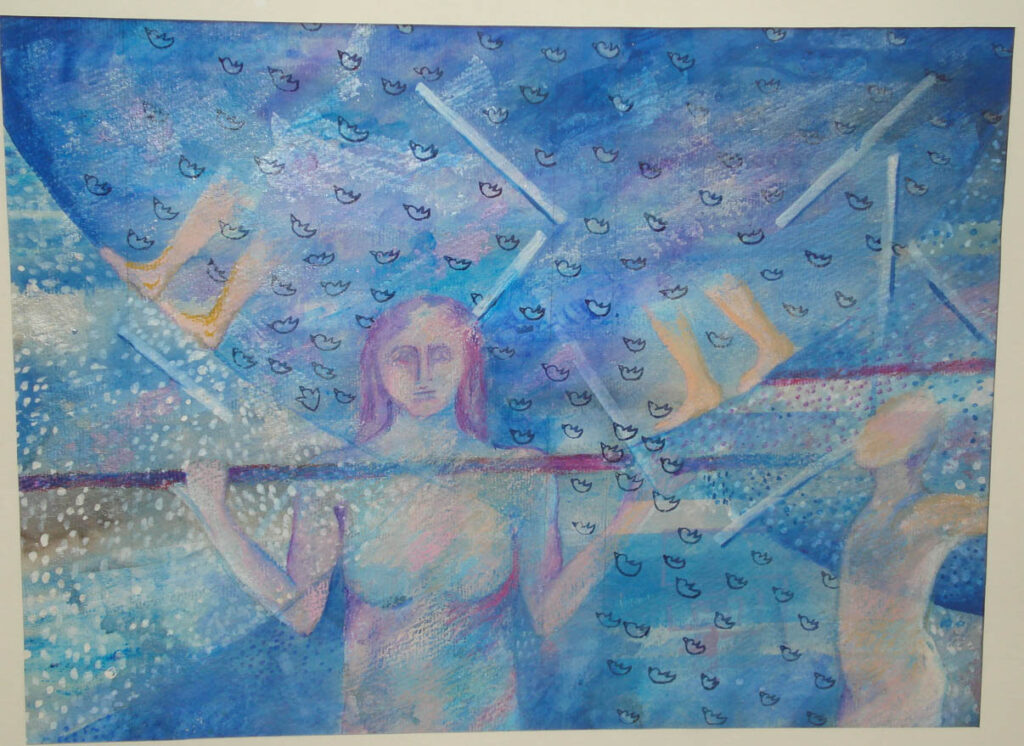
Deka: One of the crucial turning points in your artistic journey was rooted in a major life decision — leaving your marriage. Looking back, what do you feel about that decision now?
Kohli: For me, there was really no other option. I could not do justice to the aspirations of my creative self while being married. While there were hardships, that period gave me something incredibly invaluable: the time and space for my intellectual and spiritual life to evolve. I could study, experiment, perform my rituals at two in the morning, and pursue my own forms of meditation. Whatever I am today, emerged from those years. People often ask whether I would rather have been someone else. But why would I? I gave up everything in order to become who I am.
Deka: Your pursuit of a more spiritual, creative life mirrors the journey of mystic women poets, such as Meera, Akka Mahadevi and Lalleshwari. Do you feel a resonance with these women from across time?
Kohli: These women have always inspired me, especially Lalla, who left a difficult household to follow her spiritual path. I think such decisions come from instinct rather than thought. There is a kind of knowing that exists beyond reasoning. Intuition recognises what is necessary even before the mind can explain it. The stories of these women inspire me because they too resisted conventional social constraints in order to listen to their intuition.
During the twenty-one years of my marriage, I also felt creatively constrained, but the desire to create was never extinguished. I lived in a large Punjabi household, surrounded by people and domestic responsibilities. While I enjoyed many aspects of it, the pull to pursue my creative life was always stronger.
Deka: Almost as if one is compelled to follow a calling that has already revealed itself…
Kohli: Exactly. I also believe that what we call instinct actually comes from what we have experienced in many [past] lives. Certain desires and convictions are not formed in a single lifetime.
I remember meeting a medium who immediately asked whether I was an artist. When I said yes, she replied, “You have not been an artist only in this life. You have been one for many lives — it’s a long journey.”
Whether one believes in rebirth or not, I find this idea meaningful. Some impulses feel older than us. They persist and seek to be fulfilled across time, across lives.
Even in Samkhya philosophy, identity is understood not as a permanent soul but as a recurring configuration of elements which form or create our tendencies and desires. Perhaps what returns is not the Self, or what we call “soul,” but a certain longing, an unsatiated desire.
Deka: As an artist, do you begin a work with a concept in mind or does meaning emerge through a particular process?
Kohli: Meaning emerges much earlier, through lived experience and exposure to different spiritual philosophies. But it doesn’t always align with the meanings that others come up with while interpreting my work.
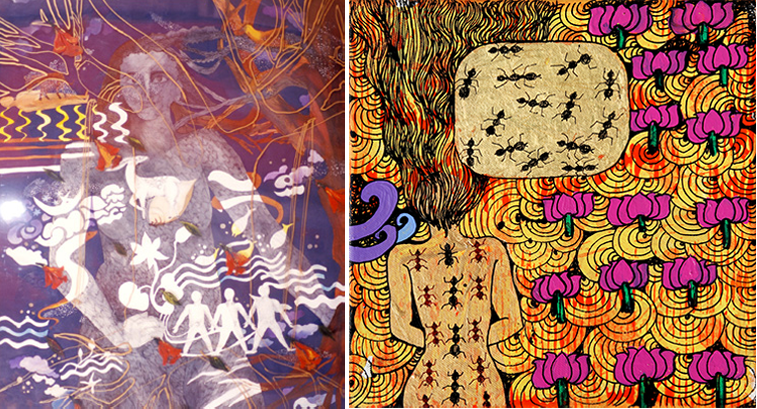
I was looking recently at a small painting of mine I called Kali, which depicted ants crawling across the back of a body. When it was exhibited, people kept asking: “Why ants?” or “What does it mean?”
For me, the ants were representative of our own limited selves. We are such minuscule existences within an unimaginably vast universe. Why is it so difficult for us to imagine ourselves as tiny presences on the body of Maya? We readily accept Vishnu in the cosmic Vishwaroopa form, but struggle to imagine Kali in equally expansive terms.
I see us as pores on that immense body; as a vast procession moving, pushing, dancing, colliding, helping, hurting, all at once. That understanding of interconnectedness lies at the heart of how I think or make meaning of the world.
Deka: How do you decide whether an idea belongs on a painted canvas, or if it should be presented as an installation, or as a performance instead? How do you zero in on your medium and materials?
Kohli: I never decide that in advance.
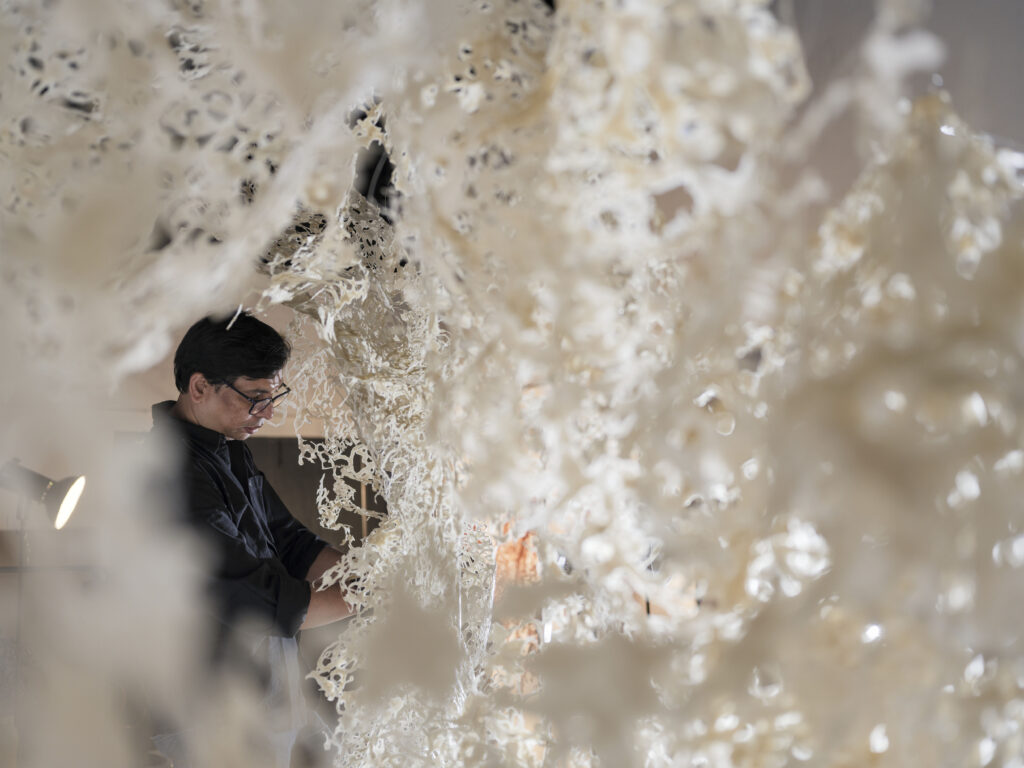
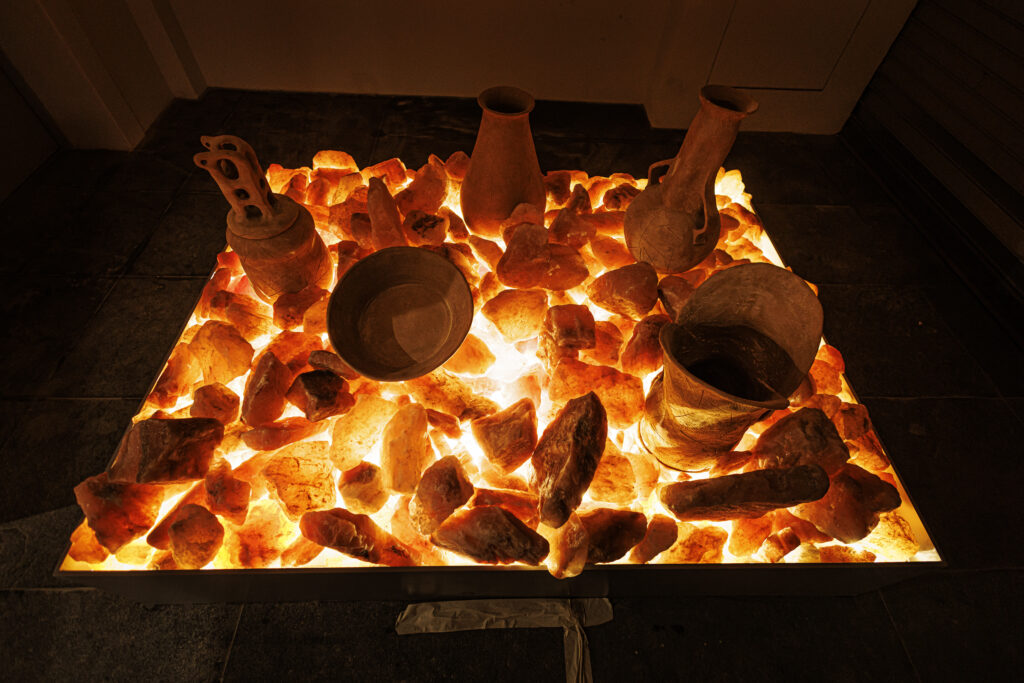
When I was working on Khula Aasmaan, I knew I wanted to work with salt, but I didn’t yet know how. I initially imagined it as a work on paper, but that concept wasn’t speaking to me. Eventually I realised it could only exist as an installation. I began imagining a doorway filled with salt — something that could be entered, as though one were crossing into another world.
The process is never about imposing an idea onto a material. It is about remaining with the material till it reveals its possibilities.
Deka: You often speak of materials in your practice as though they have agency of their own.
Kohli: They do. The moment you make something purely subjective, you become concerned with only what it means to you. I try to move beyond that.
With the salt, I spent months looking at photographs of salt mines and gathering references. Then I procured the salt itself and left it on my table for months. I kept asking it, imploring “Kuch keh de, yaar” (Please say something, friend).
Nothing happened for a long time. Then one day it clicked. The salt needed to dissolve. It needed light. It needed a structure through which people could pass. Slowly the work began to reveal itself.
It is not the question of what you want. The question is: what does the object want?
Deka: So your process involves a great deal of waiting.
Kohli: Yes. You have to understand the character of the material. You cannot simply force your intentions onto it.
People often call this instinct, but it is also persistence, experimentation, and sometimes even practical and economic considerations that shape the final work. A material can defeat you for months. As artists, we must remain humble enough to be changed by the process. If you are unwilling to be defeated repeatedly, you miss something important.
For me, an artwork emerges through a collaboration between an idea, a material, and the labour of making a piece of art. Only then does the work feel complete.
Deka: Your practice often moves between deeply personal concerns and collaborative forms of making. When do you feel the need to bring in other people?
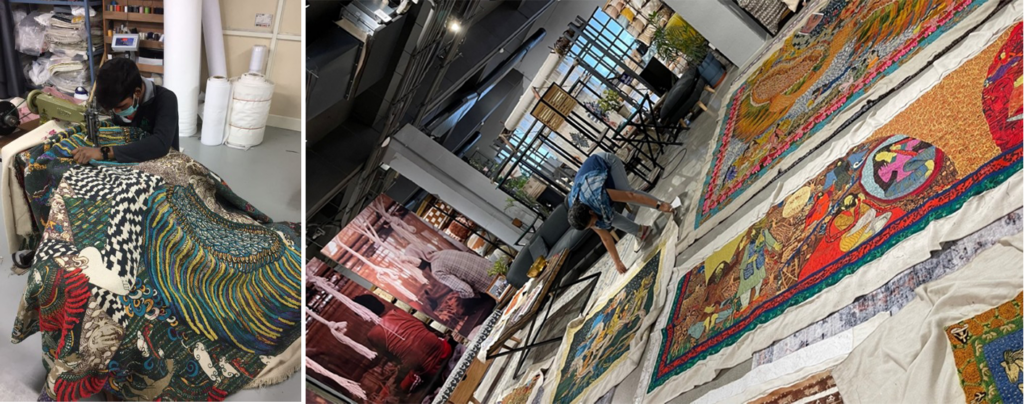
Kohli: Usually it is when I know I cannot do it myself. I am not a weaver, for instance. If a work requires skills that others have, I have to acknowledge that. There are artists who do not name the people who contribute to their work, but I have never been comfortable with that kind of erasure, of not giving credit when it is due. I see collaboration as an ethical responsibility. The people who work with me may not occupy the same position as the artist, but they are still an indispensable part of the work’s existence.
When I did Cut from the Same Cloth (2017-2023), I created a film documenting the women whose labour made the work possible: their daily routines, the songs they sang, the processes of gathering, cleaning and preparing materials. I did not have to do that, but it felt important to make their presence visible.
In the same way, I acknowledge the material itself. I thank my canvas. Every artwork is, in a sense, an invasion upon a surface, and I am grateful that it allows me to work through it.
Deka: How do ritual and intuition shape your artistic practice? Are they inherited, cultivated, or continually reinvented?
Kohli: Most of my spiritual rituals are self-created, but what I have inherited from my gurus, ancestors, saints, and seers is shiddat — a complete surrender, an absolute giving over of oneself to a thought, a process, a way of being. I have always felt an urgency to submit to discipline, a certain hunger that sought expression through art.
I deeply believe that sharing is also a form of receiving. In moments of genuine reception, there is no ego. I do not remain a fixed entity. I have always seen myself as a seeker, as a constantly evolving soul. I am not merely this body, nor am I confined to a single timeline. What one sees in me is the sedimentation of many lives, many convictions, and many journeys.
Art, for me, is a way of giving form to this continuous flux of being and becoming, while ritual is what facilitates that process of expression. Art is not separate from life; it is inseparable from who I am — what I see, what I speak, and how I inhabit the world. I experience words visually, through images. Everything I hear or utter, transforms into images, constantly moving and dancing in my mind. Sometimes, I have to close my eyes and tell them, “Stop. Let me rest for a while.”
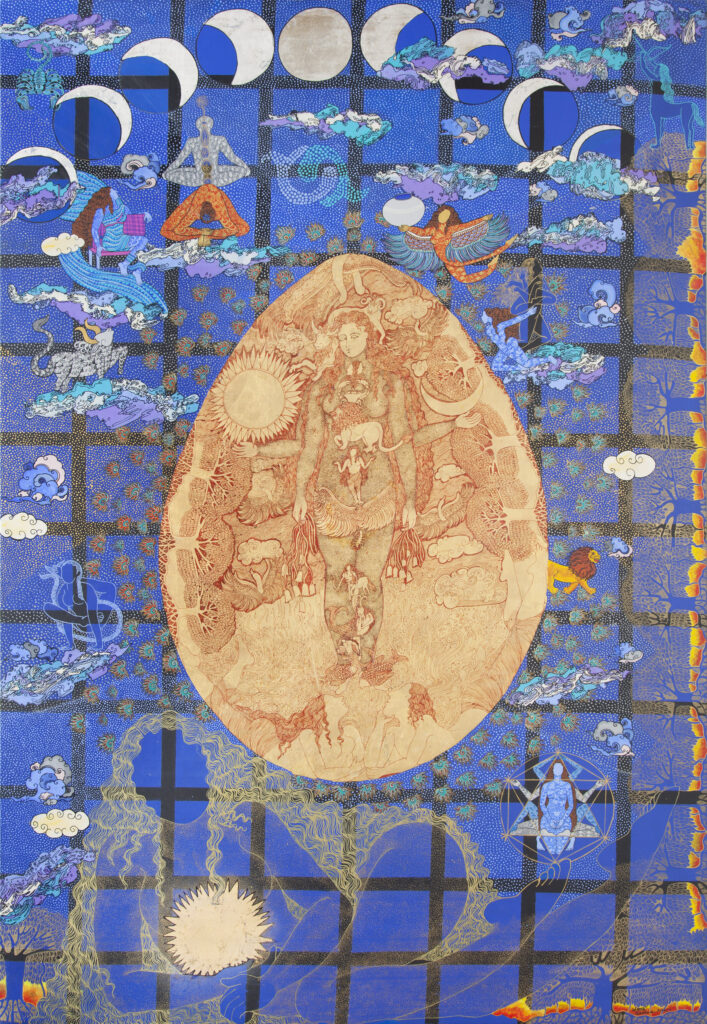
And yet, how can one ever bring this ceaseless movement of images to an end? It is, ultimately, part of that ultimate Maya which cannot be fully grasped through language. Baba Nanak speaks of this too in the verses of the Japji Sahib: no matter how many words we summon, no matter how many pages we fill, we can never adequately comprehend or articulate that vast consciousness which envelops everything.
Such truths can only be approached through deep contemplation and grace. That is why, you see, all of us — you, me, everyone — are part of this qayanati raqs (cosmic dance). My art is simply my way of participating in that dance.
First published: September 25, 2026