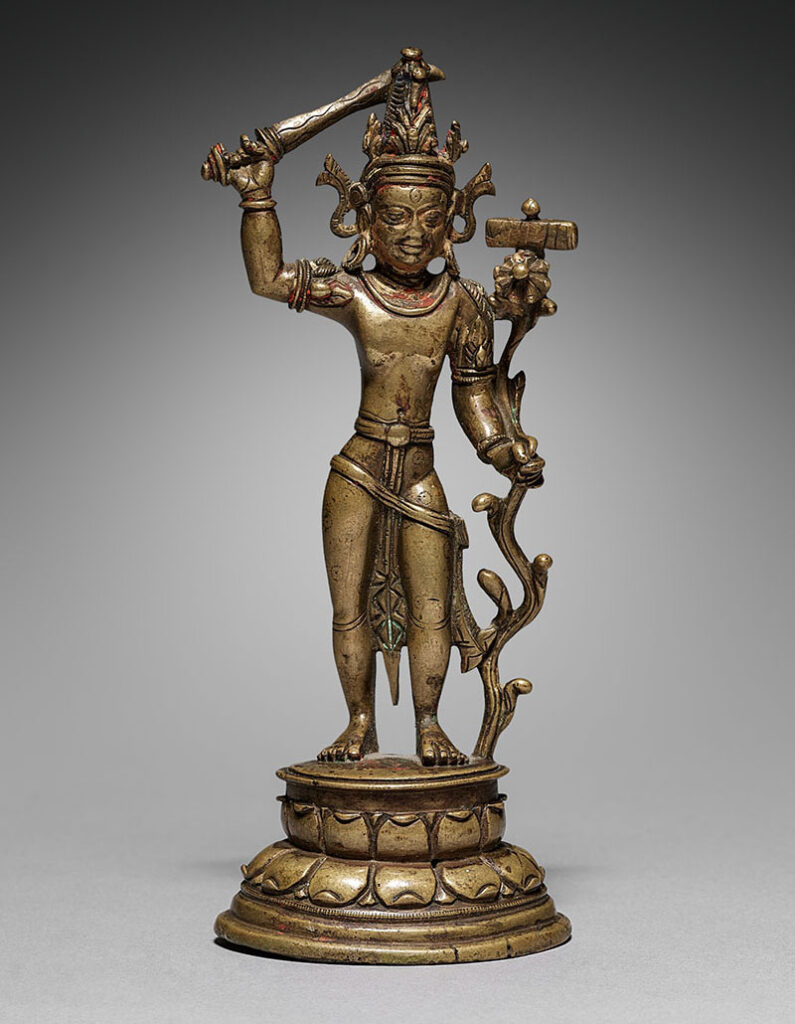
Also known as Manjughosa and Vaigsvara, he is a bodhisattva who is associated with prajna (wisdom) in the Mahayana and Vajrayana traditions of Buddhism. His name derives from the Sanskrit term manjusri, meaning “gentle glory.” He is conventionally depicted with a sword of wisdom in one hand and a manuscript of the Prajnaparamita Sutra in the other. Within Tibetan Buddhism, he is depicted in a triad along with Avalokitesvara and Vajrapani. In his wrathful form, he is known as Yamantaka or “the destroyer of death.”
More Definitions
rakshasa
Type of mortal being associated with evil and mischief, appearing first in Vedic texts and throughout later Brahmanical mythology. Typically,…
Chandesanugrahamurti
A benevolent form (anugrahamurti) of the Hindu deity Shiva, in which he is depicted bestowing his blessings upon his devotee,…
Mahayogi
An epithet for the Hindu god Shiva where he is represented as an ascetic, sitting with his legs crossed and…
Vashishtha
In the Hindu religious tradition, one of the seven maharishis (great sages). In the Indian epic Ramayana, he is a…
Sramana
A non-Vedic ascetic movement that practised austerity and rejected domestic life. Sramana thinkers first conceptualised the philosophies of samsara (the…
Mahavidyas
A group of ten goddesses from the Tantric Hindu pantheon, consisting of Kali, Tara, Shodashi, Bhuvaneshvari, Chhinnamasta, Bhairavi, Dhumavati, Bagalamukhi,…
Bhutagana
In Hindu mythology, it refers to a class of beings who attend to the deity Shiva. In art, they are…
Brahmanism
A later form of the Vedic religion developed by Indo-Aryan-speaking settlers who migrated from Central to South Asia in the…