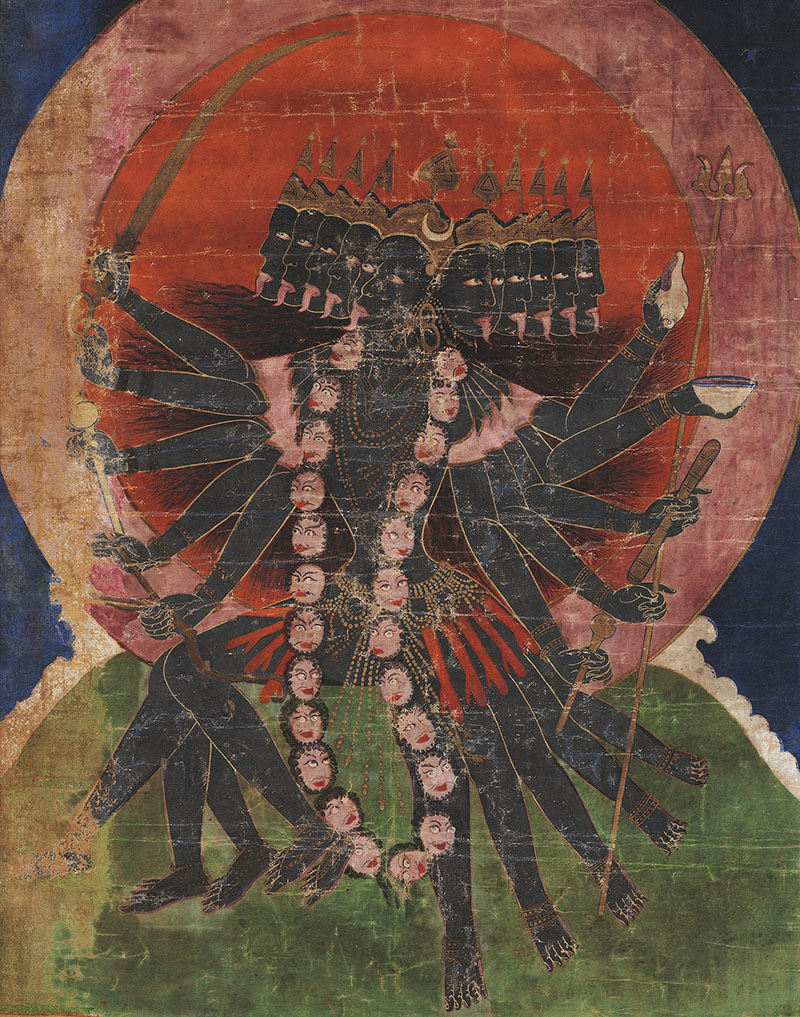
The Goddess of time and death, she is a major deity in Shaivism and Tantric Shaktism, where she is considered to be the foremost among the ten mahavidyas. She is usually depicted with blue or black skin, with four arms that carry a sword, a trishul (trident), the severed head of demon and a kapala (skull-cup).
More Definitions
Varuna
A Vedic deity associated with the moral values of rita (justice) and satya (truth), he also represents the natural elements…
Wei Buddhism
Also known as the Bei Wei ("Northern Wei") and Tabgatch or Tuoba and founded by tribesmen of Turkic origins, the…
Pashupati
An epithet originally used for the Vedic deity Rudra and now denoting one of the incarnations of the Hindu deity…
Gajasamhara
A form of Shiva as a samharamurti (destructive aspect), which shows him vanquishing the elephant-demon Gajasura. In the iconographic depiction,…
Parshvanatha
Parshvanatha (b. c. 872 BCE; d. c. 772 BCE) was the twenty-third Tirthankara (propagator of dharma) of Jainism. He is…
Salabhanjika
A prominent feature of Indian sculpture, it depicts a female deity with stylised and sometimes exaggerated feminine features, elaborate hairstyles…
Indra
A major Vedic deity, he is believed to be the king of the realm of gods within Hinduism and Buddhism,…
Mahakapi Jataka
One of the Jataka tales, it tells the story of the bodhisattva's life as a monkey king who stretched his…