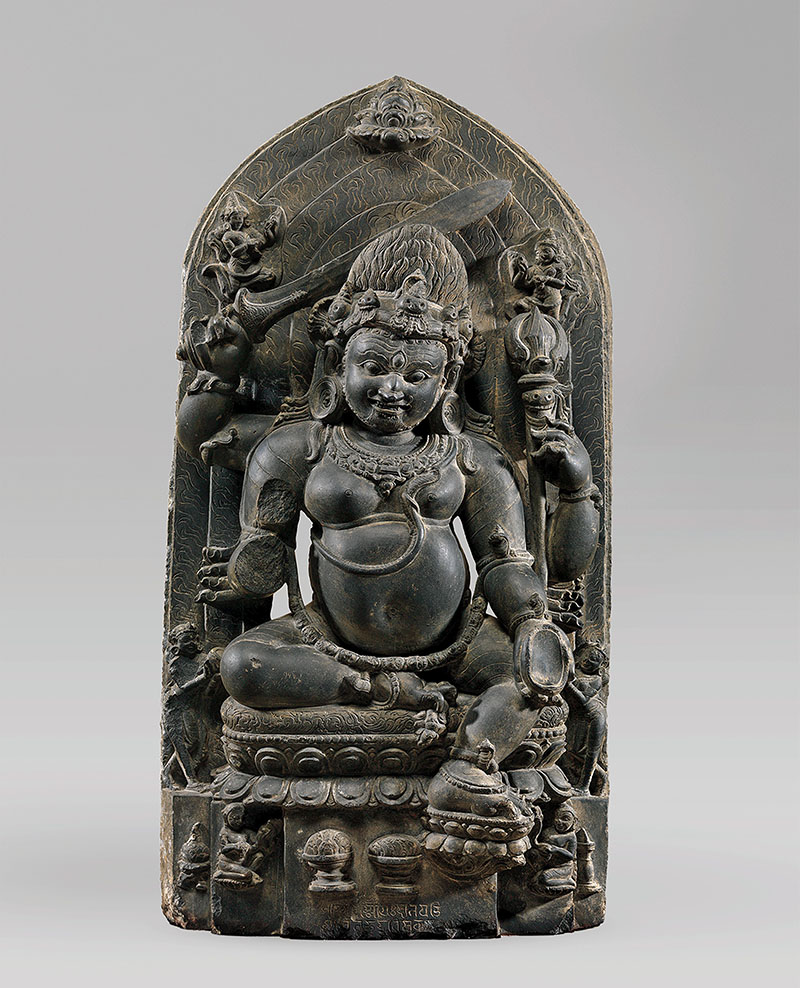
A deity common to Buddhism, Hinduism and Sikhism, whose name is composed of the Sanskrit maha, meaning “great,” and kala meaning “time” or death,” thus denoting “the one who is beyond time or death.” In Hinduism, he is considered to be a manifestation of the deities Shiva and Vishnu, as well as consort to the goddess Mahakali. Within Vajrayana Buddhism and Tibetan Buddhism, he is a protector deity and is also known as dharmapala, while in Sikhism, he is known by the name Kala.
More Definitions
Paramita
A Buddhist term for characteristics and noble qualities associated with enlightened individuals. The term is used across Theravada, Mahayana and…
Manushi Buddhas
A Buddha in human form, they attain enlightenment once they perform their allotted task on Earth and are released from…
Amoghasiddhi
Within the Mahayana and Vajrayana traditions of Buddhism, Amoghasiddhi is one of the five Dhyani Buddhas and presides over the…
Mahabharata
The longest Indian epic poem, traditionally attributed to the legendary sage Vyasa and compiled into its extant recension sometime between…
Hermes
Deity of the Greek Olympian pantheon, believed to be the messenger of the gods and a trickster who frequently travelled…
Vishwamitra
In Hindu Puranic and epic literature, one of the seven maharishis (great sages). He is also known as the royal…
Nidhi
The treasure of the Hindu god of wealth, Kubera. Also known as navanidhi, the treasure is constituted of nine elements,…
Tantra
Heterodox spiritual doctrine and body of knowledge that originated around the sixth and seventh centuries CE in the Indian subcontinent,…