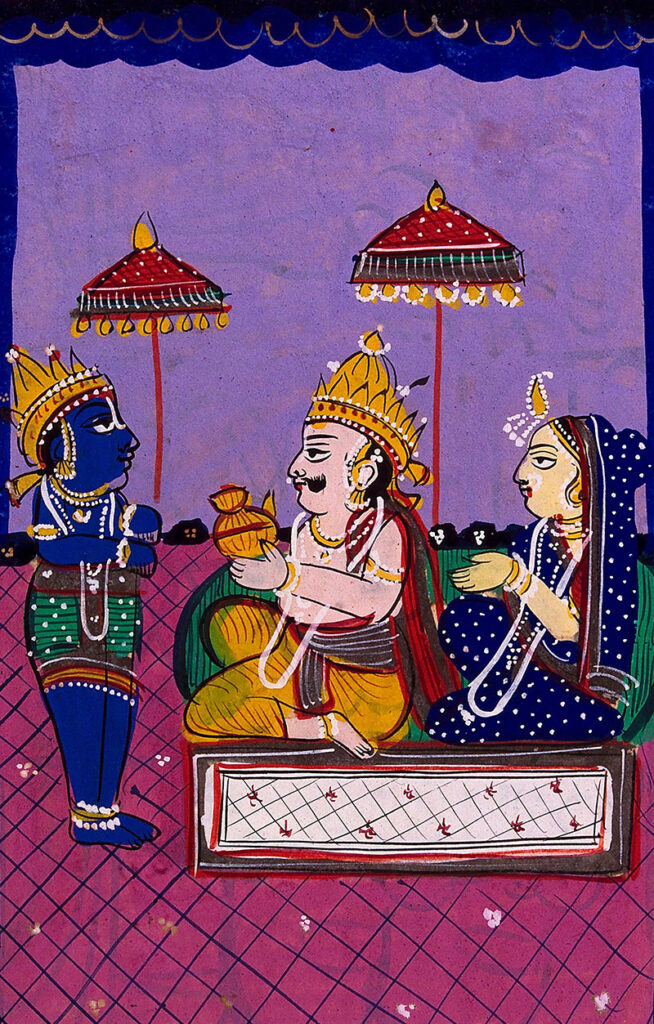
A Daitya king and the grandson of Prahalad, he is mentioned in a number of texts and myths within Buddhism, Hinduism and Jainism. He is a part of the Dashavatar legend of the Hindu god, Vishnu. Within Buddhism, he appears as an audience to the Buddha’s sermons and in a dialogue with the bodhisattva Avalokiteshvara. He is also one of the pravtivasudevas (anti-heroes) in Jain mythology. He is a prominent and celebrated figure in the southern Indian regions of Kerala and Tulunadu, particularly during the festival of Onam.
More Definitions
Puranas
A genre of ancient and religious texts written in Sanskrit, Tamil and other languages. The texts are encyclopaedic and cover…
Gurpurab
A festival of the Sikh religion, which marks important events in the lives of the Sikh gurus, including birth anniversaries…
Lokanatha
In Vajrayana Buddhism, one of the forms of the bodhisattva Avalokitesvara. Lokanatha is portrayed sitting in lalitasana on a double…
Manushi Buddhas
A Buddha in human form, they attain enlightenment once they perform their allotted task on Earth and are released from…
Shakyamuni Buddha
An epithet used for the Buddha, the founder of Buddhism, who lived sometime between the fourth to sixth century BCE.…
Varaha
Vishnu's incarnation in the form of a boar. Varaha is third of Vishnu's ten incarnate forms (dashavatara) and is associated…
Bharthari
Also known as Jogi Sant Bharthari, he is a popular king from the folk legends of northern and central India.…
Adimurti
Also known as Para Vasudeva, it is a manifestation of the Hindu deity Vishnu. The conventional iconography of the form…