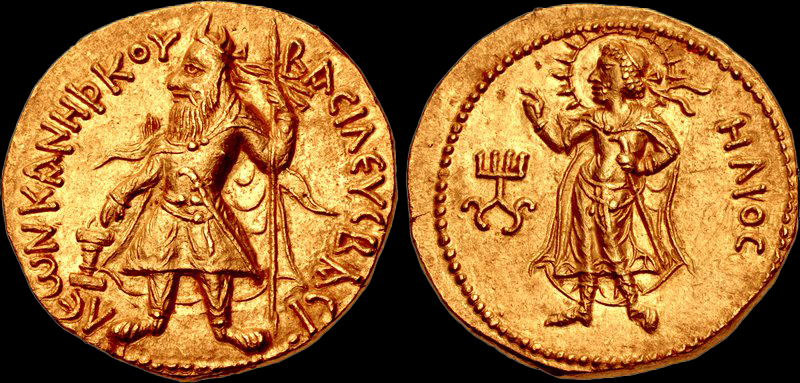
A syncretic empire founded in the Bactrian region of central Asia around the first century CE, it spread to Uzbekistan, Afghanistan and parts of the Indian subcontinent, stretching as far as present-day Varanasi, Uttar Pradesh. The empire’s rulers, who were great patrons of Buddhism and Zoroastrianism, were instrumental in the development of the Gandhara and Mathura schools of art.
More Definitions
Sri Lankan Civil War
Violent conflict from 1983 to 2009 between the Sinhala-majority Sri Lankan government and the Liberation Tigers of Tamil Eelam (LTTE),…
Rajendra I
Rajendra I (b. n.d. ; d. 1044) was king of the medieval-era Chola Empire in southern India from 1012 to…
Bijapur Sultanate
Muslim kingdom of the Deccan in India, founded in 1489 by Yusuf Adil Shah, believed to be a descendant of…
India House, London
The premises of the High Commission of India in London, UK. The proposal for the building was put forward by…
Krishnadeva Raya
Krishnadevaraya (b. n.d.; d. 1529 CE) was one of the most celebrated rulers of the Vijayanagara empire, a kingdom that…
Rajamalla IV
Rajamalla IV (b. n.d. ; d. n.d.) was a ruler of the Western Ganga dynasty, which governed parts of present-day…
Syed Ahmad Khan
Syed Ahmad Khan (b. 1817; d. 1898) was an educator, philosopher and reformer who is considered to be one of…
Tributary State
A form of pre-modern state which had a subordinate relationship to a superior state and maintained its sovereignty by making…