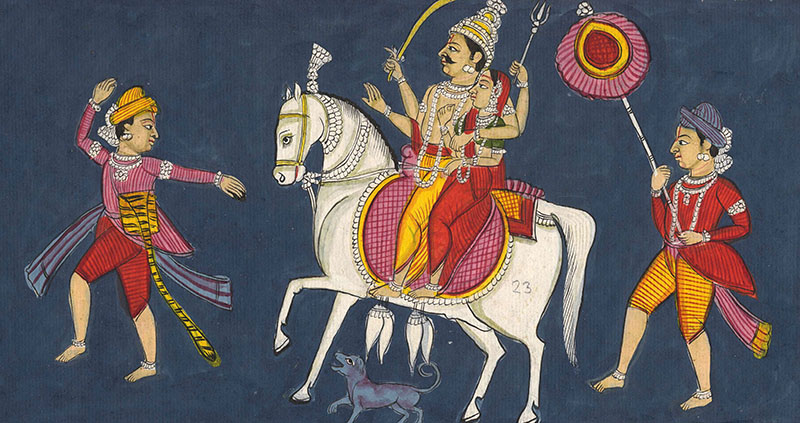
The tutelary deity of a family or a clan. The term is derived from the Sanskrit words kul, meaning “family” or “clan,” and devata, meaning “deity.
Kuladevata
Link copied!
The tutelary deity of a family or a clan. The term is derived from the Sanskrit words kul, meaning “family” or “clan,” and devata, meaning “deity.
Link copied!
The Hindu god of death, also known as Pretaraja (King of Ghosts), Dharmaraja (King of Justice) and Daksinasapati (Lord of…
A set of devotional practices that emerged in South India from the sixth century CE and spread to north India…
Section of the Sanskrit epic Mahabharata, composed as a dialogue between the Pandava prince Arjuna and his charioteer and companion…
In Vajrayana Buddhism, one of the forms of the bodhisattva Avalokitesvara. Simhanada is depicted as sitting in the maharajalila posture…
An early sramana (ascetic) sect led by Makkhali Gosala in the fifth century BCE, it was a nastika (heterodox) school…
Major Vaishnava deity, whose cult developed with the Brahmanical assimilation of non-Vedic cults of and around Mathura in northern India…
A Vedic deity associated with the moral values of rita (justice) and satya (truth), he also represents the natural elements…
Celestial figure of a young, beautiful woman in Indian art and mythology, often associated with nature. The Sanskrit term madanika…