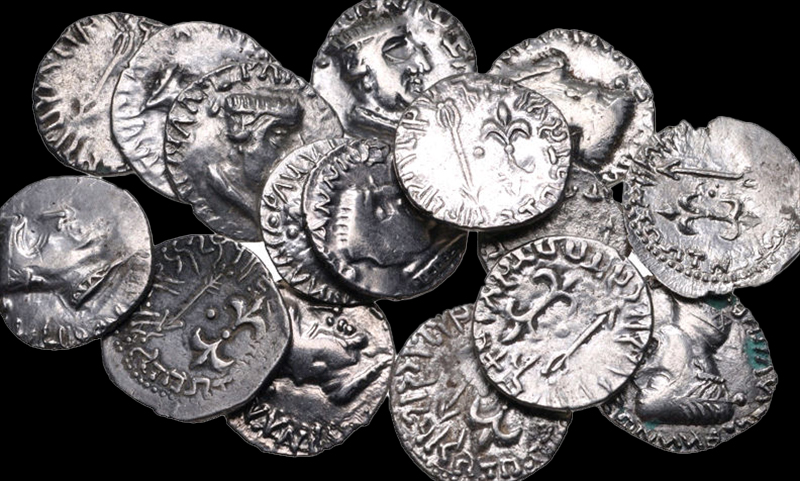
The title given to local governors who administered territories in several parts of north-western, northern, western and central India during the first centuries of the common era. They were administrative feudatories — first of the Indo-Scythian rulers (first century BCE to first century CE) and, later, the Kushan dynasty (first century CE to third century CE) — who enjoyed considerable autonomy over their territories and are documented in several inscriptions and coins from the period. One such dynasty of rulers gained control in parts of northwestern, western and central India from the second to the fourth centuries CE and is known as the Western Kshatrapa dynasty.
More Definitions
Gaekwads of Baroda
A royal family of the Maratha confederacy, who ruled the Princely State of Baroda (now Vadodara) in present-day Gujarat. They…
Kalachuri Dynasty
A name adopted by three major Indian dynasties. The earliest known Kalachuri Dynasty reigned over parts of west and central…
Rajamalla IV
Rajamalla IV (b. n.d. ; d. n.d.) was a ruler of the Western Ganga dynasty, which governed parts of present-day…
Wajid Ali Shah
Wajid Ali Shah (b. 1822; d. 1887) was the eleventh and final ruler of Awadh, whose reign lasted from 1847…
Khanzada Begum
Khanzada Begum (b. c.1478; d. 1545) was the elder sister of the Mughal emperor Babur. She finds mention in his…
Delhi Sultanate
Medieval Muslim empire covering large portions of present-day India, Pakistan and Bangladesh, ruled by a series of five dynasties —…
Pala Dynasty
A dynasty that ruled over Bengal and Bihar from the eighth to the twelfth century CE, it was established by…
Henry Daly
Henry Daly (b. 1823; d. 1895) was a British Indian army officer who served as agent to the Governor General…