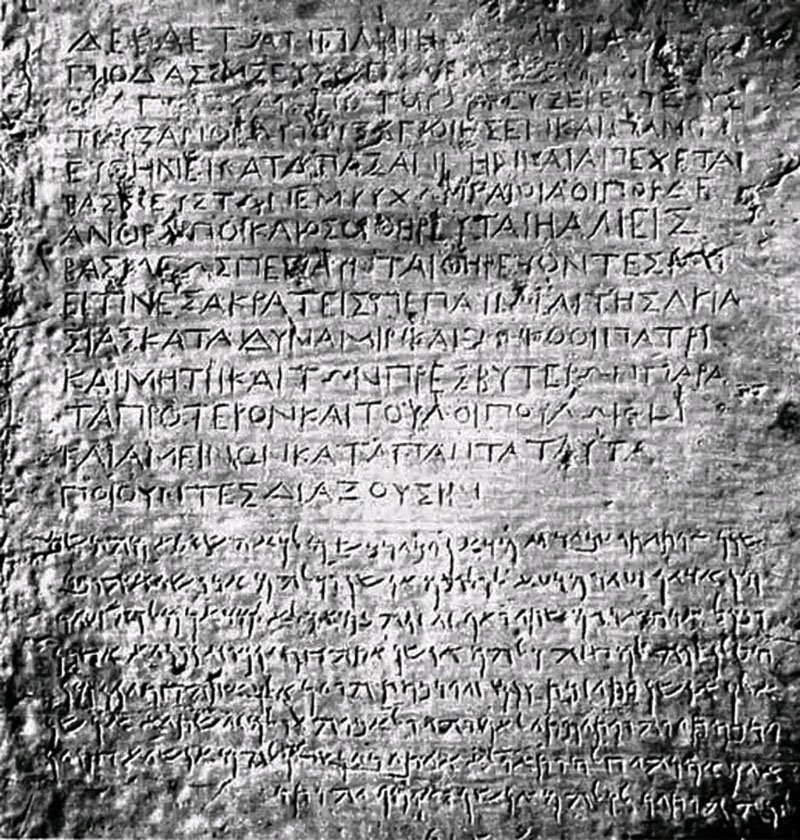
A bilingual edict, written in Greek and Aramaic, dating to c. 260 BCE. It is the earliest known rock edict of the emperor Ashoka, preceding all other known inscriptions of the ruler by ten years. The edict was discovered during excavation work near the site in 1958.
More Definitions
Shringara
One of the nine rasas within Indian performing arts, it may be understood as the feeling of love, or as…
Sutra
Literally meaning "string" or "thread," it refers to literature from the ancient and medieval periods that was originally preserved and…
Purusha
The conception of man according to Hindu philosophy as established in the Vedas and the Upanishads. The purusha is a…
Sahitya Kala Parishad Award
An award conferred annually by the Sahitya Kala Parishad for excellence in performing and visual arts as well as literature.
Bhagavata Purana
One of the eighteen major Puranas, the Bhagavata Purana is dedicated to Vaishnavism and promotes the devotional worship of Krishna.…
Driglam Namzha
Code of public etiquette in Bhutan, based on the founding principles of Bhutanese culture, namely humility, compassion and respect. It…
Adipurana
A Sanskrit poem on the life of Rishabnath, the first Tirthankara of Jainism and his sons Bharata and Bahubali. It…
Satyagraha
A form of non-violent resistance pioneered by MK Gandhi. It translates to "an appeal for truth" and is based on…