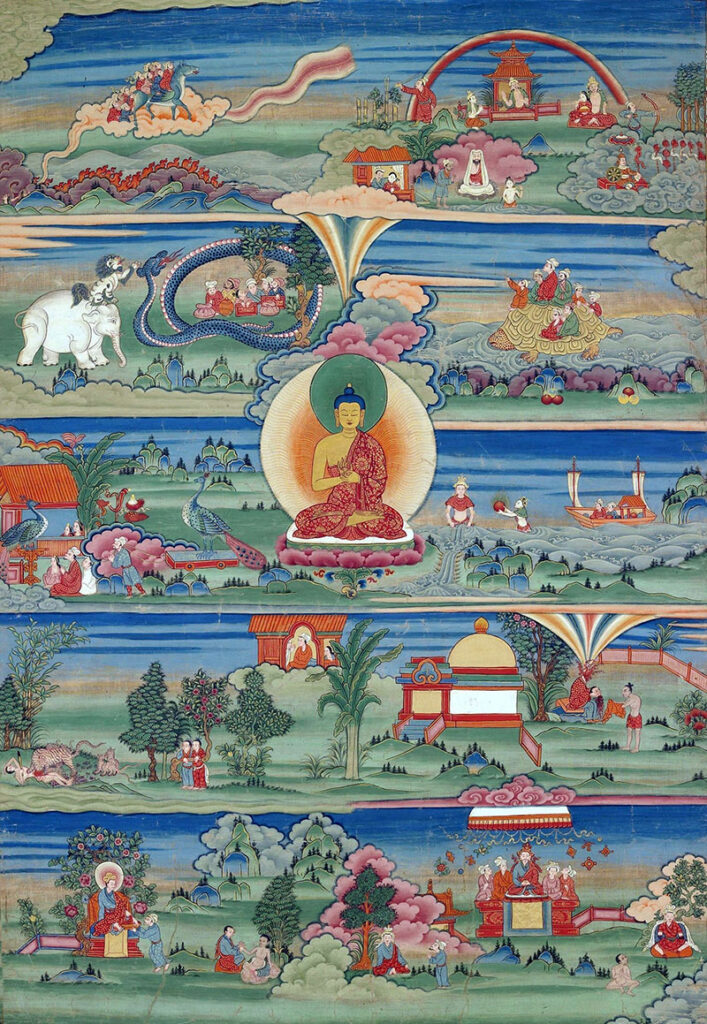
A large collection of approximately 550 stories about the Buddha’s former lives in both human and animal form. The stories are mostly set in the Indian subcontinent and are dated between 300 BCE and 400 CE. Some of the narratives are part of the Pali canon in Theravada Buddhism. Several of the stories are also the primary subjects of the Ajanta Cave murals.
More Definitions
Doha
A form of Indian poetry, it is a self-contained rhyming couplet consisting of two lines and formed of twenty-four syllables…
Satyagraha
A form of non-violent resistance pioneered by MK Gandhi. It translates to "an appeal for truth" and is based on…
Nayanar
A group of sixty-three Shaivite poet-saints in Tamil Nadu between the third to eighth century CE. Belonging to diverse castes,…
Brihat Samhita
A Sanskrit text written by the astronomer Varahamihira in the sixth-century CE, during the Gupta period. Primarily centred on astrology,…
Padshahnama
The illustrated official history of the reign of the Mughal emperor Shah Jahan. Compiled in the mid-seventeenth century, it contains…
Thiruvilaiyadal Puranam
A sixteenth-century Tamil text attributed to Paranjothi Munivar, which comprises sixty four stories narrating the miracles of the Hindu deity,…
Abhinaya
According to the Natyashastra, it may be understood as a combination of two words — abhi meaning "towards" and naya…
stambha
Sanskrit for ‘pillar’, historically appearing in various contexts, including Vedic liturgy, Brahmanical mythology, and Brahmanical treatises on architecture, theatre and…