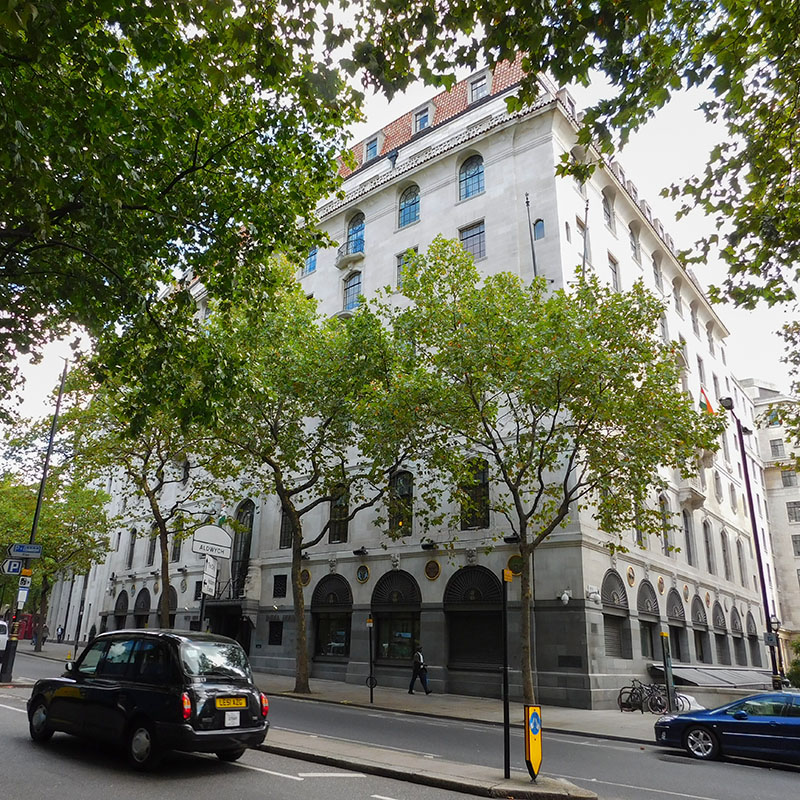
The premises of the High Commission of India in London, UK. The proposal for the building was put forward by the Indian High Commissioner Sir Atul Chatterjee in 1925, and the structure was designed by the British architects Herbert Baker and Gilbert Scott. It was inaugurated in 1930 by George V. The seven-storey structure is notable for the decorative details influenced by the Indian subcontinent, such as jaali work and Ashokan columns with elephant bases. The murals within the structure, including on the dome, were executed by a group of four young Indian artists, who trained in the UK and Italy before beginning their work on the building.
More Definitions
Charles Wallace India Trust
It is a British not-for-profit organisation that provides academic grants to Indian professionals in the arts, heritage conservation and humanities…
India International Centre
A convention centre in New Delhi, India, known for organising lectures and hosting discussions. Set up in 1960, its building…
Strategic Management for the Art of Theatre (SMART)
Established in 2015, it is an initiative of the Bengaluru-based not-for-profit arts organisation, the India Foundation for the Arts. It…
Inlaks Fine Art Award
An award given annually by the Inlaks Foundation to four or five emerging artists from India. The awardees are given…
Department of Fine Arts, University of Kelaniya
Academic institution in Colombo, Sri Lanka, established in 1978 and formerly known as the Institute of Aesthetic Studies. It traces…
Pathshala South Asian Media Institute
School for photography in Dhaka founded in 1998 by Bangladeshi photojournalist, curator and activist Shahidul Alam, and originally named Pathshala…
Goethe Institut
Cultural institute established by the German government in 1951 to promote the teaching of the German language and organise cultural…
Raja Ravi Varma College of Fine Arts, Mavelikkara
Established in 1915, it is a college for fine arts in the town of Mavelikkara, Kerala, India. It was founded…