-
ChicagoSarkar, Sohel. "Between Worlds: Indian Ayahs in Colonial-Era Paintings." Impart Perspectives, August 7, 2026. https://imp-art.org/perspectives/features/between-worlds-indian-ayahs-in-colonial-era-paintings/
-
MLASarkar, Sohel. "Between Worlds: Indian Ayahs in Colonial-Era Paintings." Impart Perspectives, Aug. 7, 2026, https://imp-art.org/perspectives/features/between-worlds-indian-ayahs-in-colonial-era-paintings/. Accessed 30 Sep 2026.
-
HarvardSarkar, S. (2026) Between Worlds: Indian Ayahs in Colonial-Era Paintings, Impart Perspectives. Available at: https://imp-art.org/perspectives/features/between-worlds-indian-ayahs-in-colonial-era-paintings/ (Accessed: 30 September 2026).
Between Worlds: Indian Ayahs in Colonial-Era Paintings
Colonial prejudice framed the Indian ayah as a suspect outsider, yet her work made her an indispensable insider.
By Sohel Sarkar
Link copied!
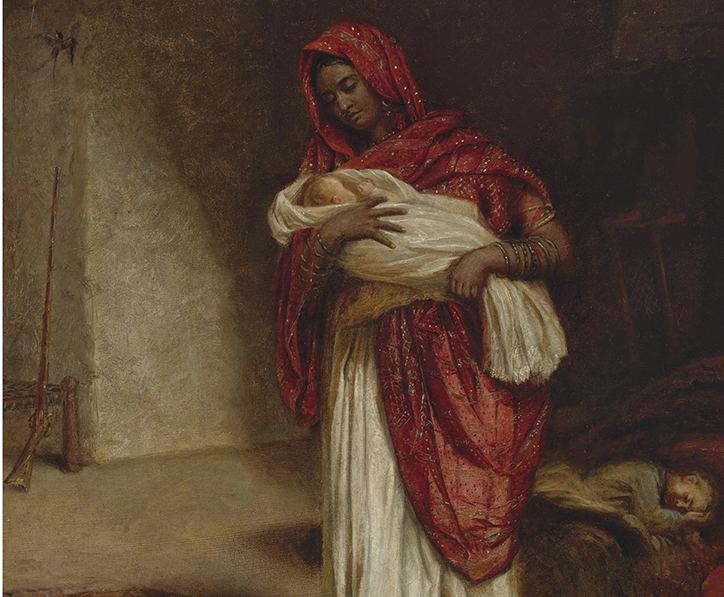
Indian Ayah with Sleeping Children (detail); Emma W Fullerton; 1879; Oil on canvas. Courtesy Sotheby
In Emma Fullerton’s 1897 painting Indian Ayah with Sleeping Children, a woman stands holding a sleeping white infant, while another white child rests on a makeshift bed behind her. The woman’s sari is simple, suggesting modest means, but the gold and silver threadwork on the fabric, the bangles, arm cuffs, nose- and ear-rings lend her a quiet splendour. She is, unmistakably, the painting’s centre of gravity. On the far left, a long-barrelled rifle leans against the wall. It seems disconnected from its surroundings, introducing an unsettledness into what might otherwise read as a straightforward scene of tenderness. Writing four years before Fullerton completed this canvas, the British author Georgiana Kingscote had captured precisely this tension in her manual for inexperienced English mothers in India. In it, she describes the ayah as “the most important personage in the Anglo-Indian nursery, one on whom the whole future health and happiness of the English child depends…”, and yet, she warns, a wise mother must “never be guided by an ayah, nor trust her completely…”.
Fullerton’s painting was among a series of artworks that appeared at the height of British colonialism, when Indian female caregivers, known as ayahs, became ubiquitous in colonial life. As the East India Company’s regime became entrenched and Europeans began settling in India for longer periods, British families grew increasingly dependent on ayahs for childcare. They were often the only female workers permitted inside British homes, with other women largely confined to outdoor work.
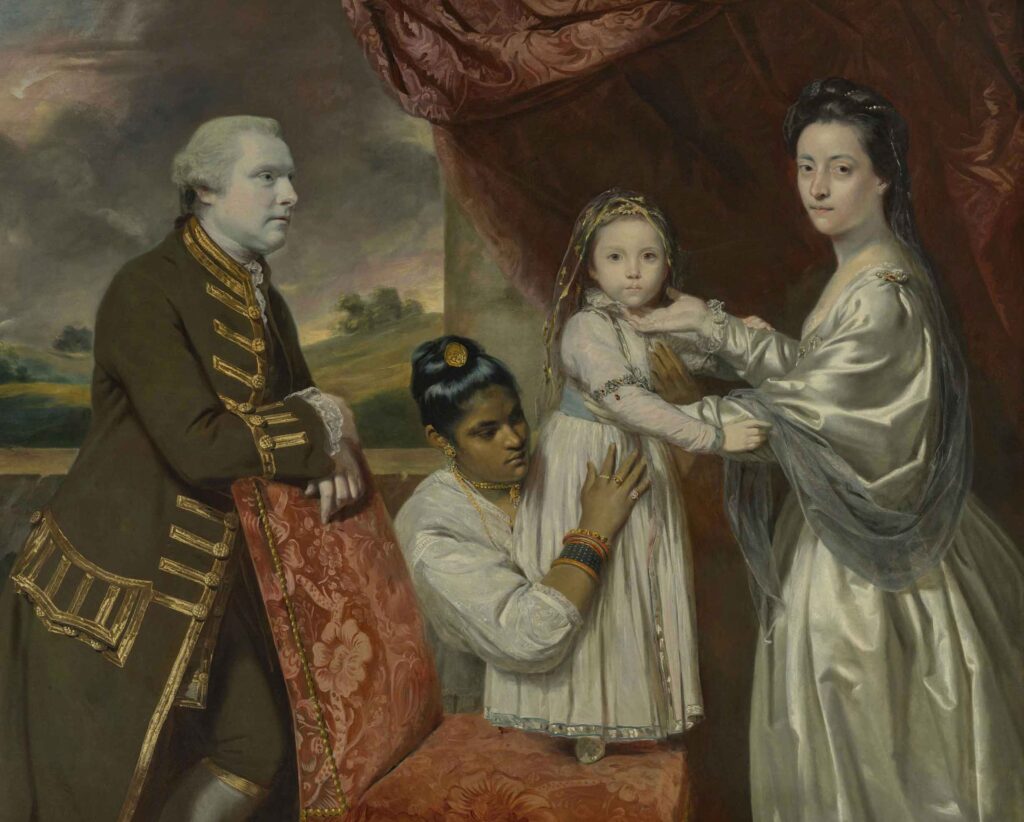
So indispensable were they that many travelled back with their employers to Britain, so as not to disrupt their caregiving duties. Until the early nineteenth century, the sea voyage, lasting six to seven months, was arduous enough to make such journeys rare. But the opening of the Suez Canal in 1869 and the shift from sail to steam cut travel time to two or three weeks, making the journeys far more frequent. Historian Arunima Datta, in Waiting on Empire: A History of Indian Travelling Ayahs in Britain (2023), notes that those who could afford to bring ayahs on these voyages did so eagerly. As part of an English’s family’s limited Indian staff on board the ship, an ayah was expected to fill multiple roles as nanny, cook, and laundry-maid, and frequently paid significantly better for it; many ayahs made the journey multiple times, becoming, as Datta says, “some of the most experienced travellers of the imperial era.”
It was this movement out of private colonial households and into decidedly public spaces — ships, railway stations, British streets — that made ayahs newly visible to British audiences, and consequently, the subject of paintings, postcards, photographs, illustrations, and newspaper articles. Among the earliest artworks on the subject was Joshua Reynolds’ painting Tysoe Saul Hancock, his wife Philadelphia, their daughter Elizabeth and their Indian maid Clarinda (1765-67). The family portrait depicts Hancock, an officer of the East India Company, with his wife, young daughter, and their Indian maid “Clarinda”, freshly returned to Britain from India. That Clarinda had accompanied them on the voyage and was retained for her services signals the family’s dependence on her for childcare. Yet, in the painting, Clarinda is the only figure who kneels — her posture at once submissive and caring, as she holds on to the child.
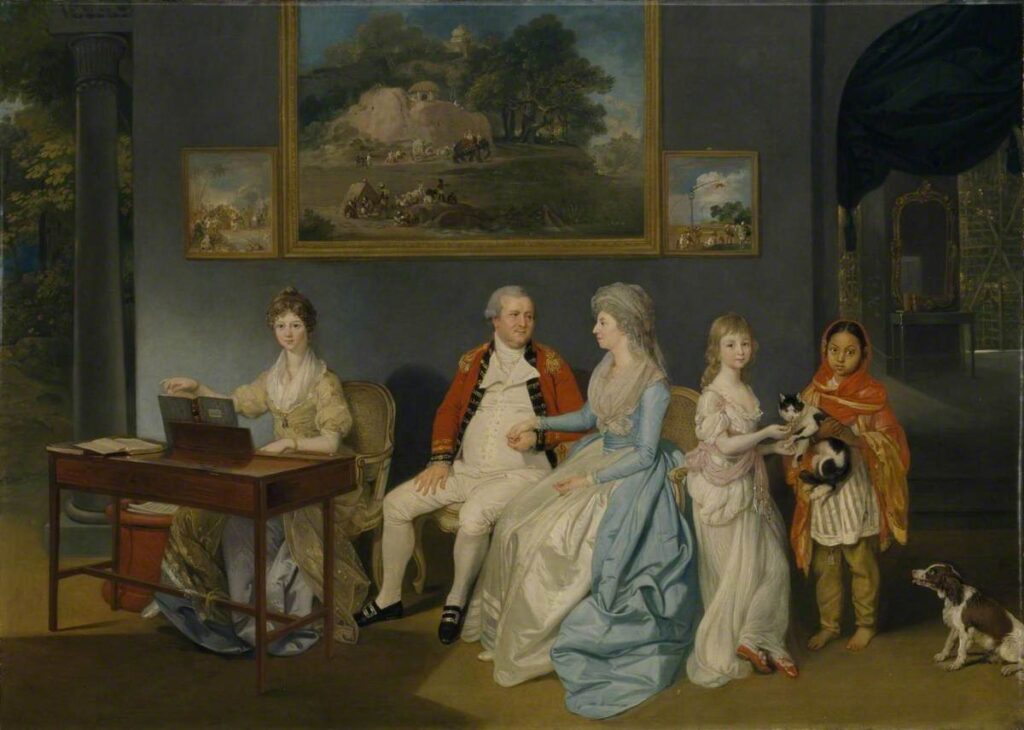
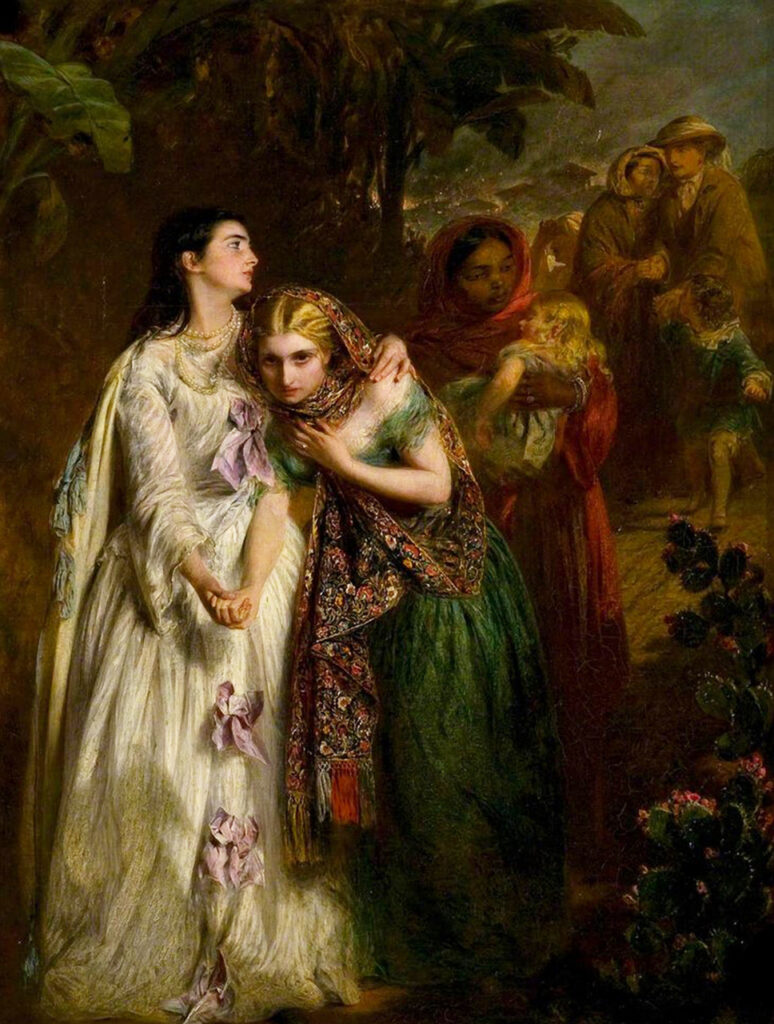
Johan Zoffany’s Colonel Blair with his Family and an Indian Child (1786) has a similar composition, but does not ostensibly name an ayah. On the right hand side of the painting, an Indian girl, her torso and head draped in a red and gold dupatta, stands slightly behind a white child. The Indian girl’s posture and expression — startled and somewhat unposed — set her apart from the rest of the family, who appear more relaxed. While she could be read as a friend of Maria Blair, the white child in the portrait, as historian Priyamvada Gopal argues, she was most likely an ayah charged with Maria’s care. If Gopal’s reading is correct, the girl in the painting is strikingly young, perhaps no older than her ward. Child ayahs were not unheard of. Datta cites records from 1892 of a “Mrs Colgrave” travelling from Bombay to London with a “child ayah” of four years of age, and in 1900 of a “child servant,” named Mariammah, brought to Britain by her employers. As Datta notes, it seems likely they were first employed as playmates, and later as servants, when they grew older.
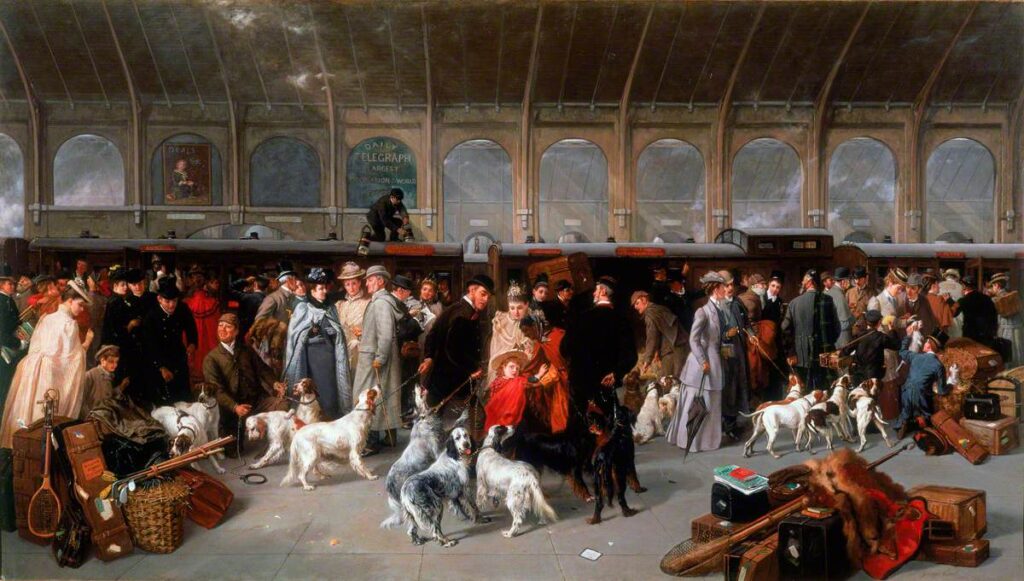
While child ayahs may have been exceptions, ayahs in general became increasingly common figures in passenger ships outbound from India to Britain by the latter half of the nineteenth century. With that, their visual representations proliferated. In Helen Allingham’s On Dover Beach (1877), a female figure dressed in a sari and an orange dupatta supervises three white children playing among shallow waves in the background. The curators of the exhibition Ayahs and Amahs: Transcolonial Journeys describe it as a display of “the British empire’s dependence on the carework of women of color.” In his 1887 work Ayahs and their Charges, Robert Taylor Pritchett painted groups of ayahs entertaining their wards at the sprawling grounds surrounding Fort William in Calcutta, a white neighbourhood where ‘natives’ were otherwise not permitted. In George Earl’s 1893 painting Going North, set in London’s King’s Cross railway station, a brown woman tends to a white child as two white men and two white women, presumably the British family that employed her, look on. The ayah is placed at the centre of this sprawling railway station scene, yet she registers as little more than part of the furniture of imperial travel — present and functional but unremarkable and unremarked.
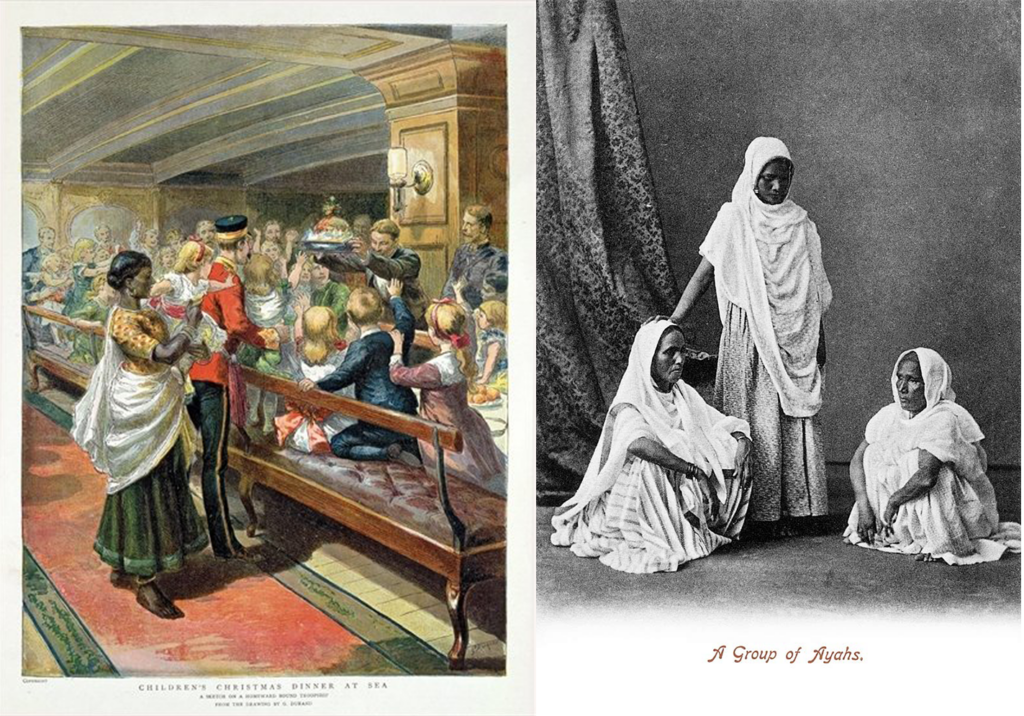
That changes in Godefroy Durand’s 1889 lithograph depicting a children’s Christmas dinner at sea, with an ayah at the forefront of the composition, managing an unruly toddler. Here, she is not a peripheral or incidental figure — her presence is vital to the gathering portrayed. An 1892 newspaper article, cited by Datta, captures this logic: ayahs were essential on ships to ensure children “didn’t cause chaos and distraction” for other passengers. A 1902 piece in the Madras Weekly Mail put it more bluntly, comparing a P&O (Peninsular and Oriental Steam Navigation Company) steamship without an ayah to “Piccadilly without Policemen.” It heaped praise on “Mary”, the Indian ayah who kept the children entertained and out of trouble on the long voyage. Datta’s records show that this efficient ayah hailed from Madras, and she was far from unusual in that regard. At the time, Madras (now Chennai) was the second-most popular port of embarkation for ayahs after Calcutta (now Kolkata), and those from the Madras Presidency were particularly sought after by British families.
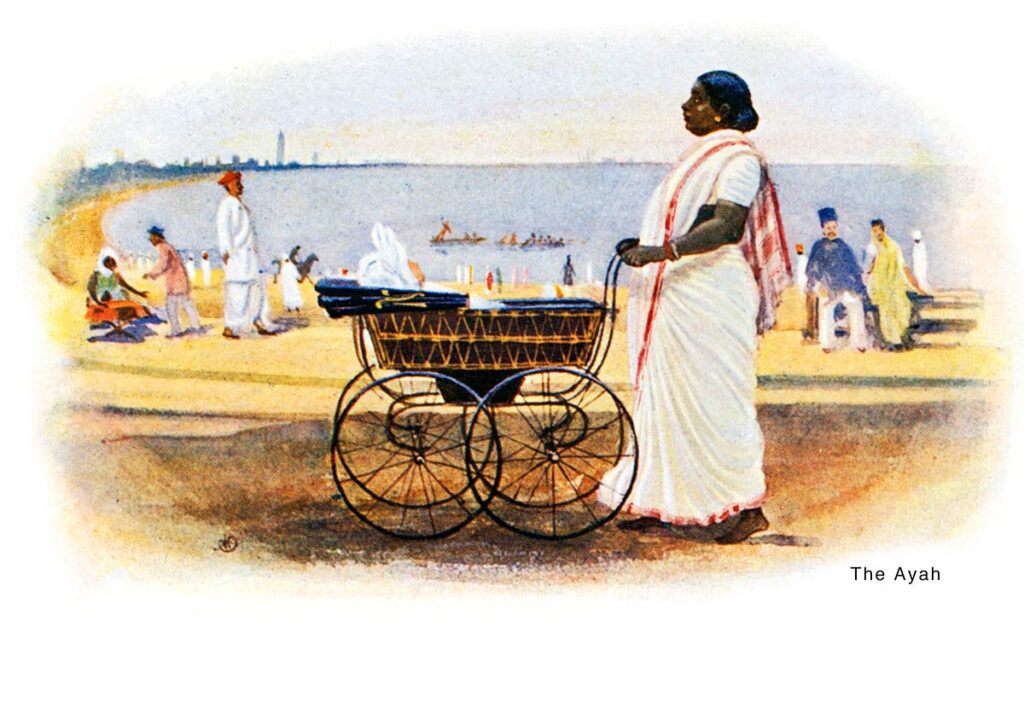
A 1910 picture postcard printed by Raphael Tuck & Sons, of an ayah holding the hands of a white child, makes this explicit in its caption: “The best ayahs hail generally from the Madras Presidency and are more in request than the natives of other parts of India, being more up-to-date and amenable to European customs.” Postcards, which had emerged as a cheap mode of communication across the British Empire in the 1870s, circulated the image of the ayah widely. In 1903, the Indian artist MV Dhurandhar sketched an ayah pushing a pram on Malabar beach in Bombay for one such postcard; another, by Moorli Dhur & Sons, shows a similar scene against a more neutral background.
Photography extended this archive further. Most images show ayahs with their wards, but a 1905 portrait by Calcutta photo studio Johnston & Hoffmann, titled A Group of Ayahs, stands apart. In it, three women are photographed together, their expressions downcast and the mood sombre, as if to draw attention to the often precarious nature of their work. As travel became more regulated, passport photographs added another layer of documentation: Datta profiles 124 ayahs who journeyed from India to various parts of the British Empire, each with a passport photo, their faces now part of the archives of a colonial administration that had little interest in their wellbeing. More often than not, these passport photos recorded ayahs with their first names only — Mary Ayah, Ruth Ayah, Lakhi Ayah — and yet, this was an improvement over earlier records, such as ship manifests, which routinely listed ayahs as possessions of their employers — Mrs Cook’s Ayah, Mrs Payne’s Ayah, and so on.
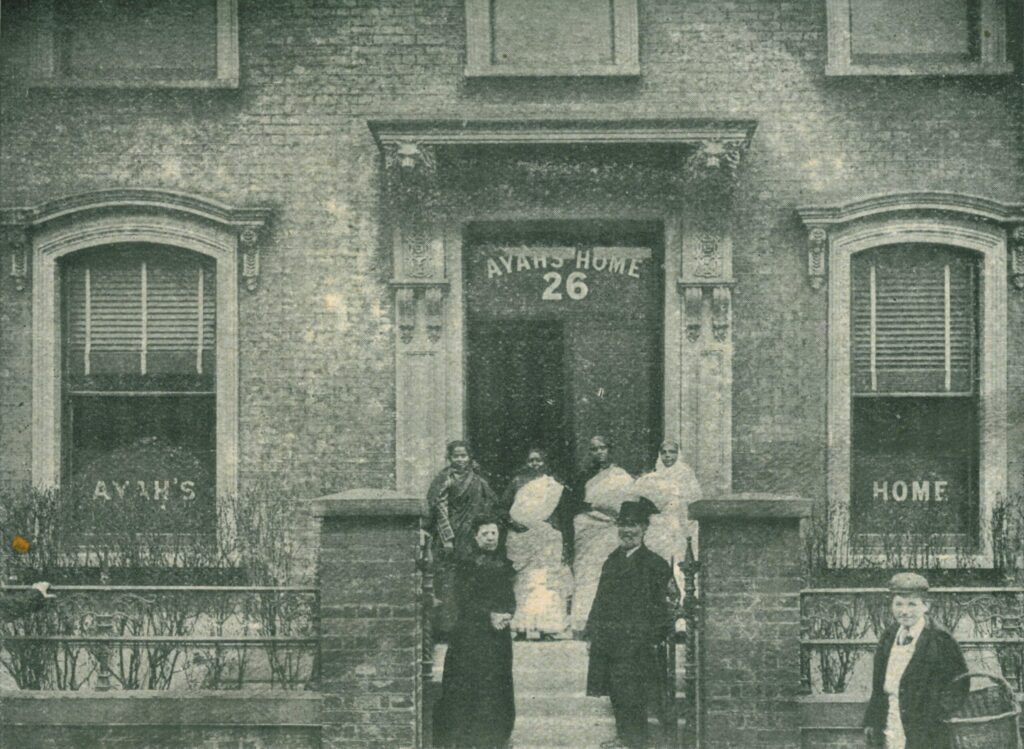
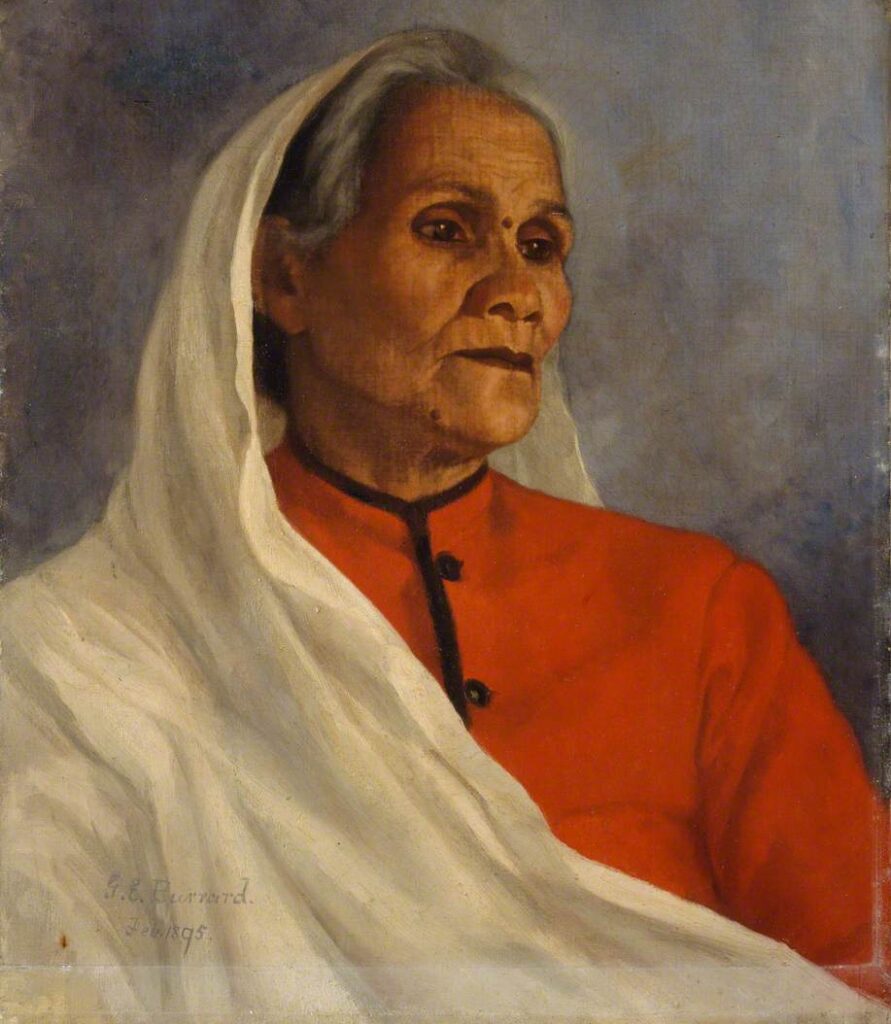
That indifference manifested in concrete ways. Despite their ubiquity, ayahs were frequently denied wages, abandoned on arrival in Britain, their passports withheld by employers. Ayahs’ Homes were established in Britain partly to shelter women stranded this way, waiting for funds to return home. Datta records the case of Nasiban ayah, who arrived in Britain in 1899, only to be abandoned by her employers without wages or money for a return passage to India. Four years earlier, a painter named Gertrude Ellen Burrard had made her portrait. And so, Nasiban — or Nussiban, as the portrait is titled — found herself documented, and even valued, on one journey, and deserted on the next.
These visual records, though, tell only part of the story. Alongside paintings and postcards that documented the presence of ayahs, and deemed them necessary and indispensable, ran an undercurrent of anxiety that found expression in household manuals, illustrations, and children’s books. Some images were crude in their hostility, like an illustration from the 1826 novel Confessions of an Oxonian, in which an Indian woman, who appears to be an ayah, is depicted stealing a white child from the verandah of an Anglo-Indian home. Other texts were more subtle, caught between admitting British families’ reliance on the services of Indian ayahs and dismissing their caregiving abilities. In her manual, The English Baby in India and how to Rear it (1893), Georgiana Kingscote admits that “the whole health and perhaps the life of your child may depend on how the ayah treats it…”. Yet she blames ayahs for the diseases children catch and questions their ability to sense cold or warmth correctly — a shortcoming she says leads to mistakes with food, clothing, even bath water. Kingscote’s manual is underpinned by racist and gendered notions. At one point, she writes, “the women of India are even more lazy and deceitful, as a rule, than the men”, and later, “Lucky is the woman who can afford to have a good English nurse to counteract the evil effects of Indian bringing up.” Such anxieties were rooted in the ayah’s peculiar position within the colonial household.
Functioning as surrogate mothers, ayahs often developed profound emotional bonds with their English wards, who learned their ayah’s mother tongue — one of their first exposures to language — alongside English, and absorbed aspects of Indian culture simply because they spent the most time with her. While the ‘sahibs’ and ‘memsahibs’ had no problems establishing their authority over Indian male servants, the female ayah occupied a more ambiguous place within the colonial household. Colonial prejudice cast her as a suspect outsider, yet her work made her the indispensable insider.
Kingscote’s cautionary language reflects precisely this tension, highlighting how dependence and racial anxieties coexisted around the figure of the ayah. Ultimately, the purpose of her book was never just about instructing young mothers in childcare. It was to also instruct them in managing a figure colonial households could not do without, while guarding against what it portrays as the “corrupting” influence of the Indian ayah on English children — a colonial civilising mission disguised as a childcare guide.
Even in children’s books of the period, we see the ayah’s value reduced to her usefulness to white families. In Edith and Her Ayah and Other Stories (1872), Motee Ayah is devoted to her charge — she follows Edith into a jungle, faces a tiger, and risks her life for the child — but is described as a “poor heathen”, an idol-worshipper impervious to the “purer” Christian faith. Her redemption, in the author’s telling, comes not from her courage but from her eventual conversion. In Ayah and Lady: An Indian Story (1822), the ayah is portrayed as quarrelsome and disorderly throughout, and redeemed only when she promises the dying lady of the house that she will travel with her little girl and care for her at sea. In both books, service and even devotion are not enough; the ayah had to be remade on the coloniser’s terms to be considered acceptable.
These tensions are far more nuanced in the Story of Henrietta and the Ayah (1864), where racial anxieties are voiced through the figure of the white child Henrietta. The Indian ayah next door is a source of fear for the child, who then lashes out with racist comments: “Send away the blacky, and then I’ll come out”, “why does she not wash her face”, “nasty black creature.” To be sure, the adults in the book counteract Henrietta’s point of view: her parents gently but firmly teach her that the ayah is kind and trustworthy; the ayah’s employers “feel indebted to her” and describe her as “the preserver of the family.” And yet, both the adults’ admiration and the child’s eventual acceptance are contingent on how useful the ayah proves to the British families around her. In the end, it is she who nurses Henrietta back to health. Similar contradictions run through other texts. In Secret Garden (1911), ten-year-old Mary Lennox is distressed by the death of her ayah, but also recalls striking her when she was angry and taking for granted that Indian servants existed to obey rather than to be treated as equals. Even affection in the novel remains bound by the racial hierarchies of empire.
What emerges from these visual and textual sources is a figure that was simultaneously everywhere and nowhere. Indian ayahs imbued colonial life — they were in nurseries, on ships, in railway stations — but the records meant to document their presence often simultaneously erased them. As Datta notes, ship manifests routinely anonymised travelling ayahs; not all passages were accurately recorded, and not all records survived. The anxieties reflected in colonial images and text were not incidental to the English dependence on ayahs, but rather produced by it. The more indispensable ayahs became, the more the colonial imagination needed to manage, contain, and even conceal them.
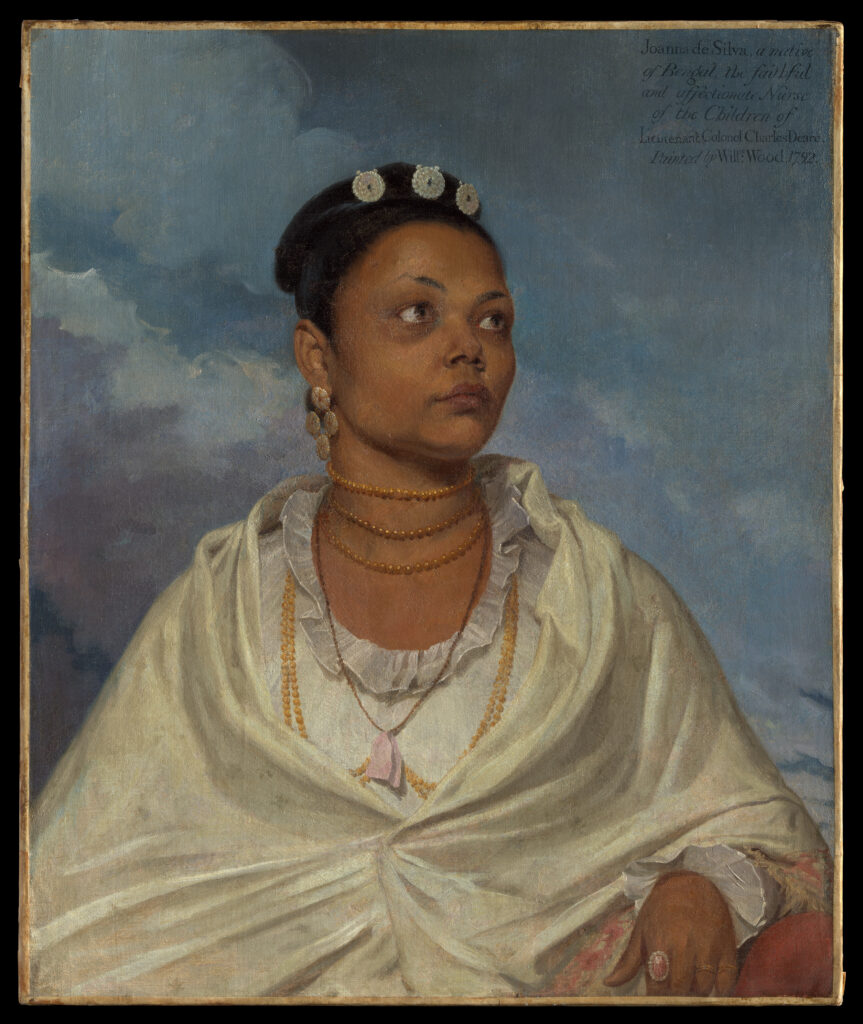
That tension dates back to the very beginning of the archive. According to Datta, one of the earliest references to travelling ayahs in the historical record appears in March 1730 — a notice from a shipping company informing the East India Company that a “native ayah named Jonana”, from Bengal, who had arrived in England the previous February while attending to Mr Mandeville’s children, was ready to travel back to India. Thereafter, in 1792, an ayah named Joanna de Silva appears in a portrait painted by British artist William Wood. The curators of the Ayahs and Amahs exhibition describe her as “a native of Bengal, of Portuguese descent, and the ‘faithful and affectionate nurse’ of the children of Lieutenant Colonel Charles Deare.” Following her employer’s death in Calcutta, the curators note that “she accompanied the Deare children to England, where her portrait was made.” Going by the dates and details, Jonana and Joanna de Silva may well have been the same person — a logistical entry and a portrait separated by sixty years and little record keeping in between.
While we cannot be certain, that uncertainty is part of the story: for two centuries, these women were indispensable to the everyday functioning of the imperial world, and yet that world kept only partial accounts of them — their names incomplete, their portraits tentative, and their lives difficult to piece together.
First published: August 7, 2026