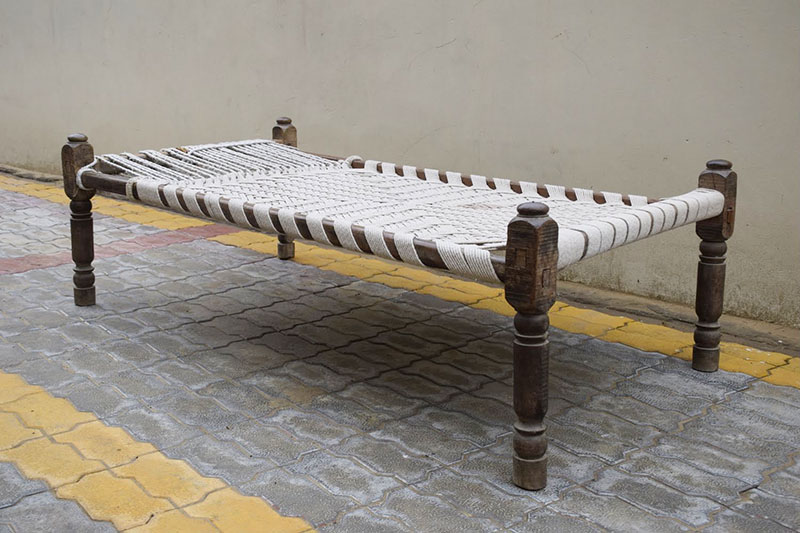
A light bedstead with a webbed surface used across South Asia, especially in regions with arid climate. The English ‘charpoy’ derives from the Urdu charpai (‘four-legged’; char: ‘four’, pai: ‘legs’); vernacular names for the object vary widely across regions. The charpoy’s frame and legs — the latter often turned or carved — are usually made of wood and typically joined using the mortise and tenon method. Ropes or strips of cotton, jute or other natural fibres are woven around the frame to create the webbing; the charpoy is often used without any additional bedding laid over this. Modern charpoys may also be made of metal, with webbings of nylon or other cheaper materials. Besides sleeping, the charpoy also serves to seat one or more people, and as a surface to lay out food and other items, and is commonly used in both homes and communal public spaces. Its light but sturdy construction enables it to be easily and frequently shifted, and stood up or even hung on a wall to save space; it is also often carried to and from fields where it is used as a resting place in between work. While the charpoy is often a rudimentary structure, its design may vary by region and the social status of its users; extant historical specimens used by the elite are richly decorated with encrusted gemstones, gilding, painting, carving and so on. While the origins of the charpoy are not known, one of the earliest mentions of the object is found in the writings of the fourteenth-century Moroccan scholar and traveller Ibn Battuta, from his time as a judge in the Tughlaq court.
charpoy
Link copied!