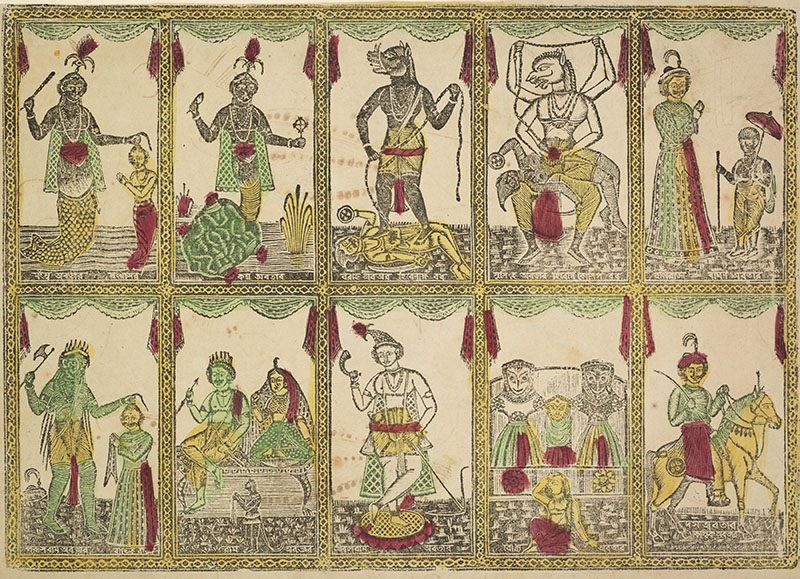
Hindu concept in which a deity manifests in earthly, embodied form to restore cosmic and moral order, primarily applied to Vishnu and fundamental to Vaishnavism. Historically, the concept of avatara (Sanskrit, ‘descent-form’) has functioned, across sects, as a flexible theological mechanism that allowed for the assimilation of various strains of worship by interpreting regional, sectarian and tribal deities as forms or incarnations of a single, supreme Brahmanical god. This is seen, for example, in Shaktism, where various folk goddesses are often identified as avatars of Brahmanical goddesses such as Lakshmi or Durga. An early articulation of the avatar concept appears in the Bhagavad Gita (fifth to second centuries BCE), in which Krishna declares that he manifests in the world across successive cosmic ages (yuga) to restore righteousness.
The ten avatars of Vishnu, or Dashavatara, were broadly standardised between the fourth and tenth centuries CE in the Vishnu Purana and the Bhagavata Purana. Of these, the animal avatars, such as the boar (Varaha) and the tortoise (Kurma), likely originated in Vedic cosmology or tribal cults, whereas the human avatars, such as Rama and Krishna, probably derived from the deification of historical or semi-historical figures; others, such as the Buddha, were assimilated from competing religions.