-
ChicagoMeynell, Dr Anna-Louise. "Bonds Across Borders: How Singpho’s Dance Festival Constructs Community." Impart Perspectives, July 28, 2026. https://imp-art.org/perspectives/dispatches/bonds-across-borders-how-the-singpho-dance-festival-constructs-community/
-
MLAMeynell, Dr Anna-Louise. "Bonds Across Borders: How Singpho’s Dance Festival Constructs Community." Impart Perspectives, Jul. 28, 2026, https://imp-art.org/perspectives/dispatches/bonds-across-borders-how-the-singpho-dance-festival-constructs-community/. Accessed 14 Oct 2026.
-
HarvardMeynell, D.A. (2026) Bonds Across Borders: How Singpho’s Dance Festival Constructs Community, Impart Perspectives. Available at: https://imp-art.org/perspectives/dispatches/bonds-across-borders-how-the-singpho-dance-festival-constructs-community/ (Accessed: 14 October 2026).
Bonds Across Borders: How Singpho’s Dance Festival Constructs Community
The Singpho's dance festival, honouring their ancestor Shapawng Yawng, celebrates an ethnic identity that existed long before the region was carved up into modern nation-states.
By Dr Anna-Louise Meynell
Link copied!
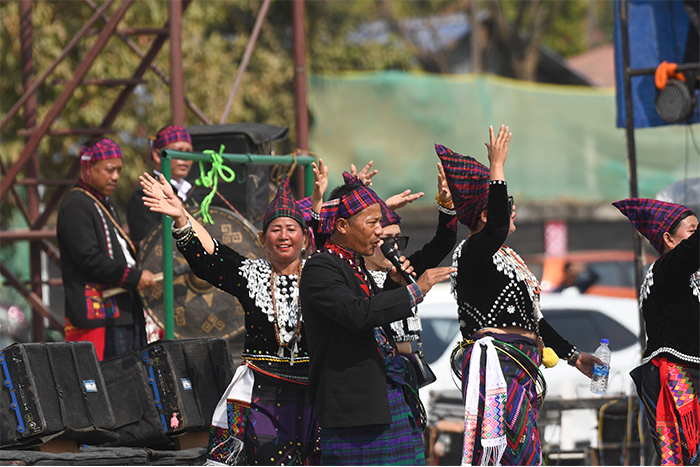
The Singpho's dance festival, Shapawng Yawng Manau Poi, is organised entirely by the community with some support from state authorities since its inception in 1985. Photograph by the author
The Singpho people live in the far eastern districts of Arunachal Pradesh and Assam in India. Across the border, their ethnic relatives reside in Southwest China’s Yunnan Province and in the Kachin State of Myanmar, the country’s northernmost region. One tribe. Three nationalities. In China, they are called ‘Jingpo’ and in Myanmar, they are the ‘Jinghpaw’ or the ‘Kachin’. While divided by international borders, they are connected through a common history and living heritage practices — from textiles and distinct food preparations, to ritual songs and dances. The tribe and its traditions have existed in the region long before it was carved up into modern nation-states.
Deeply embedded in the core values of tribal kinship is the Shapawng Yawng Manau Poi — the annual celebration that takes its name from the legendary forefather and mythical progenitor of the Singpho people, Shapawng Yawng. The term poi means festival and manau means dance. Therefore, ‘Shapawng Yawng Manau Poi’ means ‘dance festival honouring Shapawng Yawng’. The festival space is meant primarily for community members, unlike other state-sponsored, and often tourist-facing, tribal heritage festivals of North-East India. It is organised entirely by the Singpho community, with some support from state authorities.
Bonds of Tribe and Family
The four-day festival, held between February 13-16, is hosted on a rotating basis by villages and towns in either Changlang or Namsai district of Arunachal Pradesh. It mirrors similar celebrations across the border in Myanmar and China. In Myanmar, the dance festival often coincides with Kachin State Day on January 10 and is celebrated as the Kachin Manaw Festival, while in China, the Munao Zongge Festival begins on the 15th day of the first lunar month each year. Due to political turmoil in Myanmar, it has not always been possible for the Kachin to host their version of the event within their territory at the manau ground in Myitkyina. Therefore, coming to India each year becomes an opportunity for them to celebrate freely with the Singphos of India.
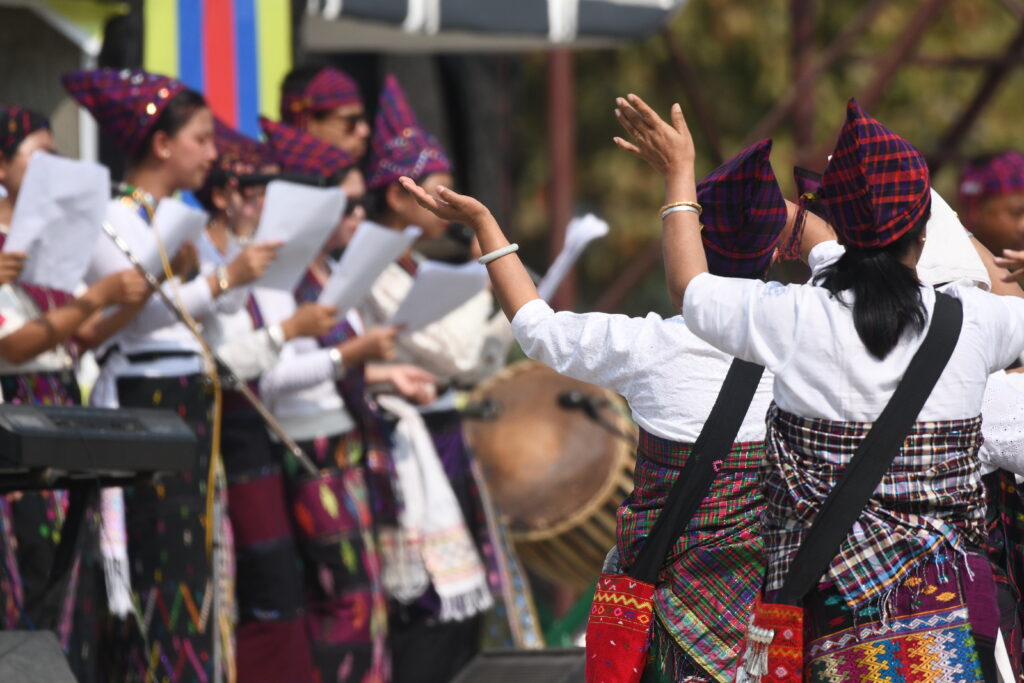
For the past several years, there has been a delegation from the Kachin community attending the Indian festival. In 2026, approximately 200-300 people attended, a majority of whom had crossed the India-Myanmar border at the Pangsau Pas — a journey of two and a half days by bus from Myitkyina. There have been years where the Jingpo of China have also attended in good numbers. But, due to the on-going tension about the boundary between India and China in the Arunachal region, very few were able to attend this year.
The Chinese Government earmarks a vast budget for the Munao Zongge Festival, which has been categorised as a “national intangible cultural heritage.” Likewise, the Shapawng Yawng Manau Poi also receives funding from Arunachal Pradesh’s state government, albeit far less than the funds provided by the Beijing government. Such state grants and visiting government officials and politicians do circumscribe the tribe’s manau festivals within nationalist contexts, but the overarching celebration of ethnic heritage remains the primary aim of the festivals in each country.
The Singpho festival in India is therefore a space of cultural celebration that transcends borders. It is a transnational third space that honours tribal kinship, complete with its own flag, where the community’s shared ethnic identity takes precedence. The distinction between people from Myanmar, China, and India dissolves as songs are performed, food and stories are shared, and their dance steps trace the movements passed down by common ancestors.
Where Motifs meet Tradition
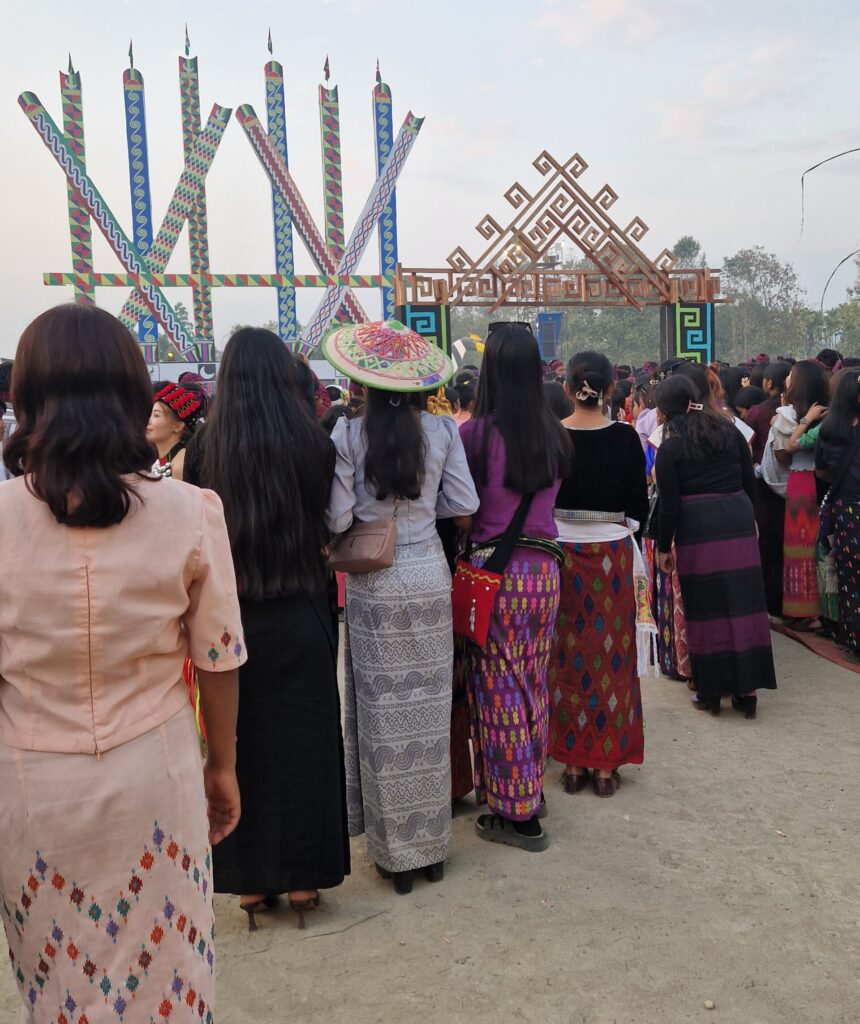
The visual language of the festival is vibrant and centred around the sacred manau ground with the ceremonial pillars. The tall manau shadung pillars at the centre of the arena, reaching up to heights of 20 metres, tower over the dance participants and are decorated in swirling patterns of red, blue, green, and yellow. These pillars represent the spiritual path of life, connecting heaven, earth, and humanity. Usually, the pillars are temporary wooden structures that are taken down once the festival is over. But since Miao was where the first Shawpawng Yawng Manau Poi was hosted in 1985 and the festival was ‘returning’ to the town in 2026, the local Singpho organising committee decided that the pillars would be commemorative, permanent ones made of concrete to mark the event.
While the word manau is roughly translated as ‘dance’ in English, this does not quite convey the emotional and cultural significance of the word that is the beating heart of this festival. The traditional mass dances, according to Singpho folklore, originated when an ancestor, Mading Yau (also called Mang Ding Yau), observed the dances of wild birds while they were feasting and taught them to his tribe members. To an outsider, a ritual dance appears to be a gathering of people walking, following one another as the line snakes around the arena. The patterns that the dancers trace with their steps are carefully considered movements and outline interlocking motifs that mirror the patterns on the manau pillars. Incidentally, the designs on the pillars are not abstract patterns. Each motif (maka) used is significant, often related in some way to Singpho myths and ancestral stories. Alongside the swirling patterns on the pillars, there are depictions of the hornbill, the drongo, and the water buffalo, which represent the origins of the festival. They are also important symbols of kinship amongst the clans spread across India, Myanmar, and China.
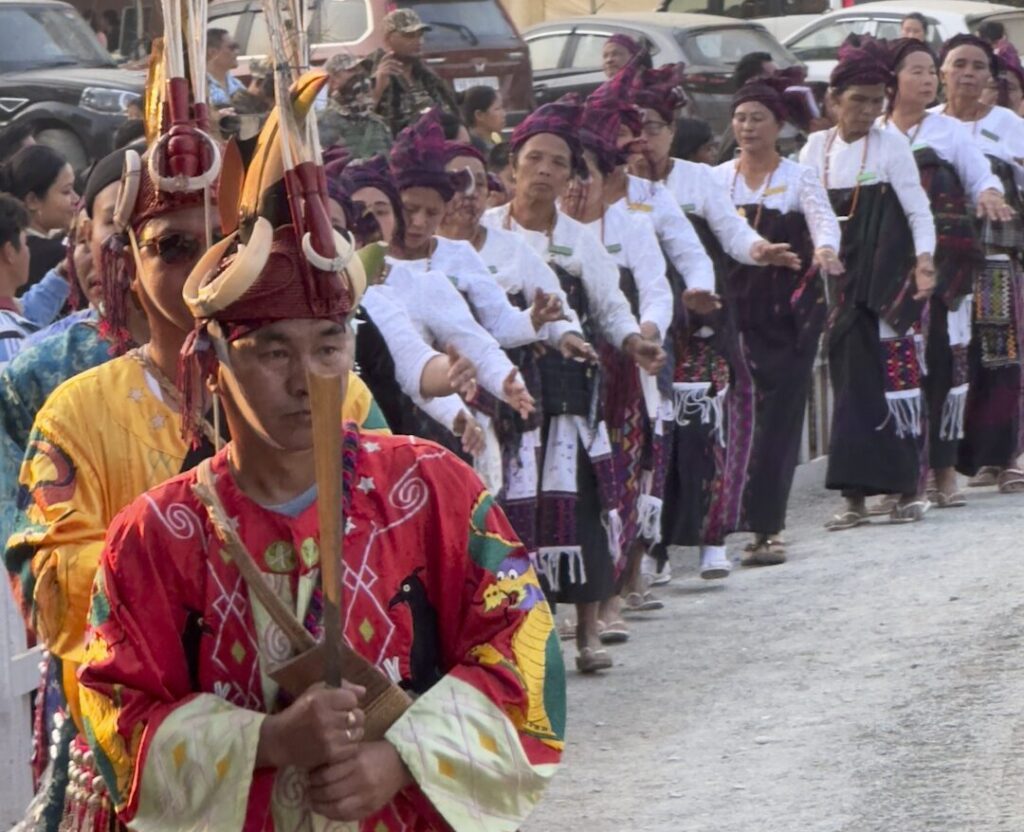
One group of motifs used to decorate the pillars, called the s’dung maka, represent the Singpho’s relationship to their ancestors, and are found on their textiles as well. These motifs are created using supplementary wefts with yarns in bright colours to embellish the surface, standing out against the main weave done in dark colours. They are primarily used on the bathut, the wraparound sarong that is traditionally worn by unmarried women, and the bathung, worn by married women. The bathut is stitched into a wide tube skirt that is folded back on itself, whereas the bathung is an untailored length of cloth tied in a customary manner around the waist. The designs are woven from memory, or by copying archival pieces handed down through generations.
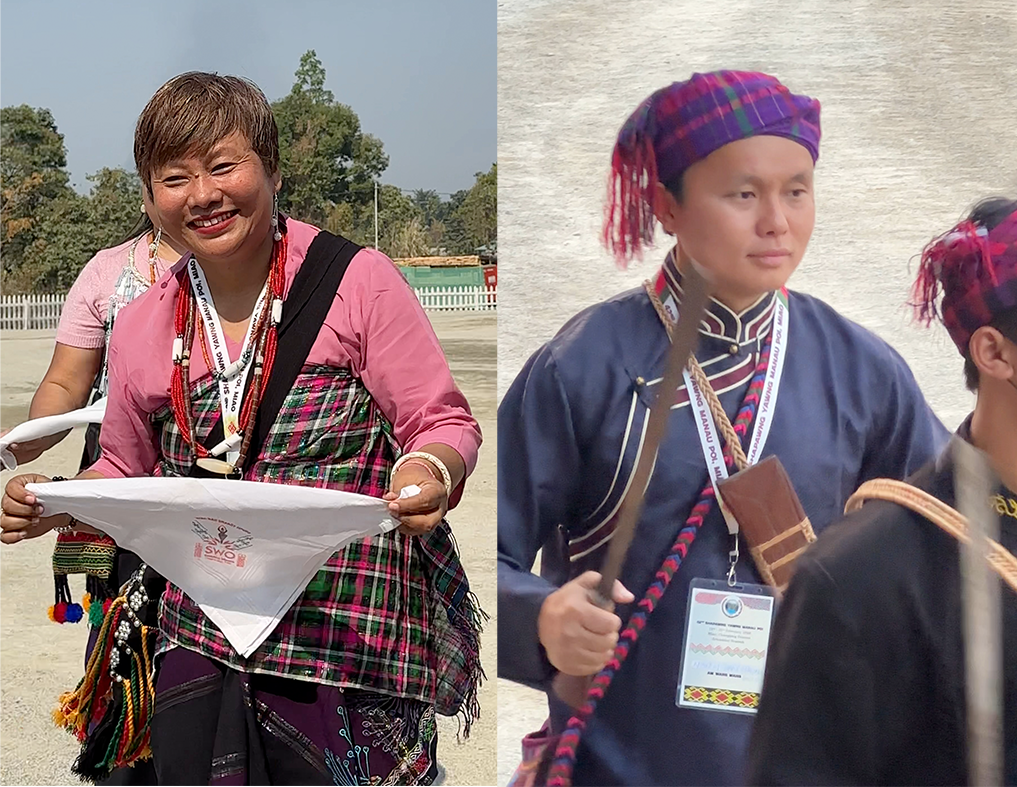
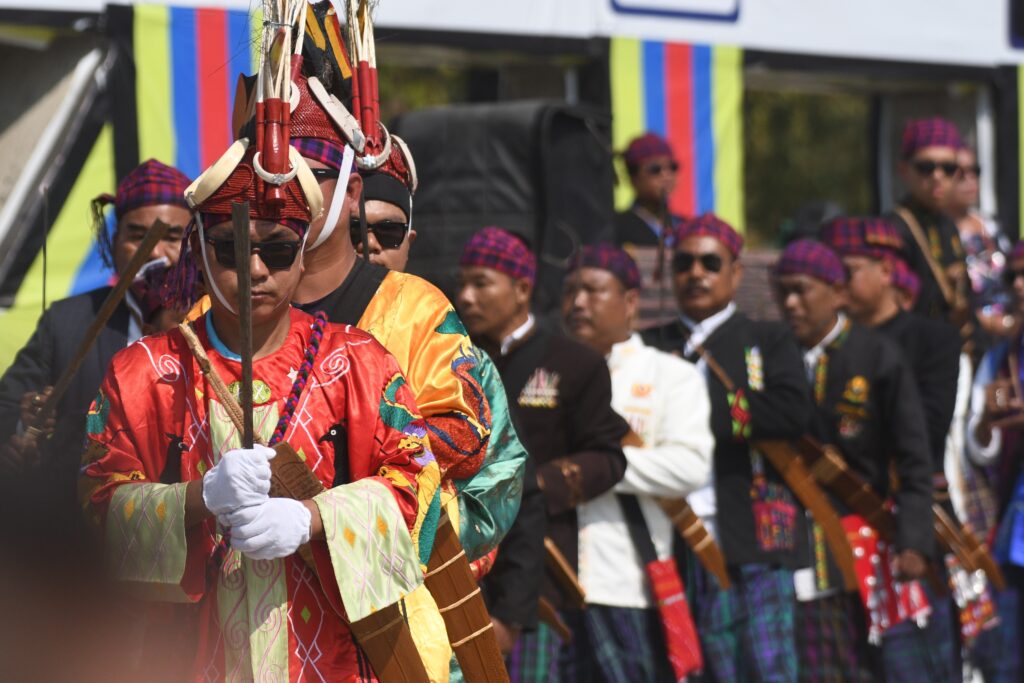
A checked length of cloth, called a ningwat, is also wrapped around the chest by Singpho women. Such combinations represent the traditional attire of the Singphos in India and are favoured by the older generations, who tend to stick to the bathung and ningwat with a white blouse underneath, in addition to the bumban textile headdress, and a woven bag that completes their ensemble. Singpho men wear a checked lungi in green, black, purple and maroon, a simple white shirt, a jacket often embellished with Singpho motifs, and the characteristic turban in checked design called a khuphok.
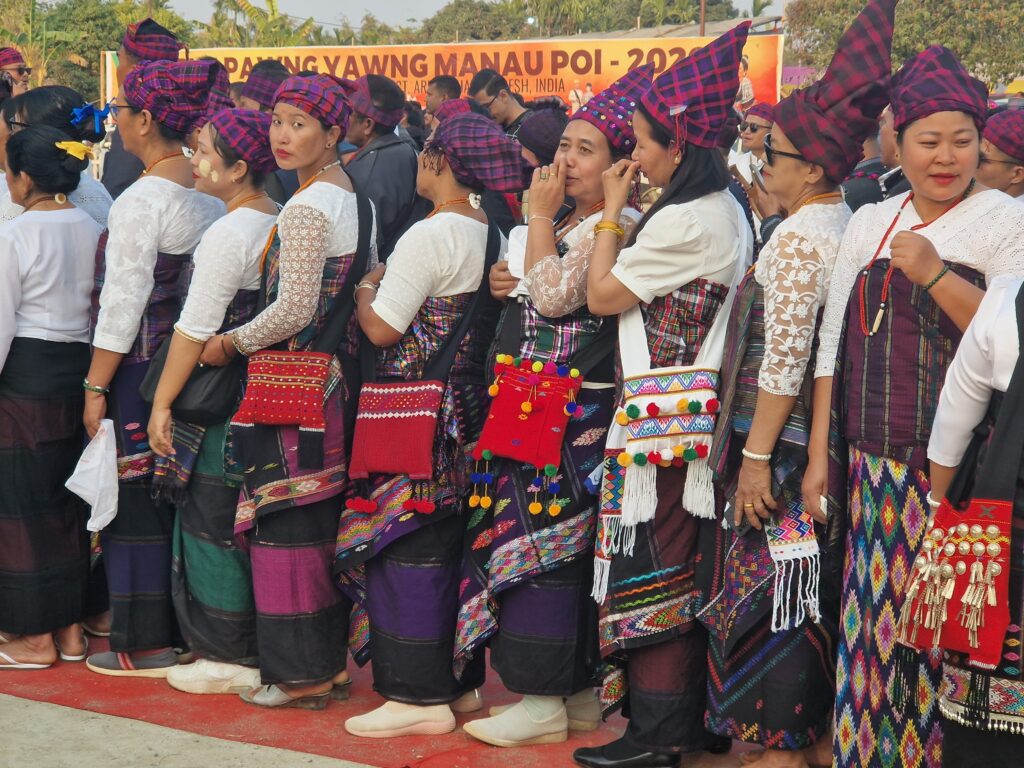
The textiles at the festival tell the story of a common heritage, but also highlight the contemporary divergent practices in production and use. In Myanmar, the production of these traditional textiles has evolved to become highly sophisticated with dedicated production workshops that explore their design possibilities. Adaptations to the looms have enabled the Jinghpaw of Kachin State to weave faster and create more complex patterns. Therefore, Jinghpaw textiles are synonymous with striking colours and patterns that are far more elaborate than Singpho textiles from India.
Many of the younger Singpho women choose to wear Jinghpaw textiles from Kachin as they enjoy the bright colours and the complex designs. Some borrow from the Kachin style of dressing — a two-piece set with a skirt and blouse-style jacket — that the Jinghpaw women typically wear in Myanmar. Other Singpho women and girls wear the bright red garments typical of the Manmaw (Bhamo) region in Myanmar. Likewise, there are women from Myanmar who choose to wear the ningwat over the two-piece, skirt-jacket set, perhaps in an effort to relate to Singpho tribe members since the ningwat is rarely used by the Kachin in Myanmar anymore. There are also women from Myanmar who choose to wear the Hkakhu Jinghpaw dress. All these styles of clothing intermingle in the festival space, becoming a cross-border cultural expression of the tribe’s textile heritage. New design practices are shared in the inclusive and accepting environment of the festival. It shows that while some designs are no longer woven, the tribe’s weaving techniques continue to thrive as an evolving practice, rooted in traditional design yet open to contemporary innovations.
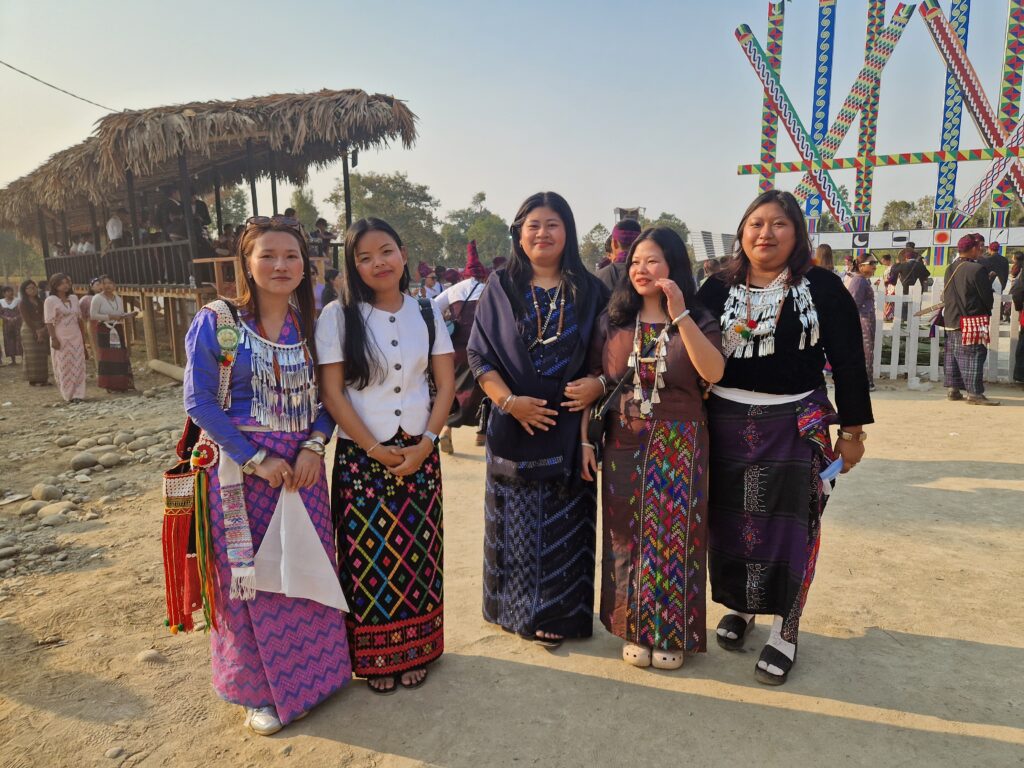
Non-Singpho visitors to the festival are also encouraged to wear traditional Singpho garments, usually gifted by a person from the tribe. Adopting an element of Singpho attire is the only way for outsiders to gain the required permission to enter the sacred manau ground.
Adjoining the dance ground, bamboo huts are constructed where communal meals are served to visitors for free by the members of the Singpho community hosting the event. In addition, a whole array of commercial food stalls with private seating sell a variety of decadent dishes, from smoked meats, pickles, local vegetable and rice dishes, and plenty of rice beer. Both the communal eating spaces and private food stalls draw crowds, no matter what time of the day, with groups of people bonding over food and drinks, songs and conversation.
Pinna Kitnal Singpho, the general secretary of the Singpho Women’s Organisation (SWO), lives in Miao. As a leading member of the organisation committee, she was involved in months of hard work, coordinating the construction of the sacred manau ground, and the surrounding bamboo huts. Her primary motivation was to “make sure the festival was a success”, and to challenge herself to see how much she could contribute. Even time off for Pinna meant gathering the village women to practice the traditional manau songs. Her house also became the base for many visitors from Myanmar, who arrived days before the festival and left a few days after the event concluded.
Nbyen ‘Dan’ Hkung Awng, informally known as “Dan”, was one of Pinna’s Jinghpaw guests from Myanmar. Dan told me that he had come to the Indian edition of the festival many times before and this year, he was accompanied by his sister Phupla Jan (official name Slg Jan Nlak Hkawn Nu). For Phupla Jan, who recently got married to Pinna’s husband’s cousin, it was a special visit as she got to meet Pinna, now her sister-in-law, for the first time. Pinna and Phulpa Jan fell into an easy friendship over the days of the festival. Pinna even remarked that the familial role as a sister was “very easy to fit into”, describing the “burra khana” they shared as a family on the night before Phulpa Jan and Dan’s departure, back to Myanmar. “It was all about exchanging information and knowledge. What happens in her homeland, what happens here, and of course, family stuff”, Pinna recalls. Such marriages between tribe members across borders is common enough that the festival becomes a chance for relatives to meet and bond every year.
Rituals of Song and Dance
Dan, as the Director of the Kachinland College in Myanmar, is especially interested in the preservation of Kachin culture through documentation and lived traditions. This year, the cultural group from his college joined forces with the Singpho youth to perform songs for the communal dances, and also performed at the festival’s cultural entertainment and exchange events held in the evenings. The performances showcased a passion and connection with the music that showed that the younger generation is deeply invested in their cultural heritage.
The pulsing music of the Shapawng Yawng festival is like the community’s heartbeat. As soon as you enter the venue, the music’s rhythm engulfs you — you hear it, feel it, move with it. Dan explains that while there are different variations on the main song that is sung during the festival, there are always certain, common musical markers. He imitates the call of the racket-tailed drongo, the mythical leader of the manau dance, which he says is an “inclusive sound, of the call to dance”, for birds of different feathers to come together. The Singpho, Jinghpaw, and Jingpo alike talk of the deep emotional pull of the manau songs that exert a magnetic force of belonging that draws them in. As they dance together, they follow in each others’ footsteps.
Jaulat Singpho, whose family runs an eco-lodge near Margherita in Assam, was a key member of the Singpho musical group at the festival who performed manau songs with students from Kachinland College. Bringing a contemporary edge to the proceedings, Jaulat used digital sound-mixing to add a techno rhythm to spice up the traditional music. His musical innovations showed how experimentation keeps traditions alive by connecting with the tribe’s next generation.
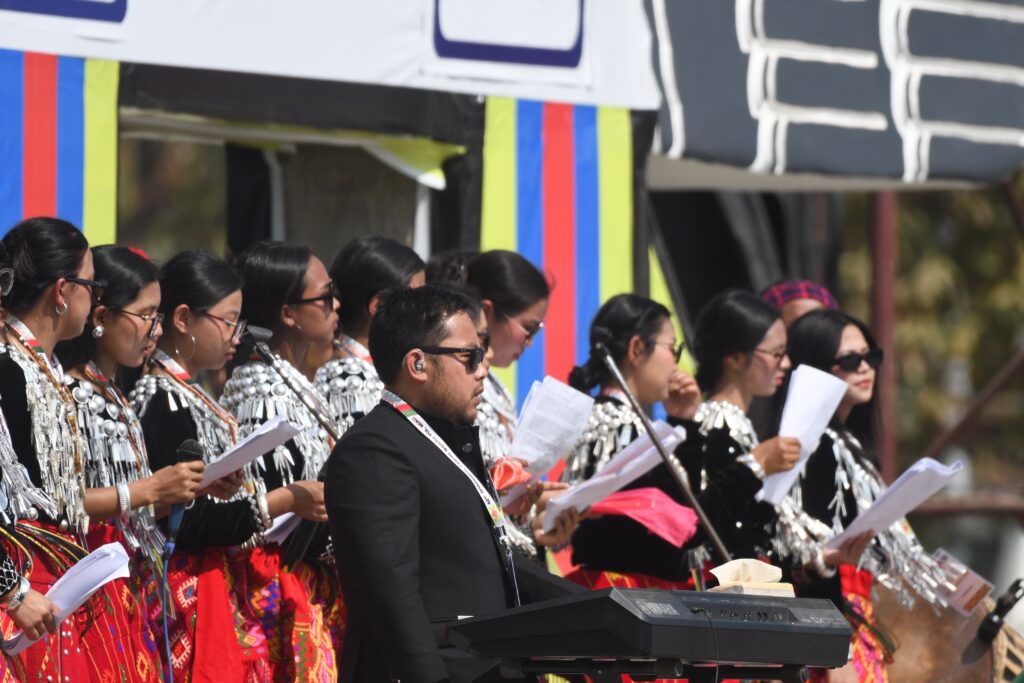
Most of the time, the manau ground is open to anyone who wants to dance — the only condition, of course, is that they have to wear at least one representative Singpho textile or cloth to gain entrance. Such allowances means that while inclusive, the festival requires all dance participants to have some understanding and reverence for the ritual of the manau.
Some dances, however, are more ritualistic and reserved only for those who are fully dressed in complete tribal attire, and who know the steps by heart. The music in such performances can be likened to the religious chants by a priest or pujari. There is a deeper engagement with the music that has religious and spiritual significance for tribe members. The physical act of dancing unifies the group of people paying their respect to the tribe’s ancestors and honouring the ethno-religious beliefs of the Singpho. At the entrance, where people gather to enter the arena, it is impossible not to get swept up in the energy and enthusiasm as impatience builds among the dancers waiting in queue.
Transcending Borders
By acknowledging the cultural and ancestral roots that unite the tribe’s clans across three nations, the festival space actively constructs community, building on feelings of ethnic belonging. While tribal leadership, lineage, and how separate clans are organised is and always has been regulated within a highly political structure, the celebration itself is inclusive of all religions and nationalities. Among the Singpho, Jinghpaw, and Jingpo communities, there are Christians, Buddhists, and Animists, in addition to very different political environments in the countries they call home.
However, the festival activities are not about these differences. Tribe members recognise that the Shapawng Yawng Manau Poi is an opportunity to strengthen kinship ties across borders and learn from each other. For the Kachin, coming to India is an opportunity to observe democratic systems, and observe how the Singpho share space in states like Assam and Arunachal with other ethnic groups. For the Singpho, this interaction offers a chance to see how fiercely proud the Kachin are about their cultural roots, particularly in terms of cultural entrepreneurship — an area in which Singphos do not typically excel.
While the festival is consciously not a ground for political discussion, the strengthening of cultural bonds, and knowledge about how the community operates on different sides of the border, is essential in the broader context of tribal kinship. Relations between the Jingpo and the Kachin are more developed due to physical proximity between the respective authorities, separated only by the Naban river on the border of China and Myanmar. Dan described how this reflects the political relationship between China and Myanmar, where trade flows freely, as opposed to between India and Myanmar where very little comes across the border, jokingly giving the example of the most visible product being Parle-G biscuits!
Therefore, the four days of the Shapawng Yawng Manau Poi is even more meaningful for the Singphos as the festival space allows them to gather and renew kinship ties, meet family members, and build community-based, cross-border connections. Nowhere is this more evident than in the interactions within the manau thingnu (community hall), designed as a purpose-built, bamboo long house on stilts with an open plan. Built right next to the manau ground, it functions as a site of gatherings. It is where friends and relatives mingle, where elders of the community are served meals by the younger generations of the tribe, and where individuals or groups can offer their respects to community leaders or knowledge holders.
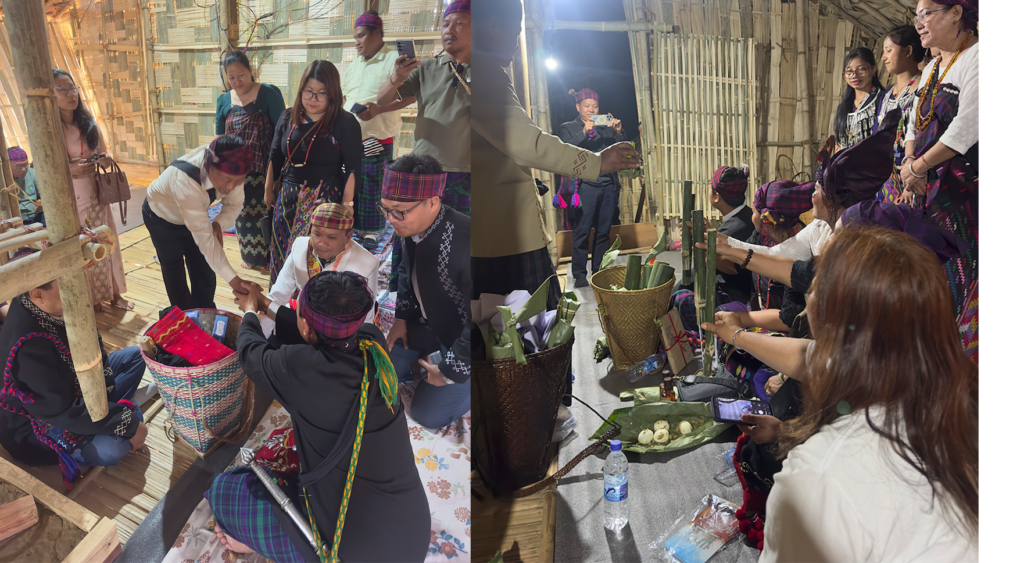
The festival’s closing hours are spent at the manau thingnu with deeply poignant, farewell rituals starting with the Ninggun Shingnoi ceremony, where tribe members honour those who have contributed to the festival’s success. This year, it was Pinna and two other community members who handed out the shingnoi (handwoven bamboo basket) as tokens of gratitude. Dan and the students of Kachinland College were among those honoured for their cultural performances at the festival. So was Jaulat Singpho and the main solo singer of the manau songs for their crucial contributions to the music of the festival.
The shingnoi gifts were indicative of the high honour bestowed and included specific, customary items, such as the symbolic cash offering of INR 140, a piece of cloth, and a dao (knife). The dao is especially significant as a shingnoi gift because it represents both a tool of protection and of labour, needed for the prosperity and safety of one’s family. In addition, there were also ceremonial food items in the basket, such as eight boiled eggs, four bamboo tumblers of mashed fish and ginger, and, of course, rice beer, sealed in bamboo tubes. The perishable items were shared amongst friends and tribe members inside the manau thingnu itself as the mood shifted into one of revelry. Small groups of people broke into song. More and more people joined in as twilight deepened into night. The young Singpho musicians sat with their counterparts from Kachin, having spent the days of the festival singing and dancing together. In the final moments, they sang to celebrate new friendships and the renewal of bonds between their clans as the night drew to a close. They promised to meet again next year.
First published: July 28, 2026