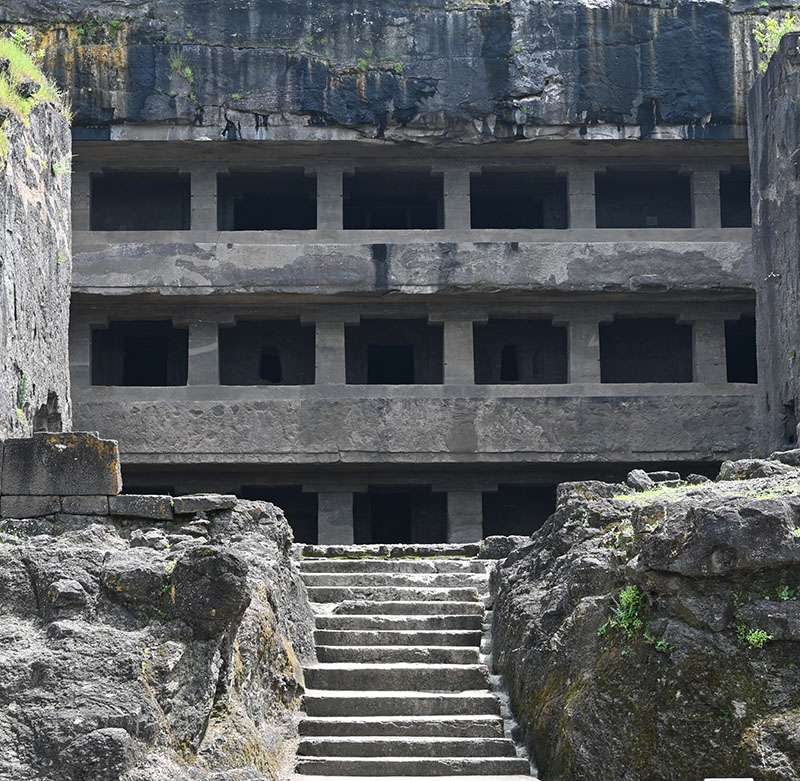
A cave temple in Ellora dating to the eighth century CE and discovered in 1876. Marked as Cave 11, it features carved images of the Buddha, Ganesha and Durga. It has a broad court and deep recessing halls, which have sanctuaries for images. Initially a congregational Mahayana Buddhist structure, it was later appropriated for Hindu worship. It was named Do Thal (literally, “two-storeyed”) since it was initially believed to have two levels; however, further excavation revealed three levels.
More Definitions
Vengi
Historic region of southern India comprising the fertile deltas of the Krishna and Godavari rivers, in present-day Andhra Pradesh, sometimes…
Madurai
A city in Tamil Nadu which served as the capital of the Pandya dynasty (c. third to fourth century BCE…
Toshali
The capital city of the ancient kingdom of Kalinga, located in present-day Odisha, although its exact location remains contested. Excavations…
Hampi
An ancient city in Karnataka, India, it was the capital of the Vijayanagara empire (1336–1646 CE). It is also an…
Taxila
An archaeological site in present-day Rawalpindi, Pakistan. Founded c. 1000 BCE, the site was located along trade routes between Central…
Surkh Kotal
An archaeological site in present-day Afghanistan that was excavated between 1952 and 1965. The excavations uncovered an architectural complex, including…
Sanchi
A historical Buddhist site in present-day Madhya Pradesh and the site of stupa complexes such as the Great Stupa from…
Silk Road
A network of historic trade routes, it connected Southern Europe, Persia, East Africa, Central Asia, East Asia, South Asia and…