-
ChicagoAlam, Zobia. "“Jewelled Tears”: Pearls in Indian Mythology and Poetry." Impart Perspectives, June 24, 2026. https://imp-art.org/perspectives/dispatches/pearls-in-indian-mythology-and-poetry/
-
MLAAlam, Zobia. "“Jewelled Tears”: Pearls in Indian Mythology and Poetry." Impart Perspectives, Jun. 24, 2026, https://imp-art.org/perspectives/dispatches/pearls-in-indian-mythology-and-poetry/. Accessed 15 Oct 2026.
-
HarvardAlam, Z. (2026) “Jewelled Tears”: Pearls in Indian Mythology and Poetry, Impart Perspectives. Available at: https://imp-art.org/perspectives/dispatches/pearls-in-indian-mythology-and-poetry/ (Accessed: 15 October 2026).
“Jewelled Tears”: Pearls in Indian Mythology and Poetry
From Sanskrit texts and the Tamil Sangam tradition to mystic Sufi poetry, Indian literature is littered with pearls as metaphors for spirituality, love, and beauty.
By Zobia Alam
Link copied!
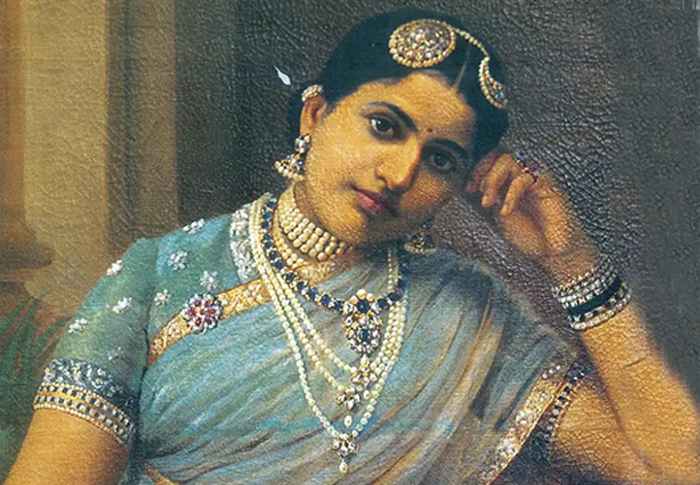
Rani of Kurupam wearing pearl jewellery (detail); Raja Ravi Varma; 1902; oil on canvas. Courtesy Google Arts and Culture
Often referred to as the “queen of gems,” the pearl is the only precious jewel that is not mined. Instead, it emerges fully formed; an iridescent bead born of resilience. The spontaneous formation of the gem seems magical, even though natural, and has been linked to gods, kings, and queens. From Sanskrit texts and Tamil Sangam literature to mystic Sufi poetry, Indian literature is littered with pearls as metaphors for spirituality, love, and beauty.
Closely associated with the Hindu deity Krishna, one popular mythological narrative attributes the discovery of the first pearl to him, when he retrieved it from the depths of the ocean as a gift for his daughter on her wedding day. The story, one of many such tales about gods, indicates that ancient Indian cultures saw pearls as a form of divine blessing. The Mahabharata (c. 300 BCE-300 CE) too describes Krishna’s adornments as the “navaratnas” (the nine sacred jewels), most prominently his pearl string necklace, the Taravali. As one of the sacred gems, the pearl is also deeply anchored within Indian astrological traditions as the gemstone associated with the Moon and the mind.
Pearls in Sanskrit Literature
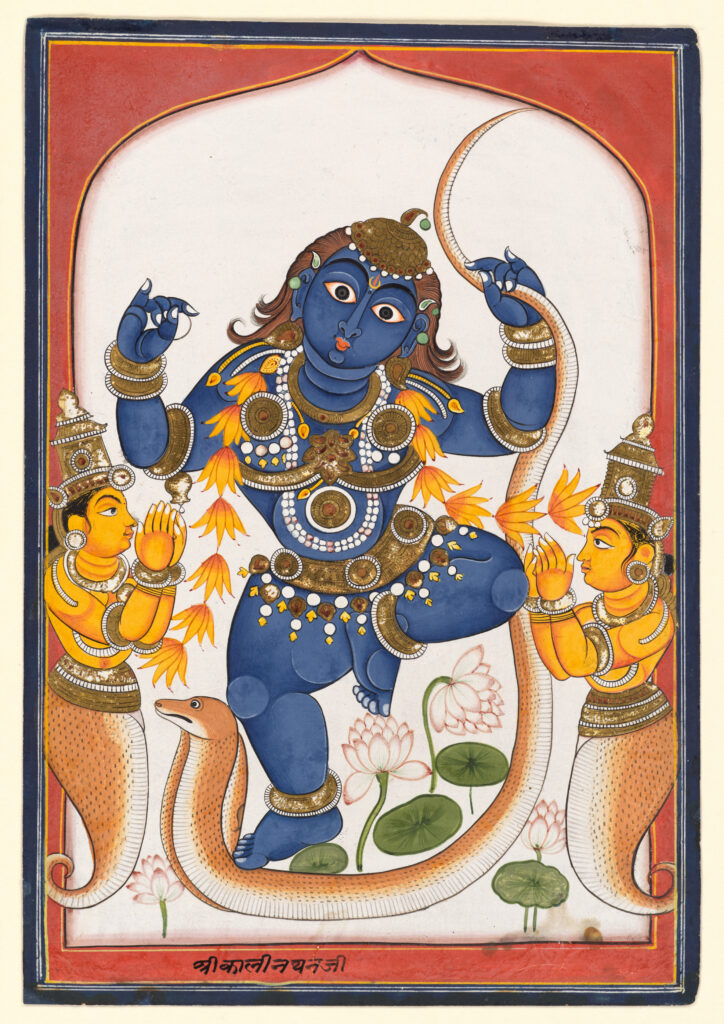
In addition to oyster shell and conch shell pearls, Varāhamihira’s Brihat Samhita (6th century CE) lists seven other kinds of pearls with more mysterious origins — namely, Naga Mani (Serpent Pearl), Varaha Mani (Boar Pearl), Gaja Mani (Elephant Pearl), Venu Mani (Bamboo Pearl), Timi Mani (Whale Pearl), Matsya Mani (Fish Pearl), and Megha Mani (Cloud Pearl). Among these, pearls associated with serpents and elephants are mentioned most often in Sanskrit poems as motifs of fame and good fortune.
A Naga Mani had to be extracted from the hood of a serpent. Not ordinary snakes but serpent lords who ruled over Patal Lok (netherworld) and semi-divine ones, such as Shesha, Vasuki, and Takshaka. According to Sanskrit Kavya literature, such serpents were easily identified even in the darkness of the netherworld because of the gleaming jewel on their hoods. Kalidasa, in his epic poem Kumārasambhavam (likely 5th century CE), noted that even when a serpent lord changes how he looks, his gem remains a visible and immutable part of his appearance. Also common were stories of serpents jealously guarding their pearls, refusing to part with them, except when they voluntarily gifted them or were killed for them. Thus, the Naga Mani became a symbol of duality in Sanskrit poetry — of danger and beauty — befitting the reputation of a jewel embedded in a poisonous creature. It was believed that if a king acquired such a pearl and wore it, he would be protected from being poisoned, defeat his enemies, and be famed for his victories on the battlefield.
Elephant pearls, on the other hand, apparently emerged in abundance from the animal’s frontal lobes. Kalidasa, was the first Sanskrit poet to introduce this imagery around the elephant pearl in Kumārasambhavam, speaking off lions mauling elephants, ripping their foreheads apart, before walking away and leaving pearls stuck to their bloody paws marks.
In another instance, while describing a battle between gods and demons, Kalidasa wrote:
“Pearls that dropped down from the elephant’s frontal lobe, rent with swords,
beautified the battlefield sown with the sprouts of the seeds of fame.”
The Brihat Samhita also implies that elephant pearls were powerful bearers of good fortune and, when worn by kings, brought them victory, good health, and “bestowed sons.” Across different classical Sanskrit texts, we find pearls being associated with both good fortune and protection.
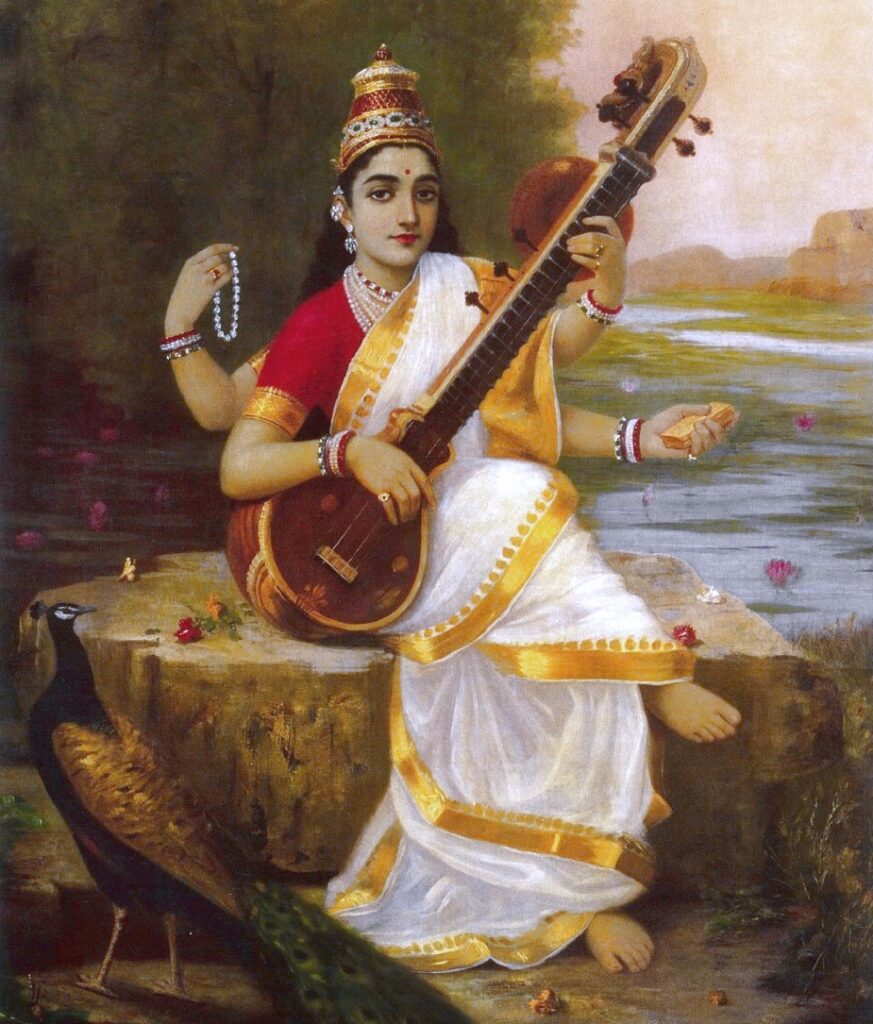
Pearls in Tamil Sangam poetry
Among the most famous sites for pearl fishing in the ancient world was Korkai, a busy trading port of the Pandya kingdom near the Gulf of Mannar. Travellers from Greece, Egypt, China, and Rome visited the South Indian kingdom for its abundant pearls, contributing to the kingdom’s wealth and prestige. Pearls and the pearl site of Korkai would also find mention in Tamil literature. In particular, Sangam texts (c. 300 BCE to 300 CE), such as Akanānūru, Natrinai, Pathitruppathu, Maduraikanchi, Purananuru, and the epic Silappatikaram reveal the cultural significance of pearls in ancient Tamil society.
Pearls operated across both akam (inner world) and puram (exterior world) traditions of Tamil Sangam poetry. In the akam tradition with poems about love, longing and other inner emotional states, pearls served as metaphors for feminine beauty, from actual ornaments adorned with pearls to physical features such as teeth, described as “radiant pearls.” The gem also symbolised emotional states — for instance, an “unpolished” or “unwashed” pearl could refer to innocence or naivety, and even the early stages of love.
The puram tradition, on the other hand, used pearls to allude to royal authority and political power in poetry about kings, wars, and public life. Descriptions of rulers, especially Pandya and Chola kings, were not complete without references to their pearl jewellery that symbolised their control over the natural resources of the ocean. Pearls were presented to favoured poets, courtiers, and warriors and sent with envoys to foreign courts as tributes. Puram poems also vividly portrayed the material aspects of pearl fishing — from pearl divers and coastal communities to the merchants who managed a booming maritime economy.
Often Sangam poetry would also describe elements of nature using pearl terminology in both akam and puram traditions. Sangam poet Mathurai Thathankannanār, in the Akanānūru collection of love poems would write:
“swarms of bees taste the fan-like, bright
flowers which are as white as pearls,
that spread like hailstones that are of the
colour of shells, that bring great happiness.”
Similarly, poet Pālai Kouthamanār, in one of the puram poems of Pathitruppathu, would describe a vivid coastal landscape:
“On the sand-filled shores, adumpu creepers spread low on dunes,
and conch shells brought by the waves blow.
Those who live there find fabulous pearls
and long coral pieces from the cool ocean with delicate shores.”
Using the pearl motif, Sangam poetry constructed a complex, symbolic web of ideas to bridge inner and outer lives within Tamil culture.
From ancient Sanskrit texts to Tamil poetry, the cultural significance of pearls would continue to resonate across empires and cultures and eventually become one of the treasured gems of the Mughal court as well. The Mughal emperor Jahangir famously introduced the fashion of wearing a single-pearl earring. The story goes that in 1614, the gravely ill emperor vowed to pierce his ear and become the “ear-pierced devotee” of Khwaja Moin-ud-din Chishti, the Sufi saint, if he got better. When he did eventually recover, he honoured his vow and began wearing the single pearl earring as a symbol of his deep reverence. The practice soon spread to his attendants and courtiers. Jahangir was also frequently depicted touching a string of pearls as if they were prayer beads while Aurangzeb named his private mosque inside the Red Fort “Moti Masjid” (Pearl Mosque).
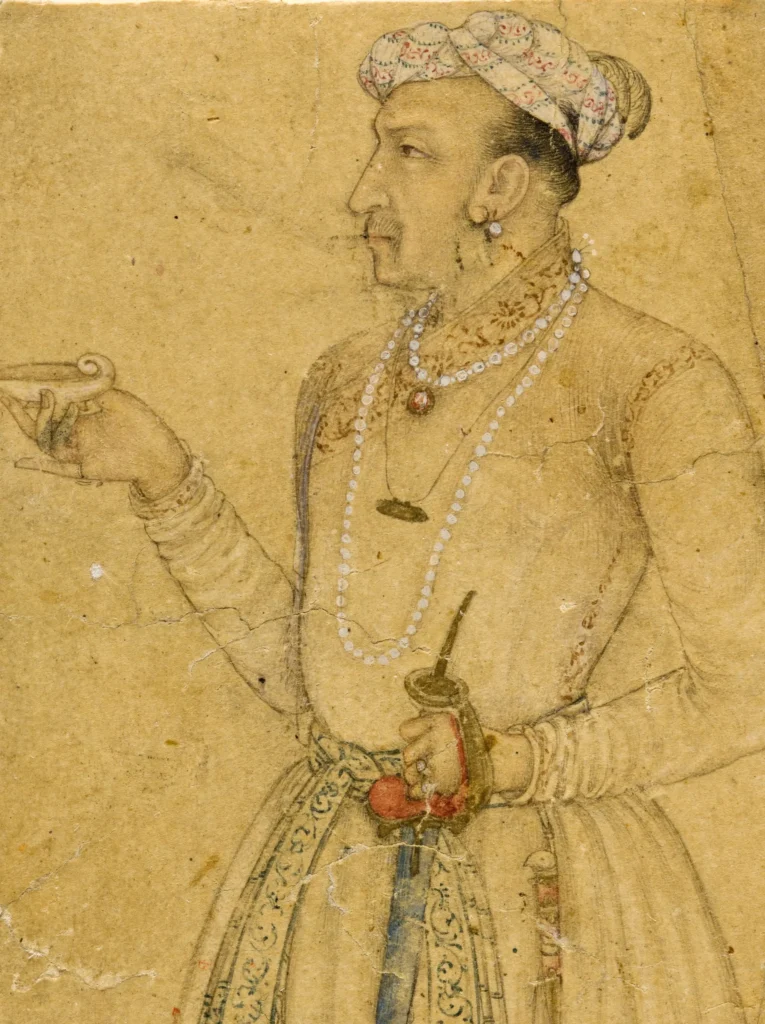
The Mughal’s fascination with pearls as a symbolic objects of purity, denoting both piety and royalty, may have stemmed from Islamic and Christian texts, where pearls denote spiritual worth. Pearls are mentioned multiple times in the Qur’an in descriptions of Paradise as a metaphor for beauty, untouched by human hands. For instance, companions in Paradise are compared to “hidden pearls.” Similarly, in the Gospel of Matthew, Jesus describes the Kingdom of Heaven as a “pearl of great price.”
Pearls and Sufi poetry
The pearl as a symbol of divine love and spirituality also made its way into Sufi mystic poetry. Poets such as Saadi, Hafiz, Rumi, and Al-Ghazali described celestial tears shed by the angels transforming into dew that fertilised oyster shells to become pearls. Others, such as Nizami Ganjavi and Amir Khusrau, consistently used the pearl as a symbol of both love and spirituality, and of deep sorrow and longing.
The pioneer of romantic epic poetry in Persian literature, Nizami’s best-known work is the Khamsa or Panj Ganj (12th century CE) — a collection of five long narrative poems that portrays the power of romantic love. In the third part of the Khamsa, which contains the poem Layla and Majnun, Nizami explored the tragic and unattainable love between the two protagonists. Layla, often described through pearl imagery or comparisons to the moon, is separated from Majnun. After her death, he weeps “pearls of sorrow.” Nizami writes, “the white shell, its pearl vanished, is washed clean” as now our “jewelled tears of mourning flow into it.” In another line, he uses pearl fishing as a metaphor, saying “hear what the deep-sea diver sounding the ocean of the soul has to tell you!”
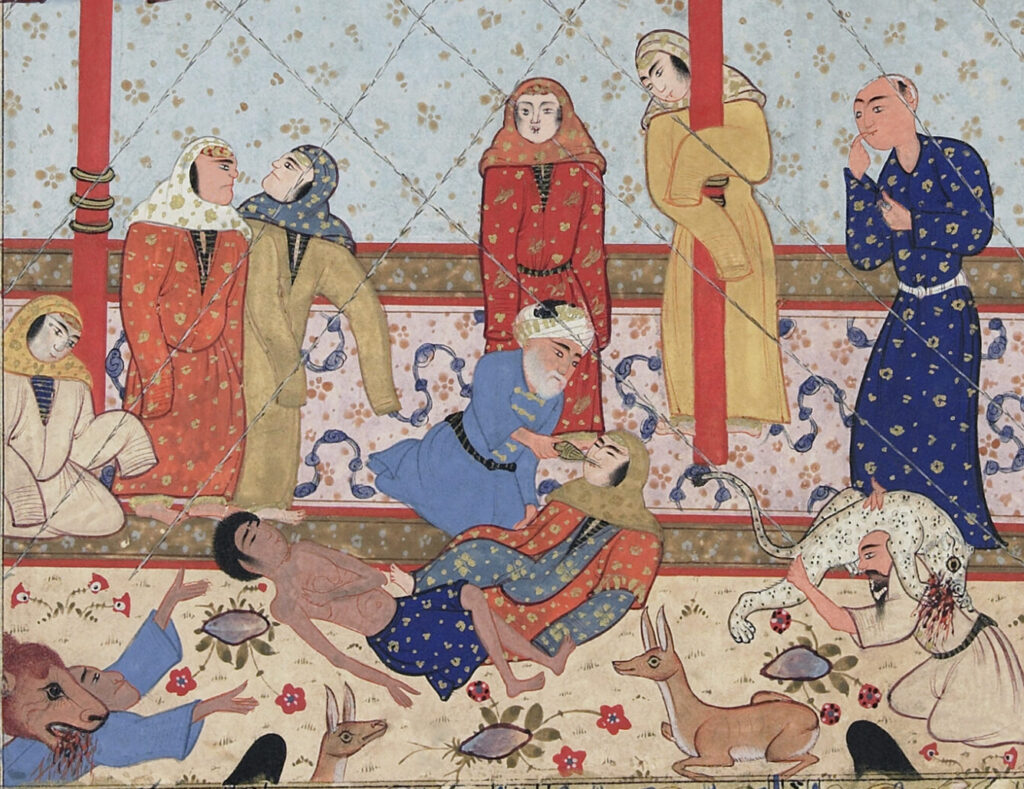
Amir Khusrau, revered as the “Father of Qawwali,” was deeply inspired by the Khamsa and was the first to compose his very own rendition of the quintet. Consequently, inspired by Nizami, Khusrau’s poetry also incorporated pearl symbolism to evoke themes of love, longing, and spirituality. In the introduction to In The Bazaar Of Love: Selected Poetry Of Amir Khusrau (2011), Paul Losensky and Sunil Sharma explain that Khusrau was “active in courtly and Sufi circles at once, and the ethos of courtly love that informs his poetry can conventionally be read as an allegory of longing for the divine.”
One of Khusrau’s narrative poems, The Romance of Duval Ram and Khizr Khan (c. 1315 CE), adopts pearl symbolism to portray tragic love. The affection between the two protagonists grows every day like the “new moon.” However, they remain indefinitely apart, like “two pearls in a jewel box, separate yet together.” Here, the pearl serves as a symbol for their unfinished story and the unspoken longing for love that persists forever. Khusrau, in one of his ghazals, also describes a garden where rain “comes scattering in pearls” and clouds travel like “caravans loaded with pearls.” The use of pearl imagery in this ghazal takes on a mystical tone, perhaps alluding to the Gardens of Paradise.
Tracing how the pearl was regarded across cultures and empires in the Indian subcontinent, and across historical eras, reveals a fascination that extends far beyond its value as mere ornamentation or as a precious commodity. The true essence and allure of the pearl lies in its enduring, layered symbolism reflected in the diverse literary traditions of the region.
First published: June 24, 2026