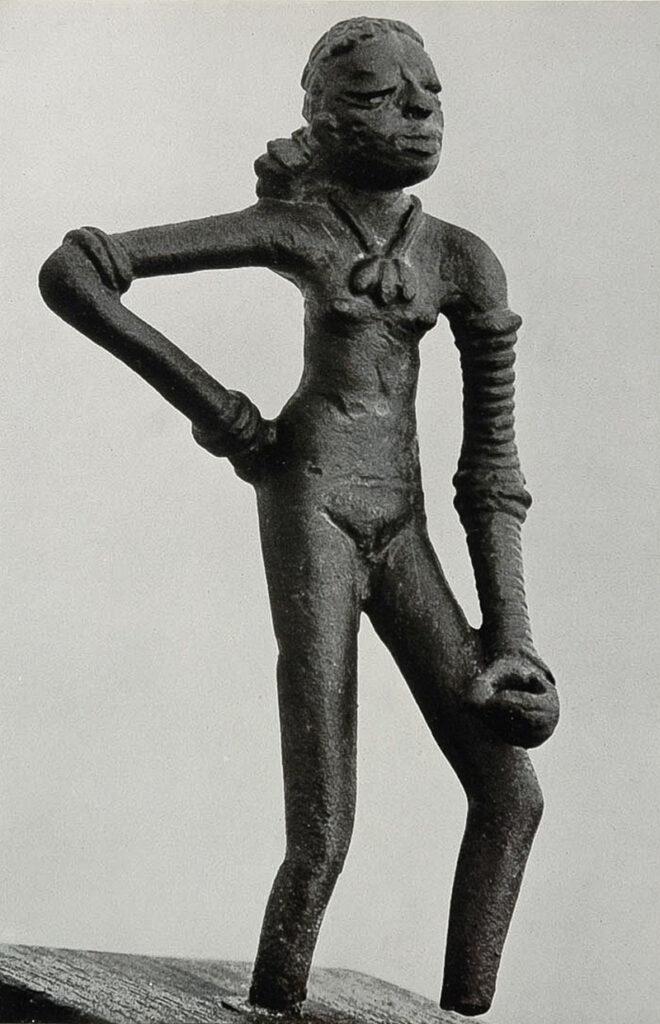
A prehistoric period characterised by the production and use of bronze as well as signs of urbanisation. Its commencement varies in different regions of the world, such as the Indus Valley Civilisation (3300–1300 BCE), Greece and China (c. 3000 BCE), and the United Kingdom (c. 1900 BCE). It is the second of the three-age classification of human history, preceded by the Stone Age and followed by the Iron Age. The transition from the Neolithic cultures to the Bronze Age is known as the Chalcolithic period.
More Definitions
Palaeolithic
Also called the Old Stone Age, this is the period of human history marked by the development and use of…
Tube Drill
A technology for drilling developed during the Mature Phase (c. 2600–1900 BCE) of the Indus Valley Civilisation. It was made…
Upper Palaeolithic Period
The final stage of the Palaeolithic period, lasting from roughly fifty thousand to twelve thousand years ago. This period was…
Petroglyph
A form of prehistoric art created by engraving images onto rock surfaces. Petroglyphs are created by scraping away the outer…
Brahmagiri
An archaeological site in Chitradurga, Karnataka, that contains evidence of habitation from the Megalithic and Neolithic periods in India. It…
Indus Valley Civilisation
A Bronze Age civilisation located along the basin of the Indus river, in the northwestern regions of South Asia comprising…
Prehistoric
The period of human existence prior to the invention of writing systems, starting approximately 2.5 million years ago and ending…
Chalcolithic Period
The period that marked the transition from Neolithic cultures to the Bronze Age, characterised by rudimentary writing systems as well…