-
ChicagoRoy, Spandita. "The Artist as Witness: Zainul Abedin’s ‘Famine Sketches’." Impart Perspectives, May 15, 2026. https://imp-art.org/perspectives/dispatches/the-artist-as-witness-zainul-abedins-famine-sketches/
-
MLARoy, Spandita. "The Artist as Witness: Zainul Abedin’s ‘Famine Sketches’." Impart Perspectives, May 15, 2026, https://imp-art.org/perspectives/dispatches/the-artist-as-witness-zainul-abedins-famine-sketches/. Accessed 20 Oct 2026.
-
HarvardRoy, S. (2026) The Artist as Witness: Zainul Abedin’s ‘Famine Sketches’, Impart Perspectives. Available at: https://imp-art.org/perspectives/dispatches/the-artist-as-witness-zainul-abedins-famine-sketches/ (Accessed: 20 October 2026).
The Artist as Witness: Zainul Abedin’s ‘Famine Sketches’
Abedin’s portrayals of the starved peasant populace during the 1943 Bengal Famine pick at broader socio-historical anxieties around what separates the hungry from the human.
By Spandita Roy
Link copied!
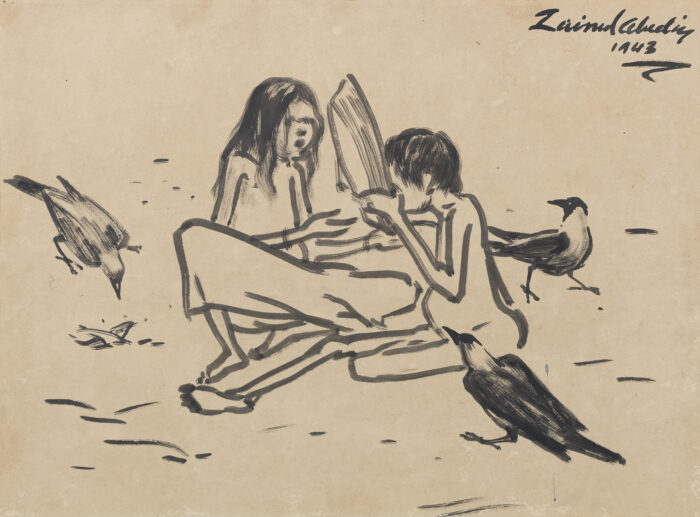
Untitled 'Famine Sketch' from Bangladesh National Museum Collection; Zainul Abedin; 1943; Black ink on paper. Published in Great Masters of Bangladesh (pub. Skira Editore-Bengal Foundation, 2012). Courtesy Bengal Foundation
“Famine preys on the poorest of the poor, the weakest of the weak, those whose very lives and life-stories are erased by marginality and neglect.”
— Janam Mukherjee in Hungry Bengal: War, Famine, Riots, and the End of Empire
During the pre-colonial era, famines were by no means a ‘rare’ phenomenon in the monsoon-reliant Indian subcontinent. However, in most instances, they were mitigated by kings and their vassals through a series of socio-economic measures. These ranged from the release of grain reserves and organising daily langars (food kitchens) to halting land revenue collections and suspending food grain exports.
However, famines did become a frequent and devastating feature of the extractive colonial regime under the British. In the Great Bengal Famine of 1770, between seven and ten million people — approximately one-third of the region’s population — died, while more than three million people perished, according to ‘official’ figures, during the Bengal Famine of 1943. These catastrophes were engineered, with colonial authorities collecting land revenue and taxes at higher than normal rates from the starving population while continuing to export grains. Profiteering, and hoarding activities by colonial officers and their representatives further deepened food crises and sent prices skyrocketing. The 1943 famine, referred to as India’s own “Holocaust,” saw the British encouraging extreme and deliberate profit inflation to finance war spending by the Allied forces, destroying or confiscating rice stocks to thwart the advancing Japanese army, and, as a final blow, instituting the ‘boat denial’ policy that severely impacted local trade and fishing.
With the advent of the famine, the bucolic and verdant countryside of rural Bengal turned into a derelict wasteland, and the agrarian population found itself in the throes of a civilisational collapse. Droves of hunger-maddened, uprooted, and displaced villagers thronged to the metropolis of Calcutta (now Kolkata). Grotesque, skeletal figures haunted the city’s streets begging for phyan (rice starch). Emaciated men, women, and children roamed landfill depots, scavenging for scraps, alongside dogs, crows and vultures, even as corpses piled up in street corners. In the midst of this tumultuous time, Zainul Abedin, an artist hailing from Mymensingh (present day Bangladesh), embraced an aesthetic of uncompromising realism to depict the horrific scenes of destitution, starvation, and death. Holding up a mirror to the unacknowledged genocide, the truth-telling sensibility of his “famine sketches” drew widespread attention.
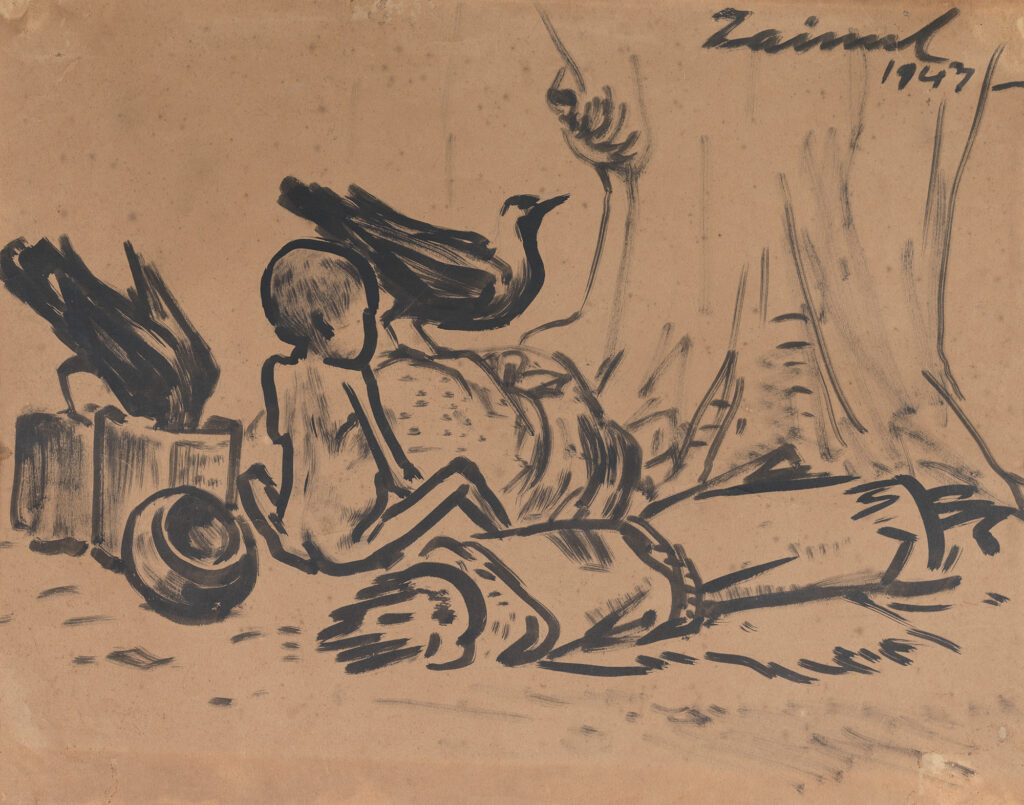
When the famine struck rural Bengal, Abedin was teaching at the Government Art College in Calcutta and was also a member of the Anti-Fascist Writers and Artists Association. In the Great Masters of Bangladesh series of monographs, he is described as being horrified to see peasants, especially from his native East Bengal region, huddled in Calcutta’s street corners with little clothing, “just waiting to die.” In many ways, Abedin’s portrayals of the starved peasant populace of Bengal pick at broader socio-historical anxieties around what separates the hungry from the human. At the time, they underscored the coloniser’s rejection of the peripheral population of British India, who became the Empire’s ‘non-human’ Other — the shameful evidence of its inhumanity. Public ire condemned the spectacular failures of the colonial and provincial governments of India after Abedin’s sketches were published in the 1945 Jan-Feb issues of the People’s War, the Communist Party of India’s English weekly, and Ela Sen’s 1944 book Darkening Days, which the British authorities banned.
The Bengal Famine produced a storm of patriotic cultural production by artists, later compiled into an album titled ‘Bengal Painters’ Testimony’ (BPT) published in 1944. It was sold for Rs 5 per copy for famine relief efforts. But among these artists, Abedin’s work alongside that of fellow-artist and Marxist activist Chittaprosad Bhattacharya, struck a particularly deep chord. Both Chittaprosad and Abedin’s sketches share a similar aesthetic — rendered in stark black ink and unflinching in their depictions of human suffering.
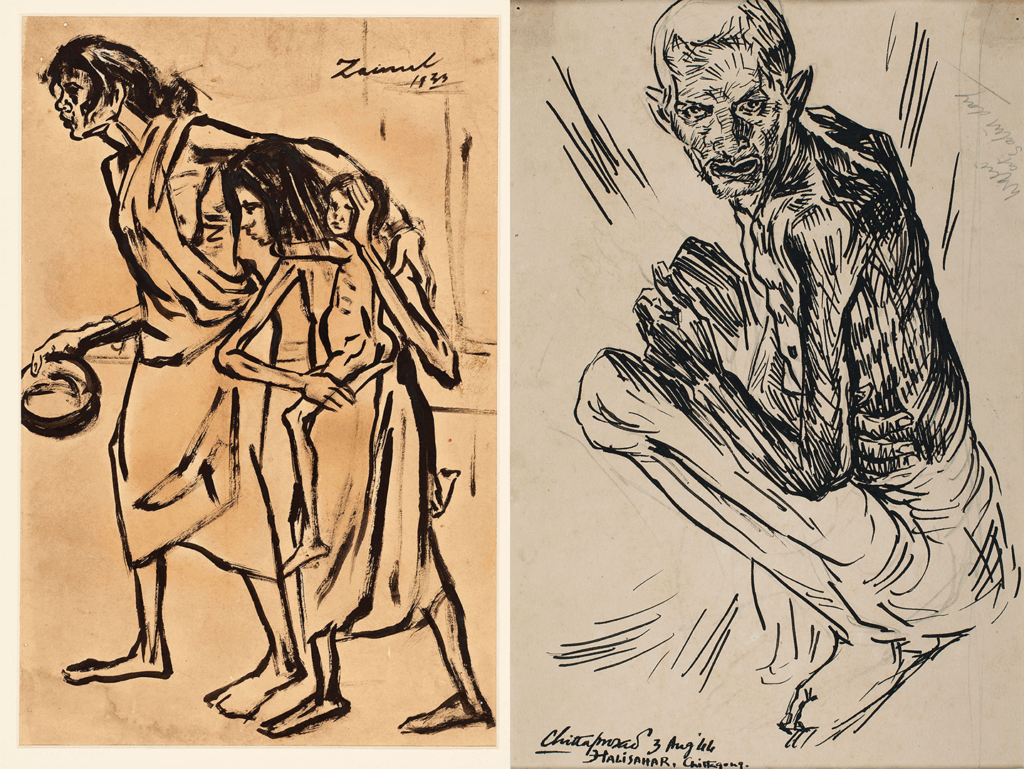
However, Chittaprosad’s works were overtly political, designed to fuel a social revolution through political posters in public spaces, newspapers like People’s War, and through books like Hungry Bengal (1943), based on his travels through famine-struck Midnapur. In contrast, Abedin’s work, with all the hallmarks of minimalist expressionism, registered at a more affective level. Even today, beyond the immediate circumstances of their creation, his sketches spark a visceral reaction in viewers. When Chittaprosad first introduced Abedin’s famine art to the larger public through the People’s War weekly, Sarojini Naidu would comment, “I have been greatly moved… They [the sketches] have an arresting power and truth that cannot fail to touch the heart and imagination of the least sensitive and compassionate amongst us… They are more eloquent in their poignant appeal… than the most eloquent and impassioned words.”
To create these empathetic portraits, Abedin had to abandon his artistic training in ‘academic realism’ that advocated using colour and tone to produce photographic, three-dimensional representations of people and objects. Instead, he charted new ground with a monochromatic style, foregrounding the corporeality of hunger and the anatomies of starvation. The artist’s vivid sketches emerged in the form of line drawings on cheap wrapping paper. Faced with a lack of proper art supplies, he used homemade Chinese black ink made from burning charcoal. Characterised by an unyielding starkness, this rudimentary but dynamic style of Abedin’s work from this period is bereft of any tonal modulations. The harsh, thick lines redirect attention to the skeletal forms as does the remarkable use of empty space to flatten background details in the drawings to favour the central subjects. His sketches of villagers not only came to represent the collective misery of the rural peasantry of Bengal at the time, but also deconstructed the famine as colonial violence etched on human bodies.
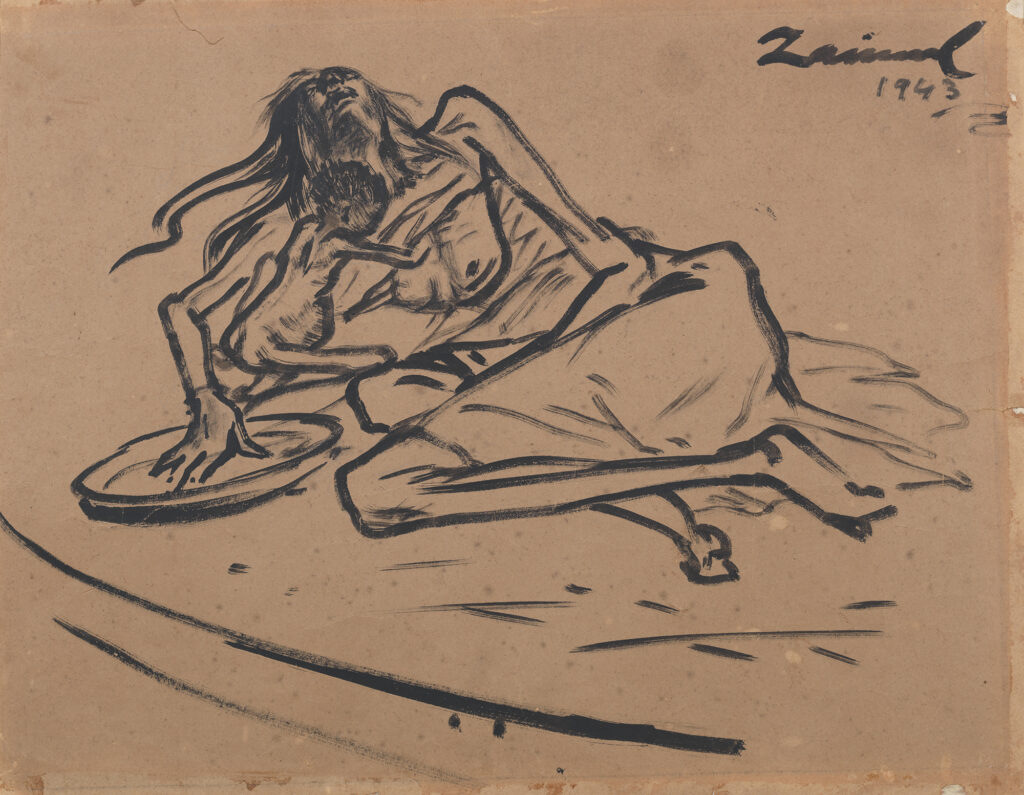
With disorderly, savage appearances — dehumanised by ravaging hunger and reduced to animal instincts of survival — the famine victims were the material outcome of the Empire’s so-called “civilising” mission. Devoid of any conventional aesthetic aspirations, the rapid brush strokes and the immediacy of the minimalist compositions capture Abedin’s sense of urgency as he went about creating a damning visual archive. It was as if he had anticipated how the famine, in its aftermath, would be minimised through strategic erasures or retellings in canonical Western accounts that still eulogise Winston Churchill and his celebrated ‘War Cabinet’. At the time though, the ‘social realism’ of Abedin’s art in the context of the transnational anti-fascist struggle became a very crucial aesthetic within narratives of dissent, domestically and worldwide.
The visceral imagery of emaciated bodies haunting the thoroughfares of Calcutta established that hunger could and was being enforced as a ‘subtle’ mechanism of torture by the colonial regime. This was at a time when the British authorities were being accused of violently suppressing the nationalist fervour around the ‘Quit India’ movement. This implicated the Western Allied powers, peddling narratives of “anti-fascism,” as well as the local, bourgeois class. Delving into the politics of the era, scholar Ahona Panda observes, “Empire had begotten the famine, and the nameless, faceless peasants who died in this imperial genocide complicated the nature of anti-fascist politics in the colony.” The exploitative and extractive nature of the colonial apparatus became too apparent to carpet sweep through diplomatic manoeuvres.
Entangling art and political protest, Abedin and his fellow artists would ultimately manage to destabilise both imperial and national hegemonic narratives that had tried, unsuccessfully, to relegate the plight of the nation’s subaltern subjects to the footnotes of history.
First published: May 15, 2026