-
ChicagoImpart Encyclopedia of Art. "Charpoy in Northwestern India." May 15, 2026. https://imp-art.org/articles/charpoy-in-northwestern-india/.
-
MLA"Charpoy in Northwestern India." Impart Encyclopedia of Art, May. 15, 2026, https://imp-art.org/articles/charpoy-in-northwestern-india/.
-
HarvardImpart Encyclopedia of Art (2026) Charpoy in Northwestern India. Available at: https://imp-art.org/articles/charpoy-in-northwestern-india/ (Accessed: 16 October 2026).
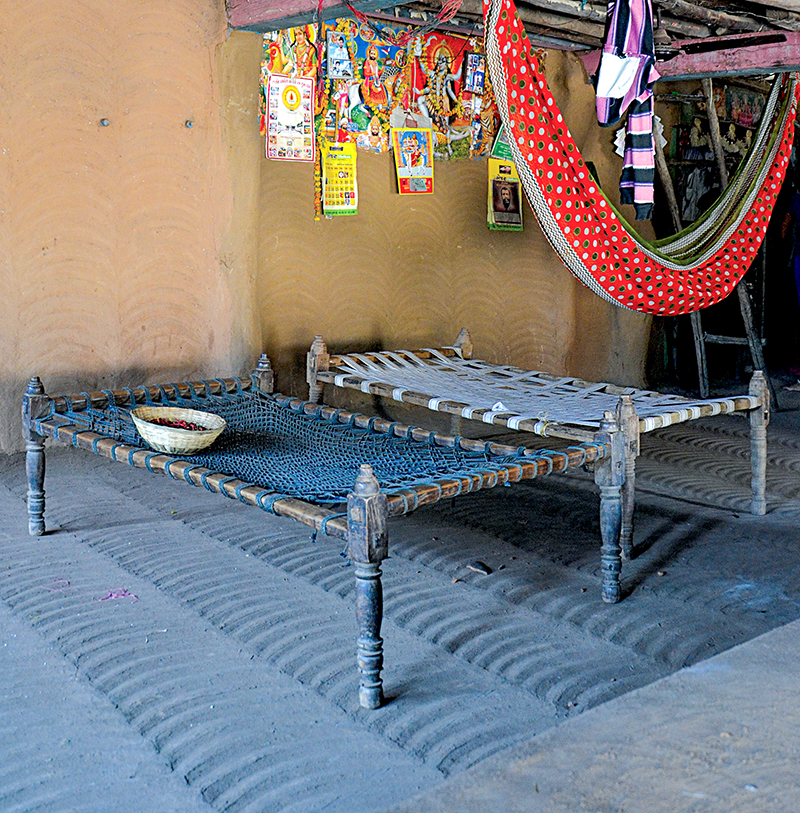
A wooden bedstead with a woven base ubiquitous in the Indian subcontinent, the charpoy is among the most common forms of vernacular furniture in northwestern India, where it is known regionally as mausa, khaat, macha, manja, palang, dholio, dholni, or khatlo. It is used extensively in both private and public spaces, for sitting, sleeping, resting, and as a versatile surface for other household activities.
Terminology
The words for the charpoy in northwestern India vary with regional dialects, and reflect some associated design variations. In Rajasthan the charpoy is known as khaat, mausa, or macha; in Punjab as manja; in parts of Haryana as khaat, palang or pilang; and in Gujarat as khatlo. The term macha is also used in Punjab and Haryana to refer to larger-than-average charpoys used in public spaces and meant to seat many people. The Hindi word charpai is also widely used across states. In Saurashtra in Gujarat, a variant of the charpoy features heavy, turned wooden legs and is known as dholio; the feminised term dholni is used for a modification of the dholio with slimmer legs and ornamental carvings. Across regions, diminutives of these terms are used for smaller versions used by children: khatli in Gujarat, machli in Rajasthan, manji in Punjab and khatola in Haryana. The webbing of the charpoy is known as munjh in Rajasthan, and vaan in Punjab and Haryana.
Design and construction
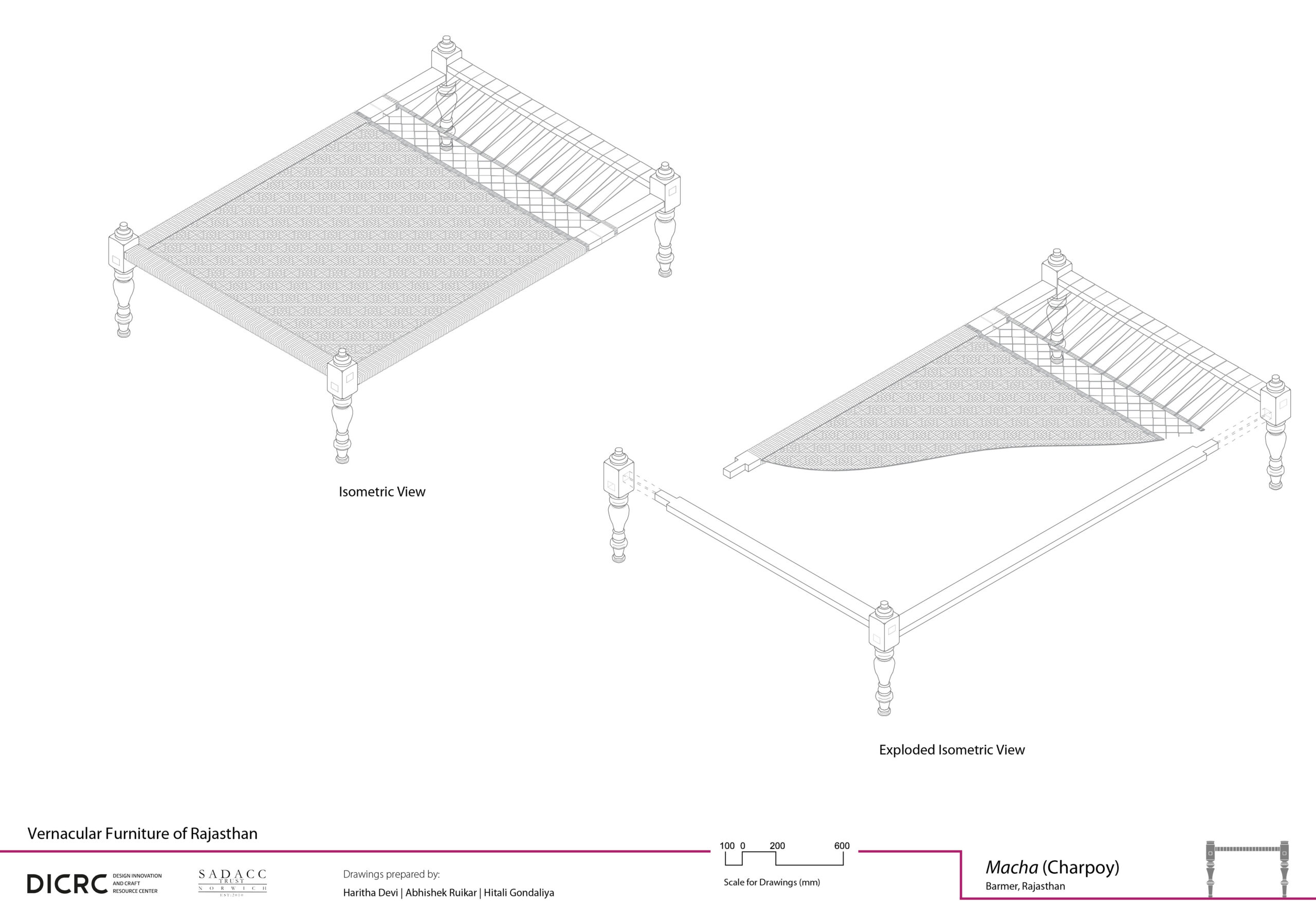
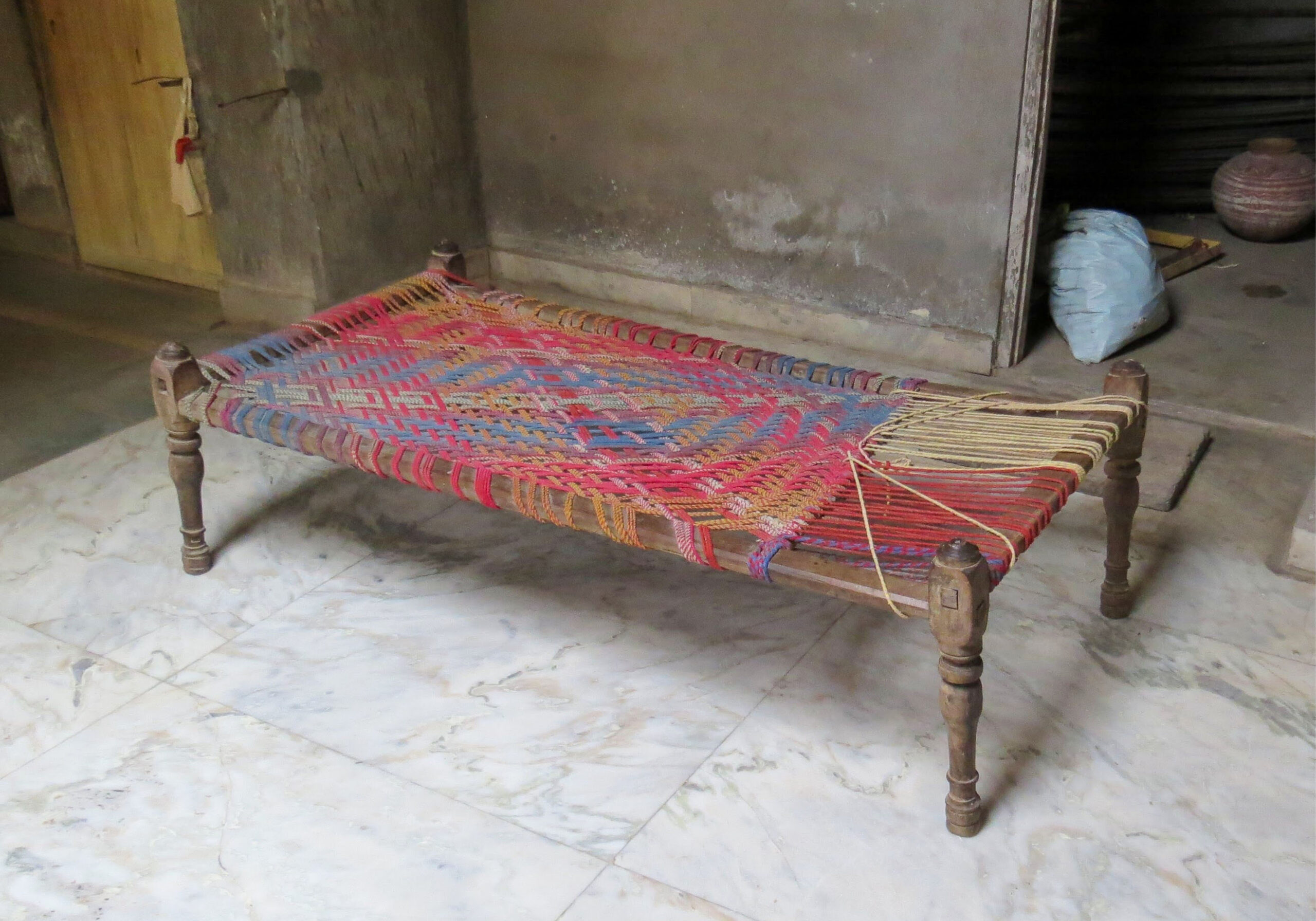
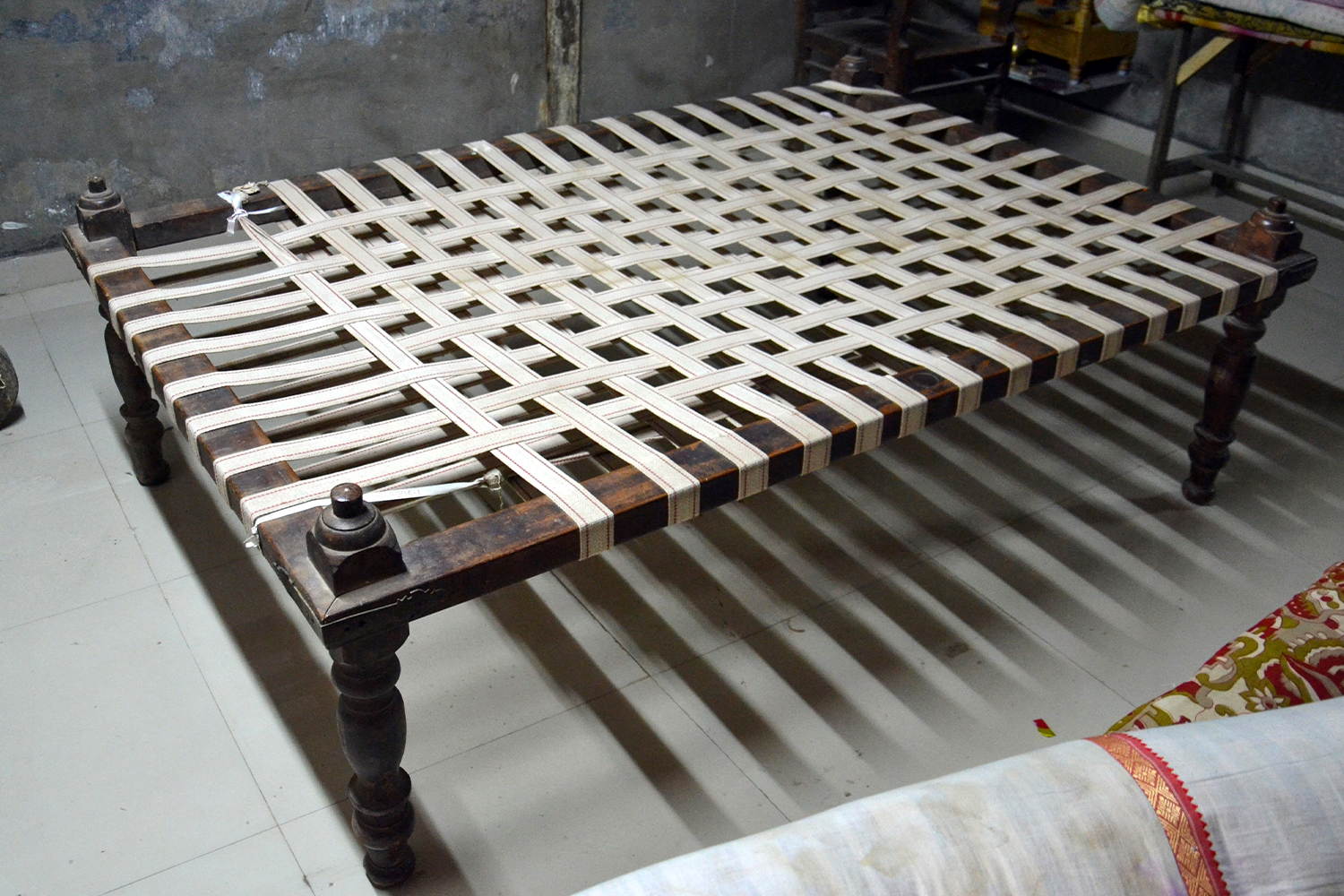
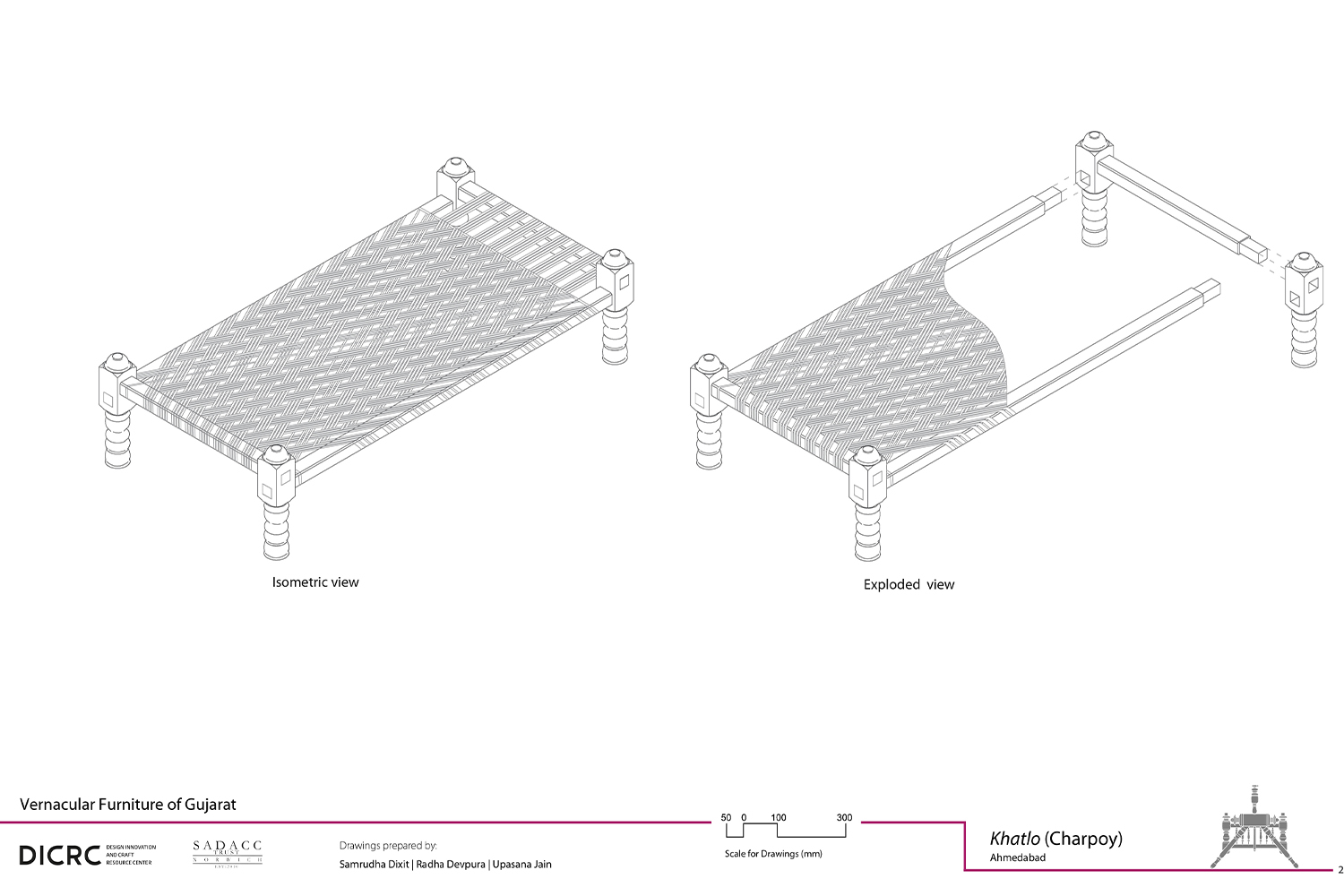
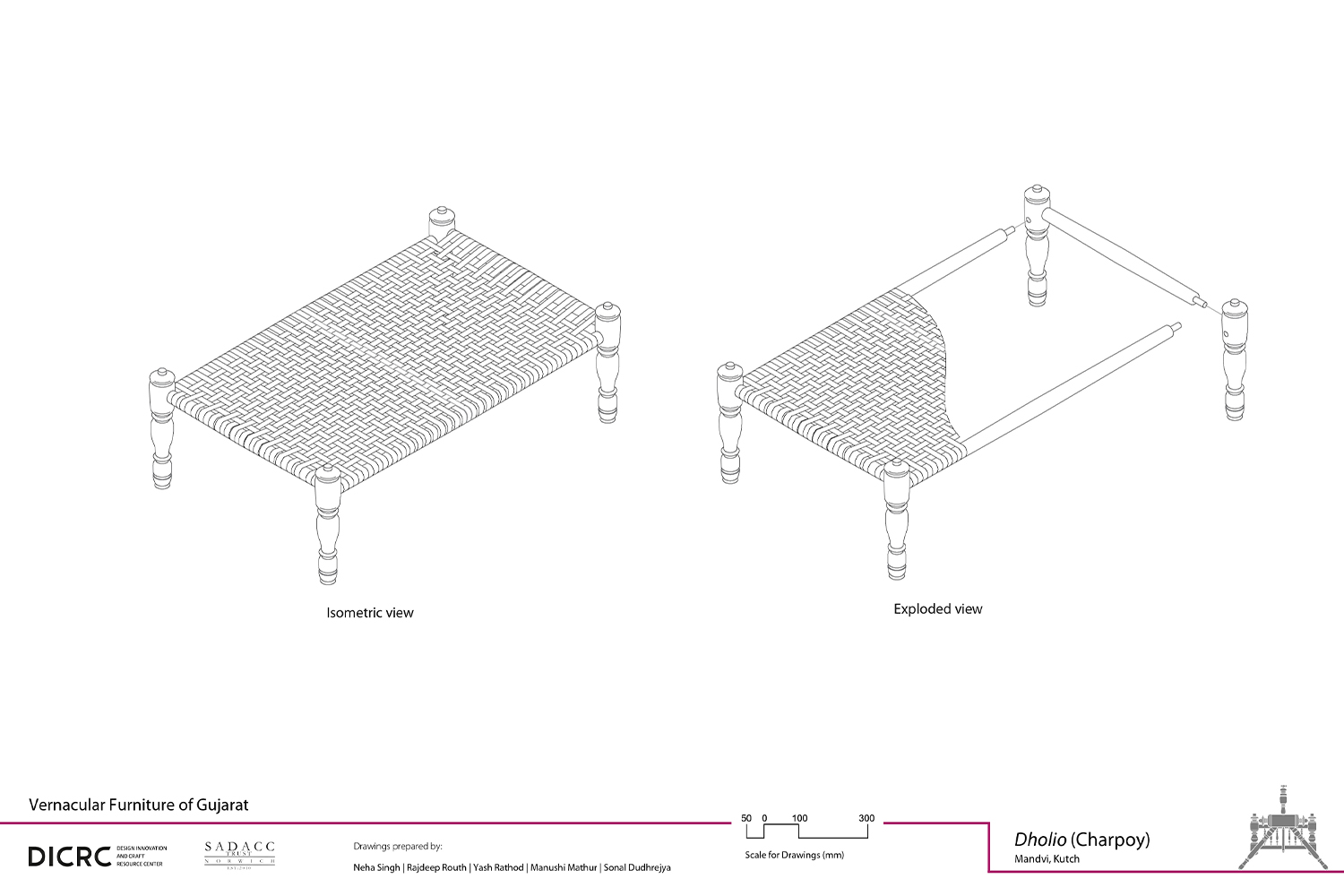
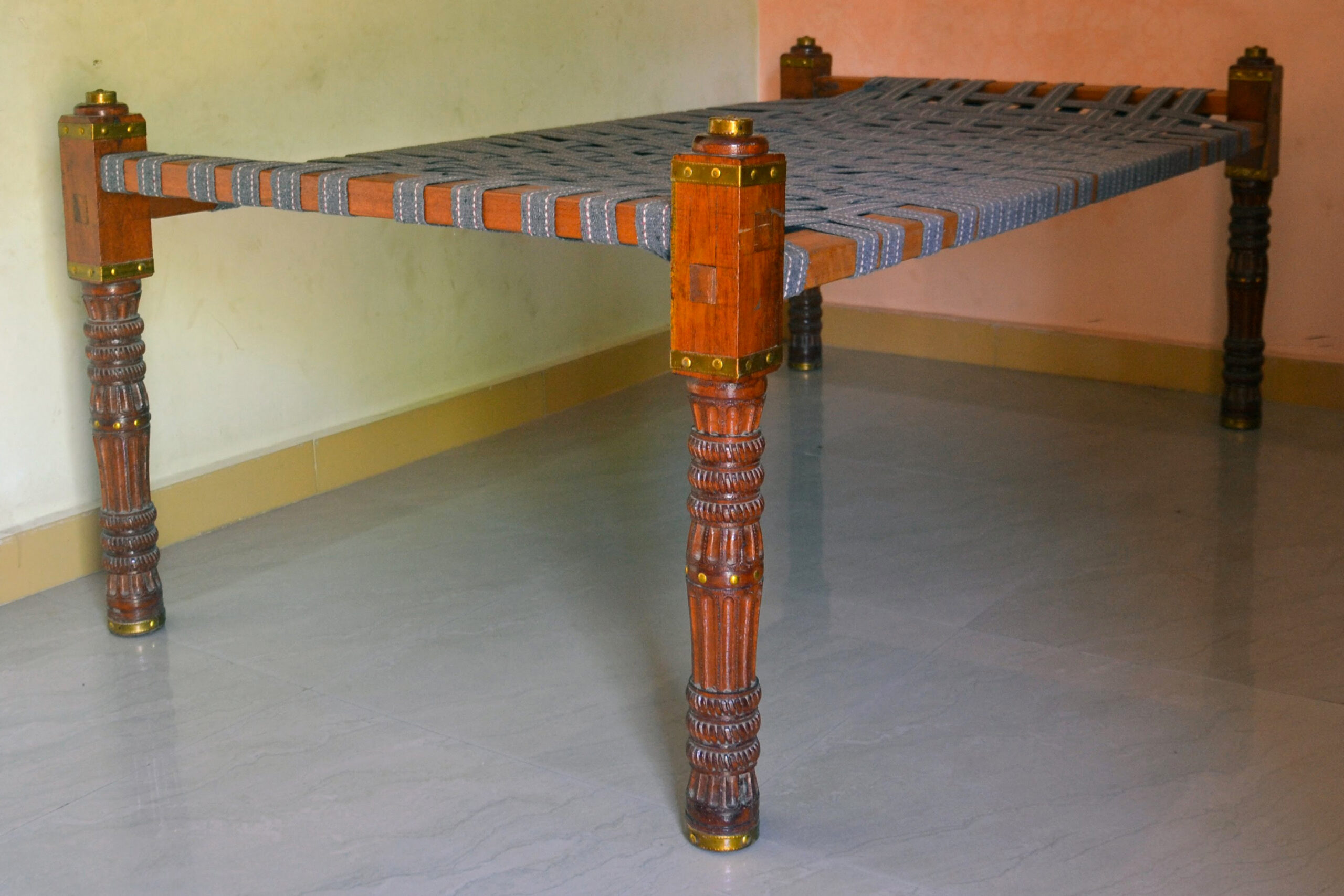
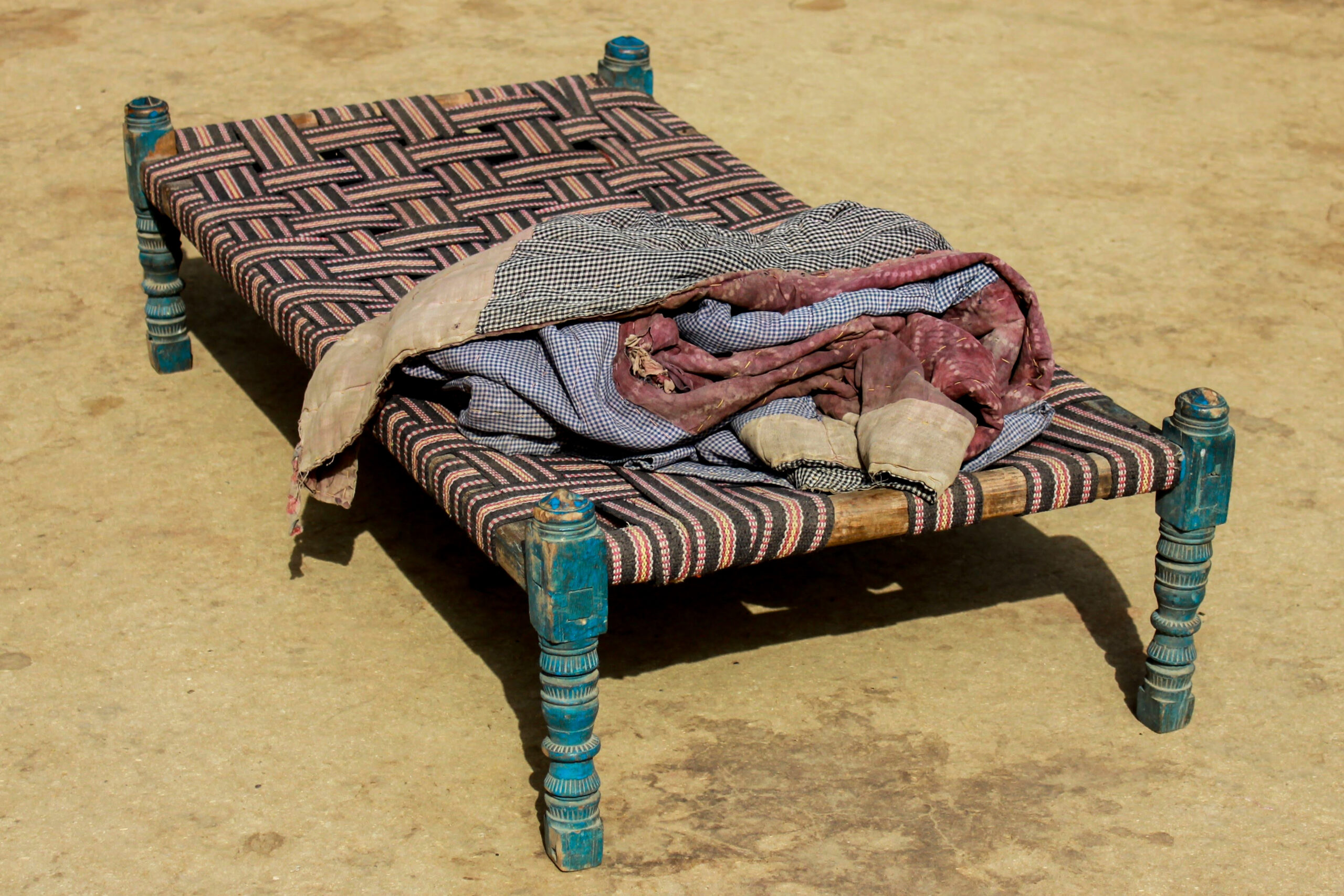
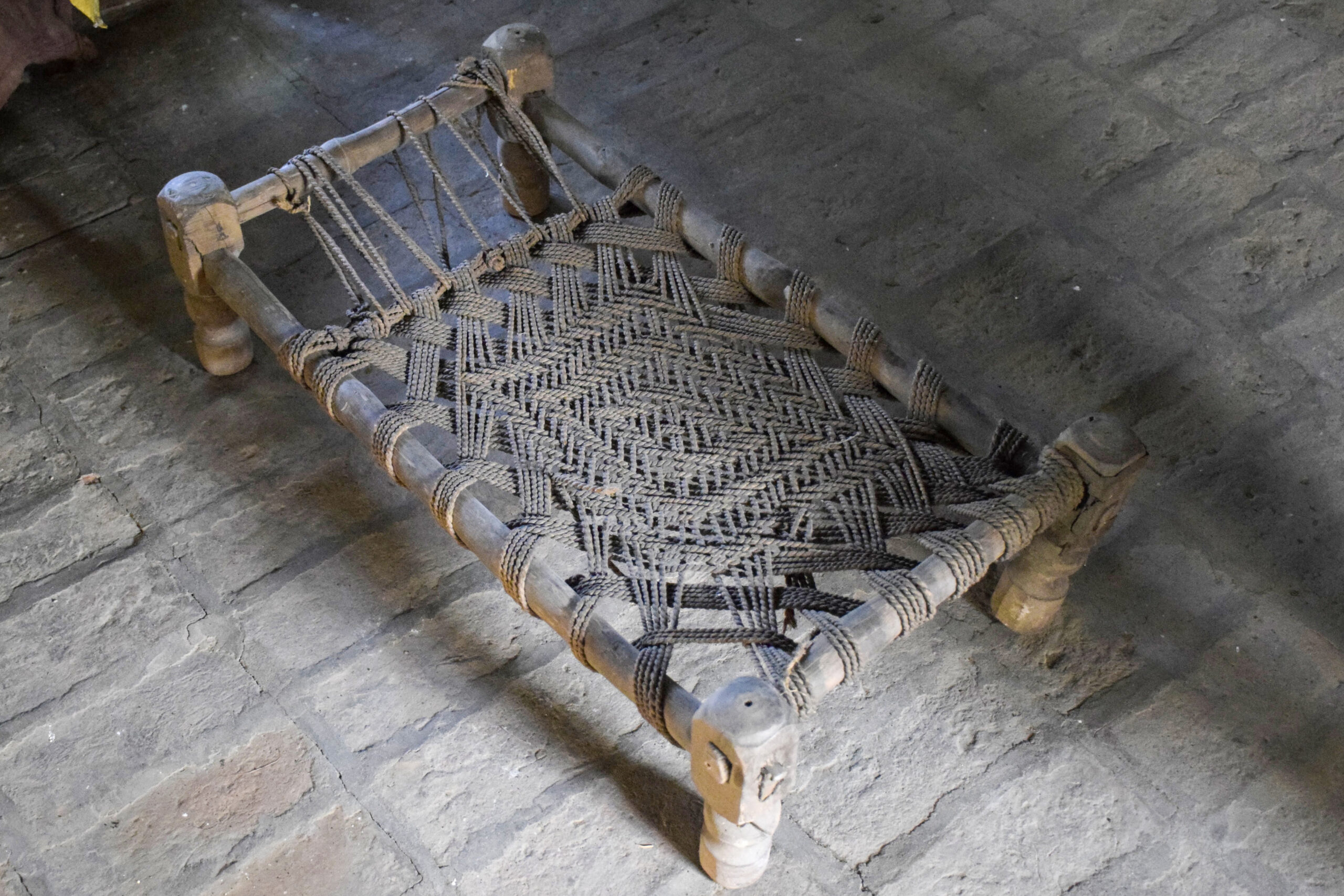
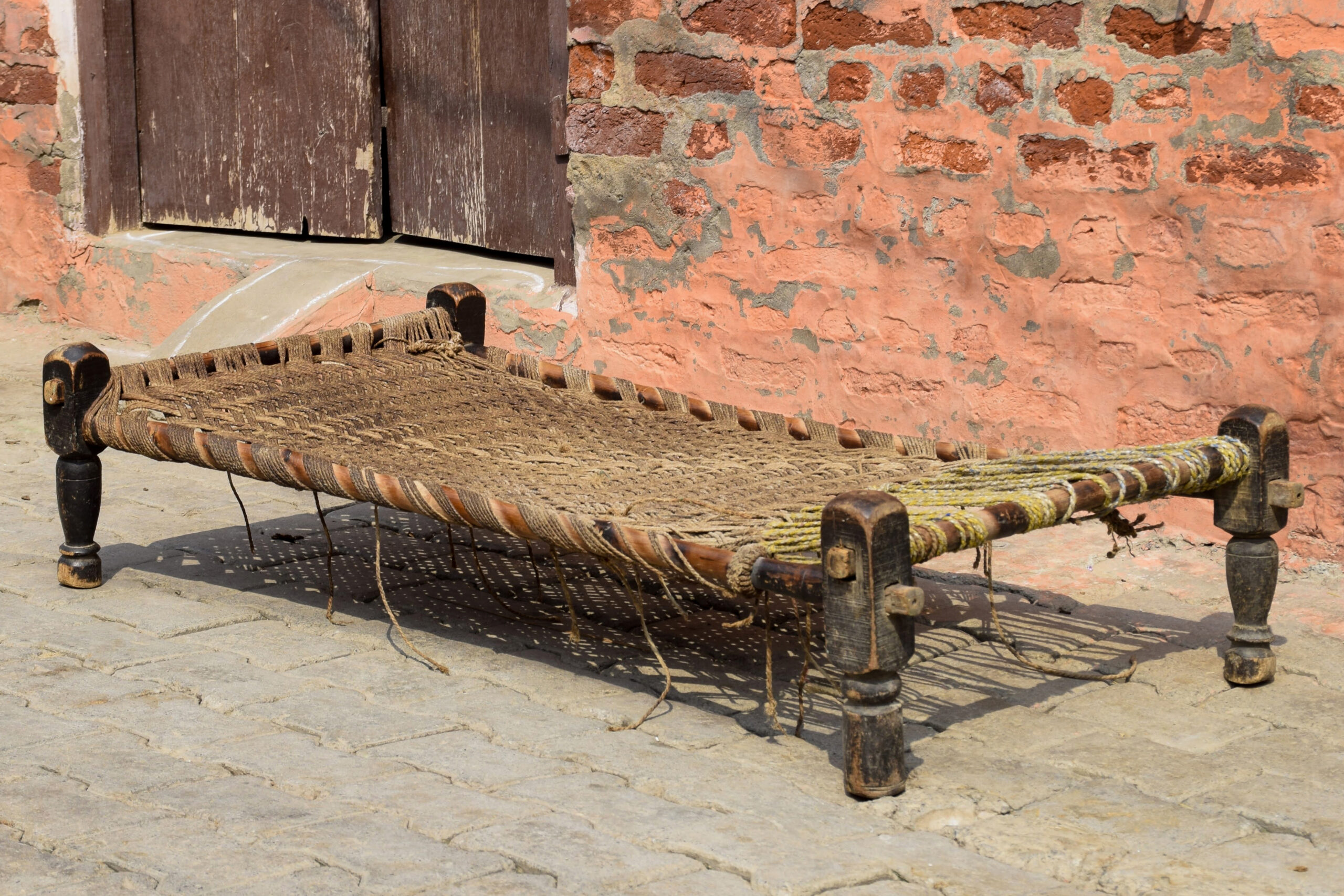
A charpoy is a simple bedstead comprising a rectangular wooden frame with four turned or carved legs and a woven top, usually accommodating a single person lying down and multiple people seated. The frame members are fitted into the legs using mortise and tenon joints, with the width-wise members joined above the long members. The level difference creates a shallow curve in the webbing of the charpoy and provides support for the neck and back while lying down. The perforations in the weave allow for the circulation of air, an advantage in hotter seasons; during winters, a mattress and quilts may be used over the charpoy.
The wood used varies by region: in Rajasthan, teak (Tectona grandis) is often used; in Punjab and Haryana, kikar (gum arabic, Vachellia nilotica), kaali talli (Indian rosewood, Dalbergia sissoo), sal (Shorea robusta), deodar (Cedrus deodara) and walnut (Juglans regia) are used, often sourced from the beams of abandoned houses. Lighter wood may be used for charpoys that are meant to be portable — semi-nomadic pastoral communities carry their belongings, including charpoys, when moving from one settlement to another; agrarian families also prefer lighter charpoys with sparse webbing, which can be easily carried back and forth from the fields. Child-sized charpoys in Rajasthan, Punjab and Haryana may be constructed from bamboo to make them lightweight.
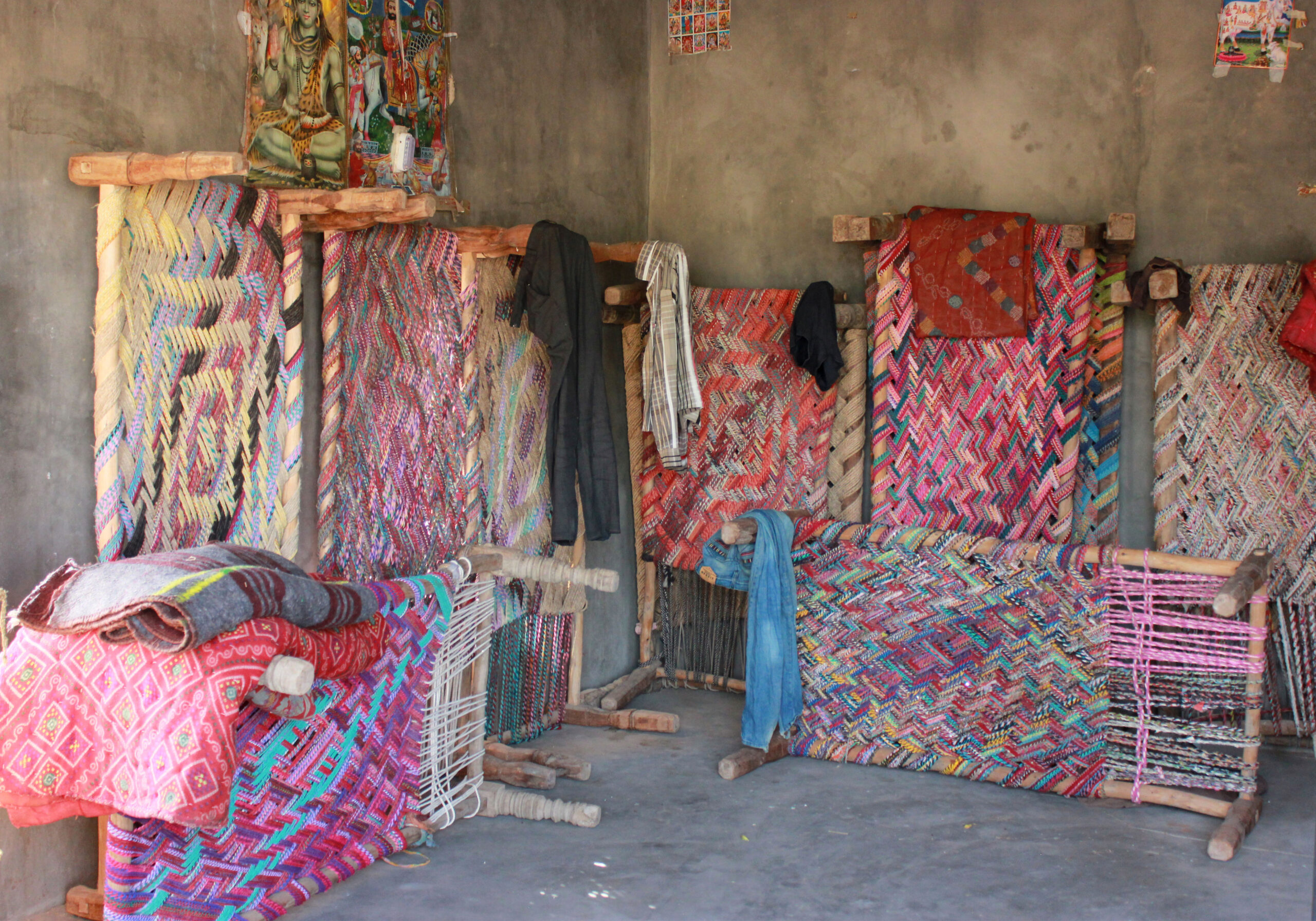
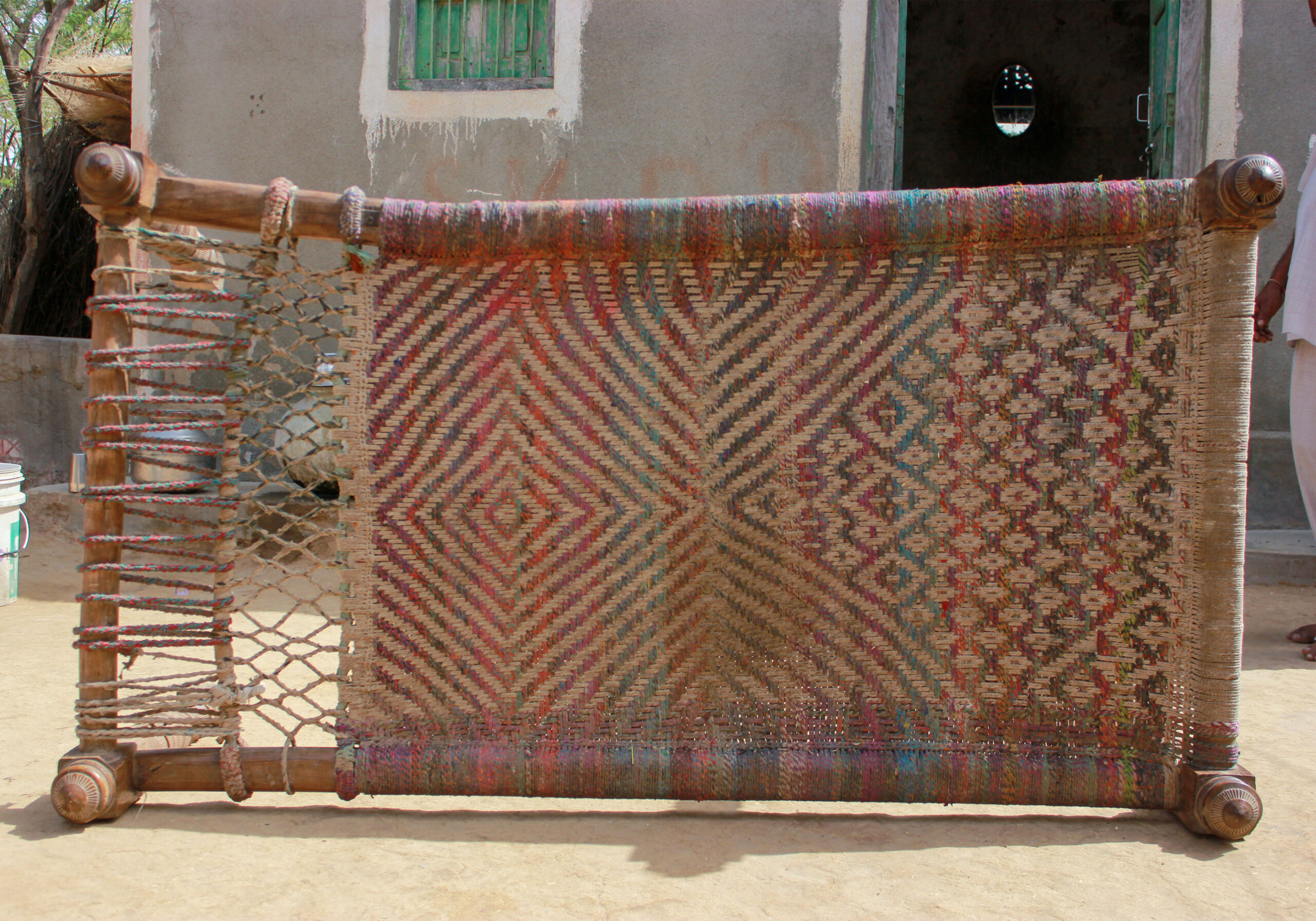
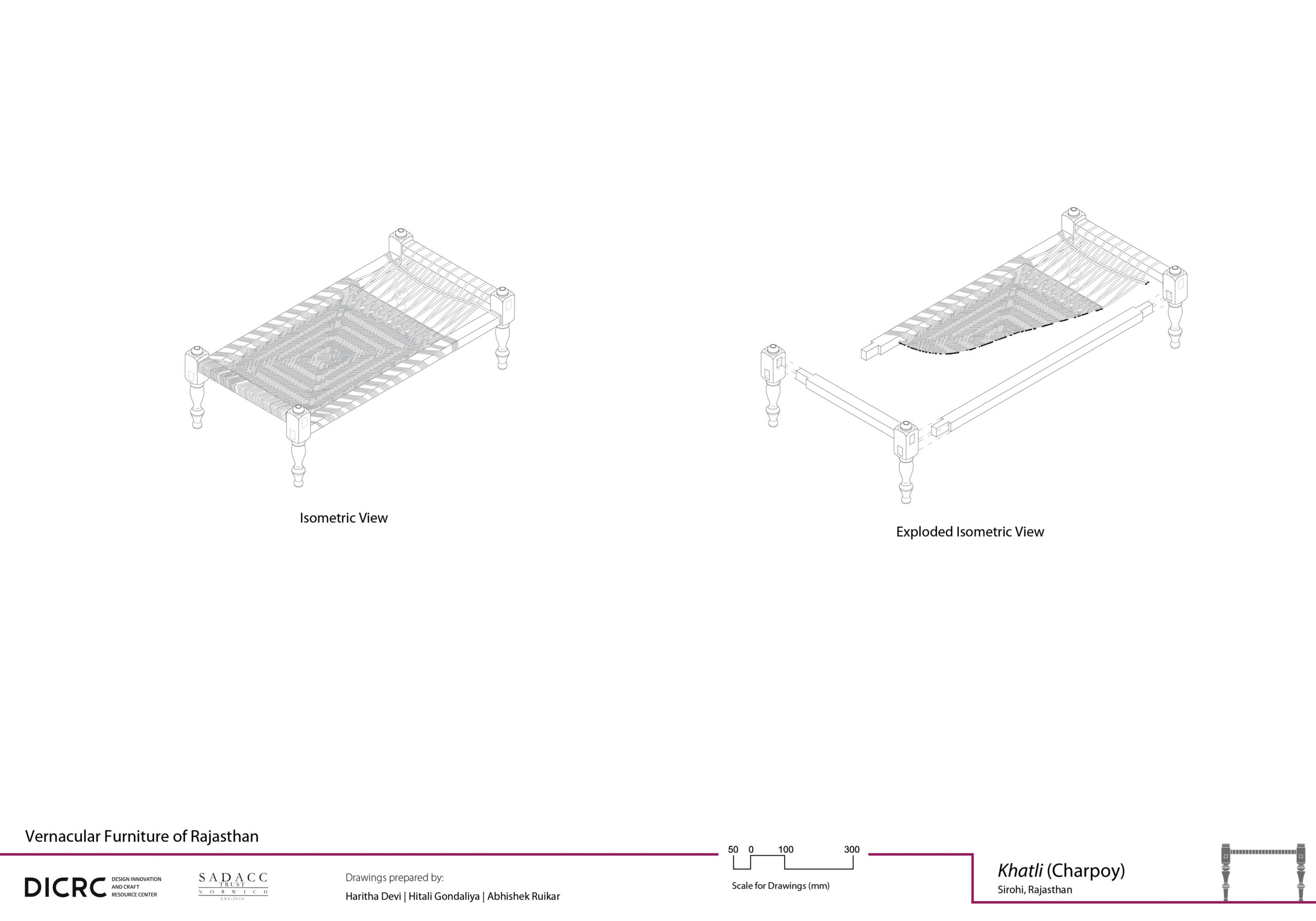
A carpenter is often commissioned to build a charpoy, as is the case with other domestic furniture and woodwork. In Punjab and Haryana, the component parts of the charpoy are made by separate groups of people — the legs by woodturners and the frame by carpenters. Adivasi people living in remote areas often buy the legs and frame members from a local woodcutter and have them assembled by itinerant carpenters when they visit their village. Low-income families often hand-carve relatively crude wooden members to slot into legs bought from a carpenter, or use charpoys made from hard-wearing metal. The webbing may be woven either by professional weavers or by members of the family themselves; the design of the weave varies greatly depending on regional custom and personal preferences. Readymade charpoys are also usually available for purchase at village fairs.
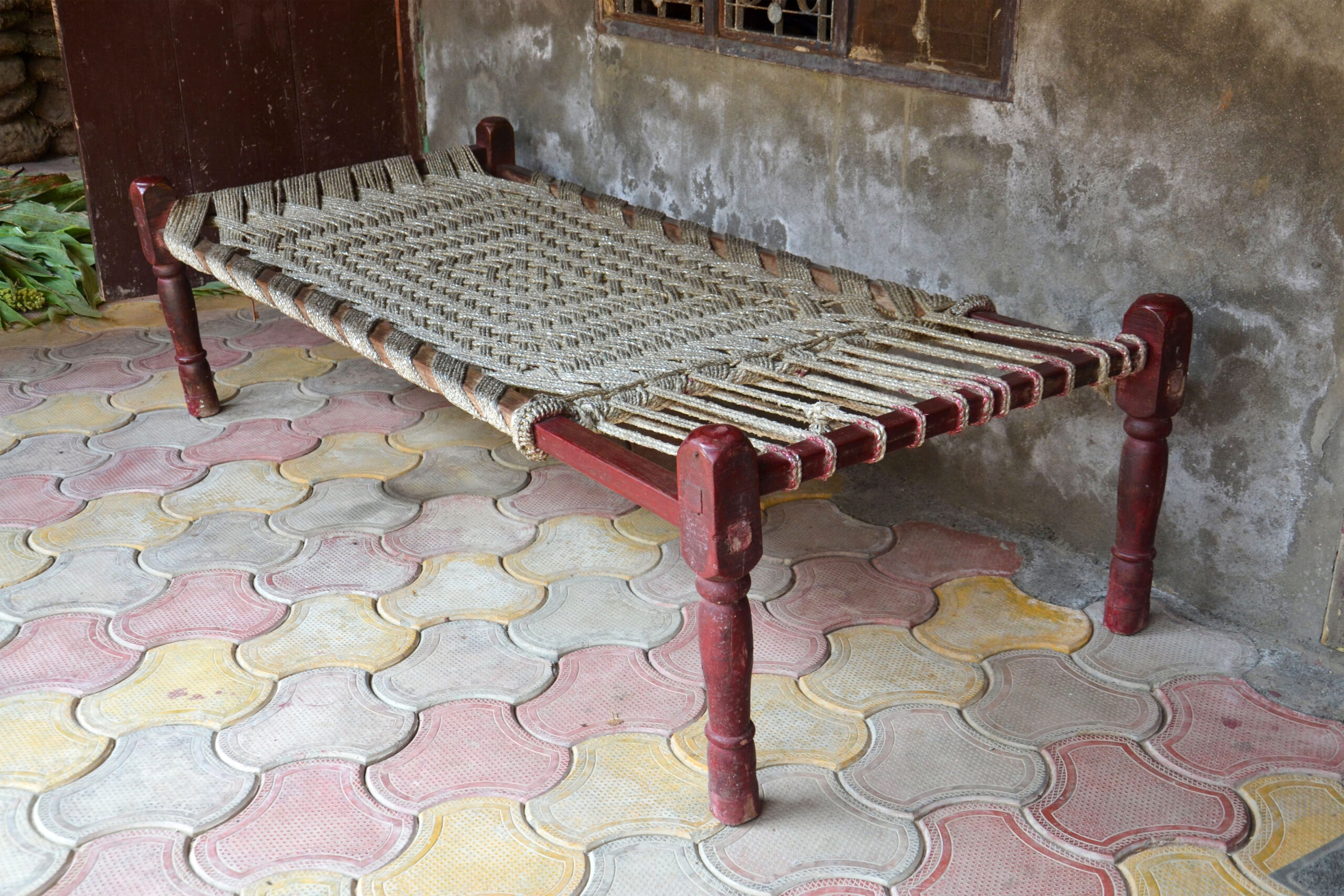
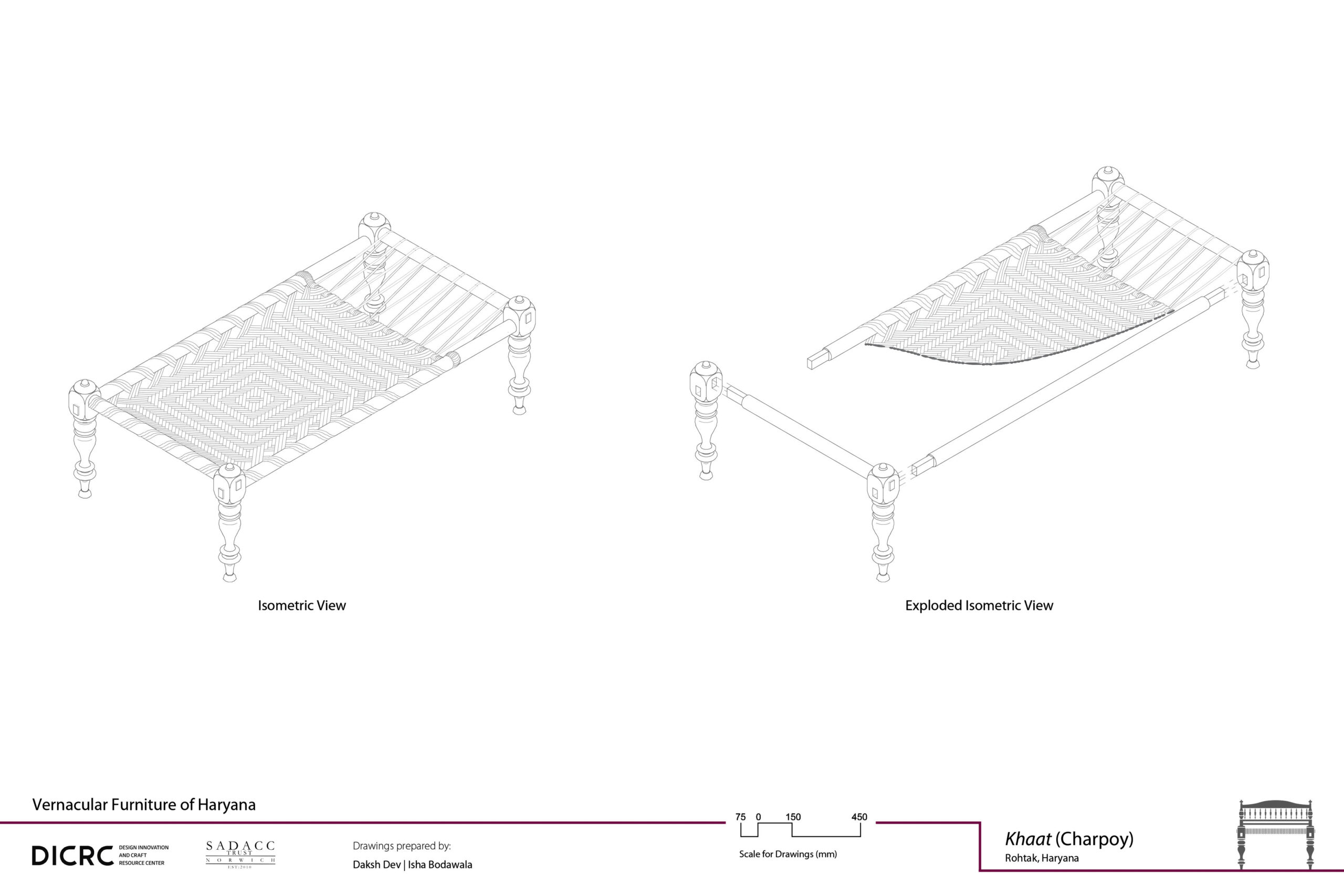
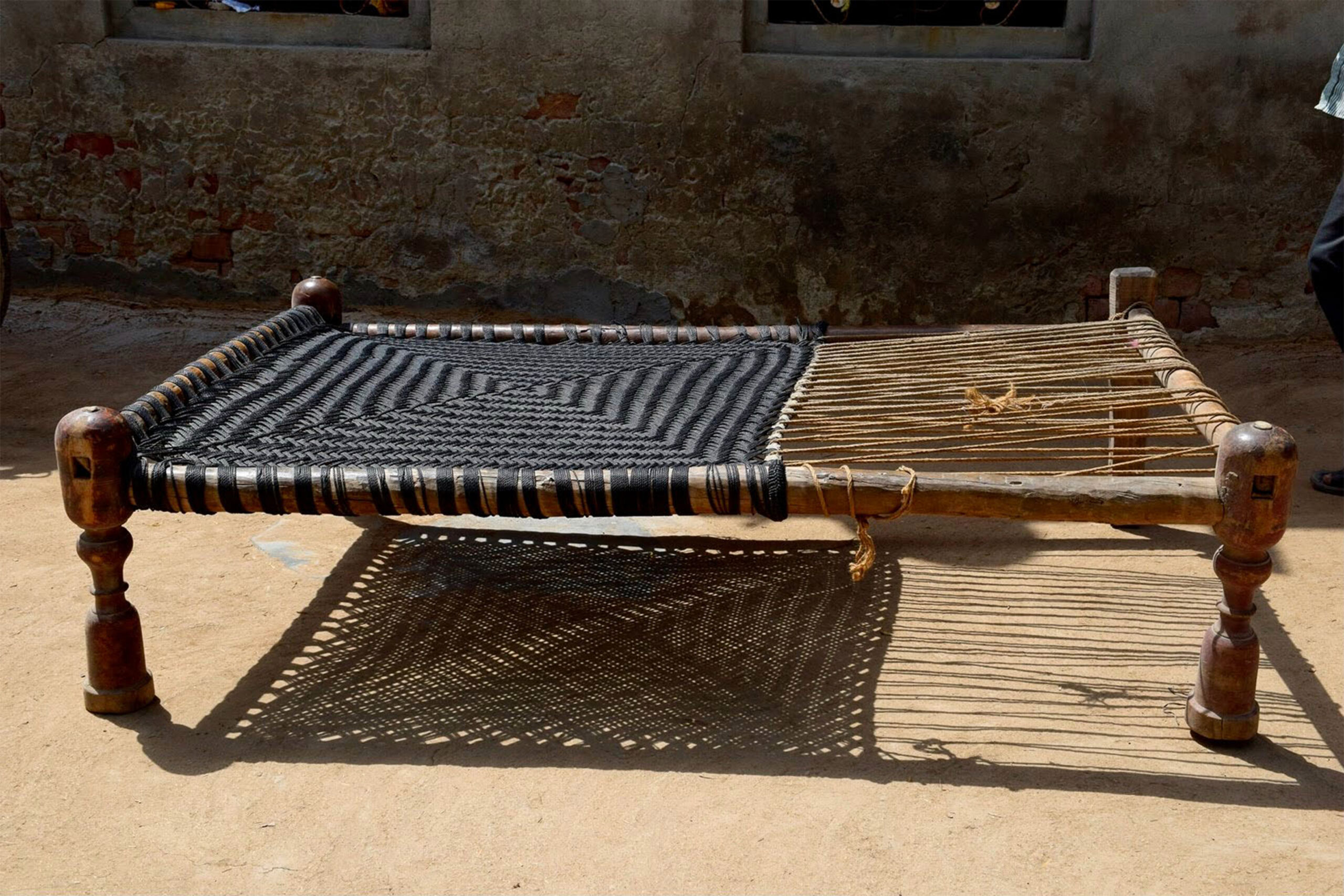
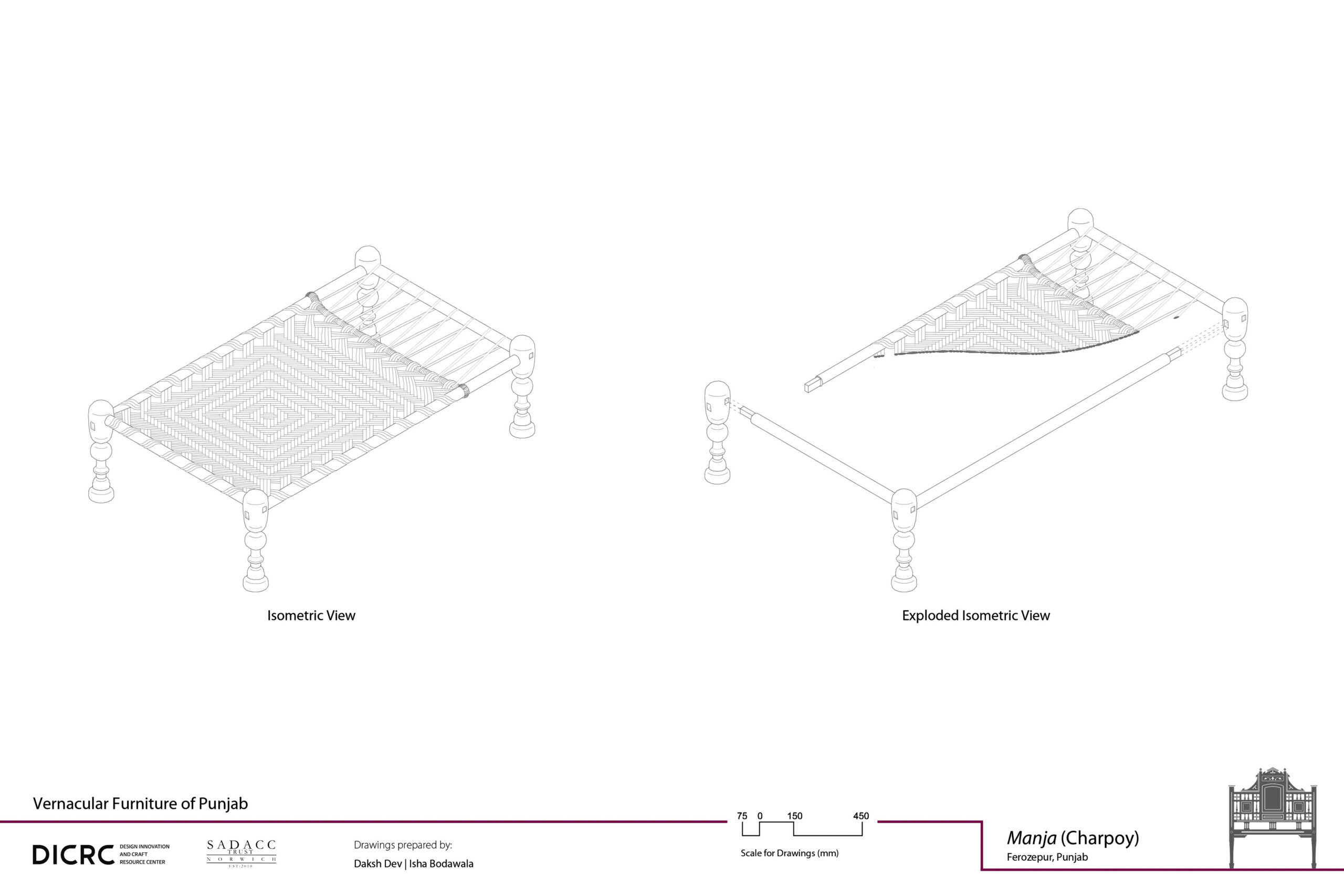
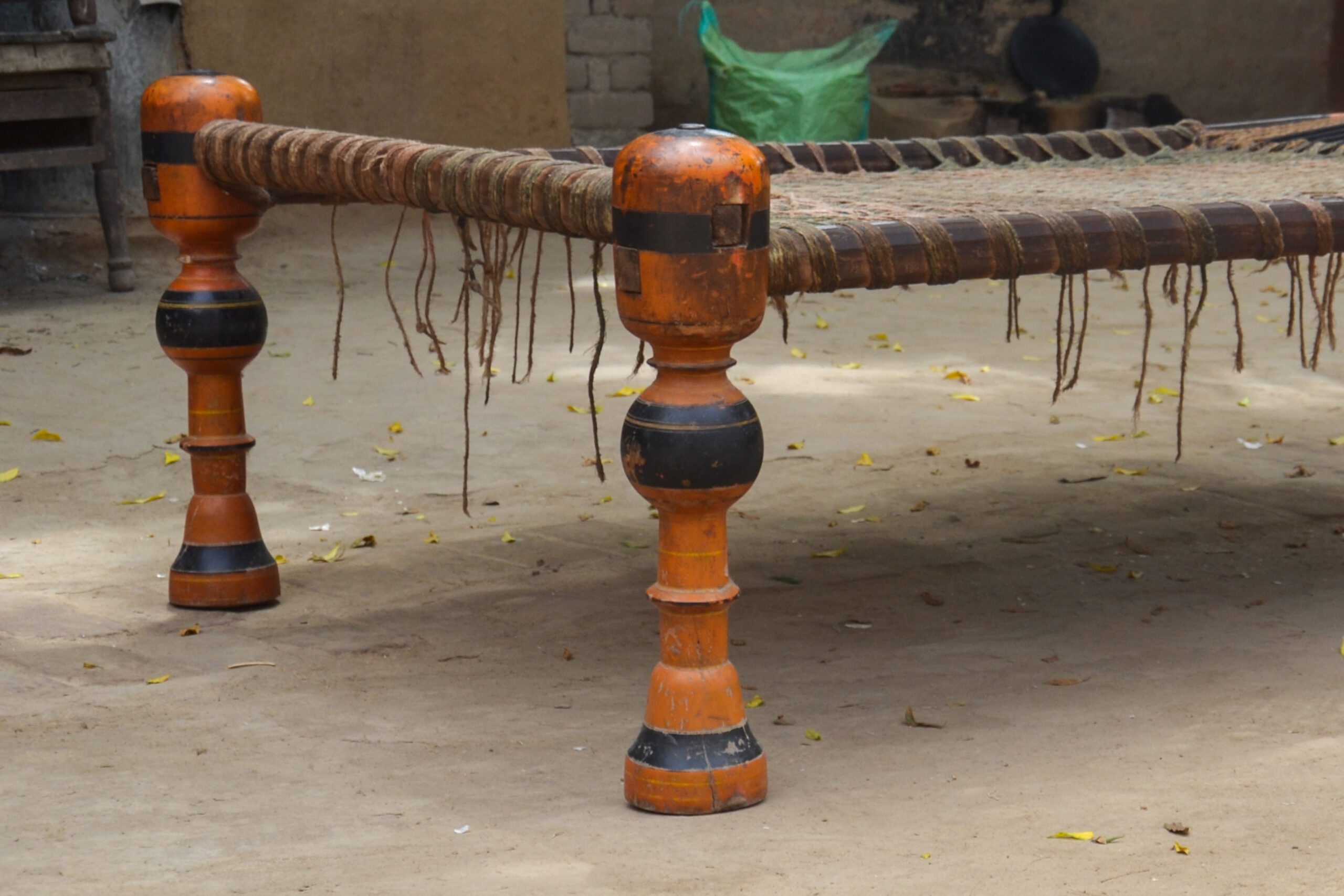
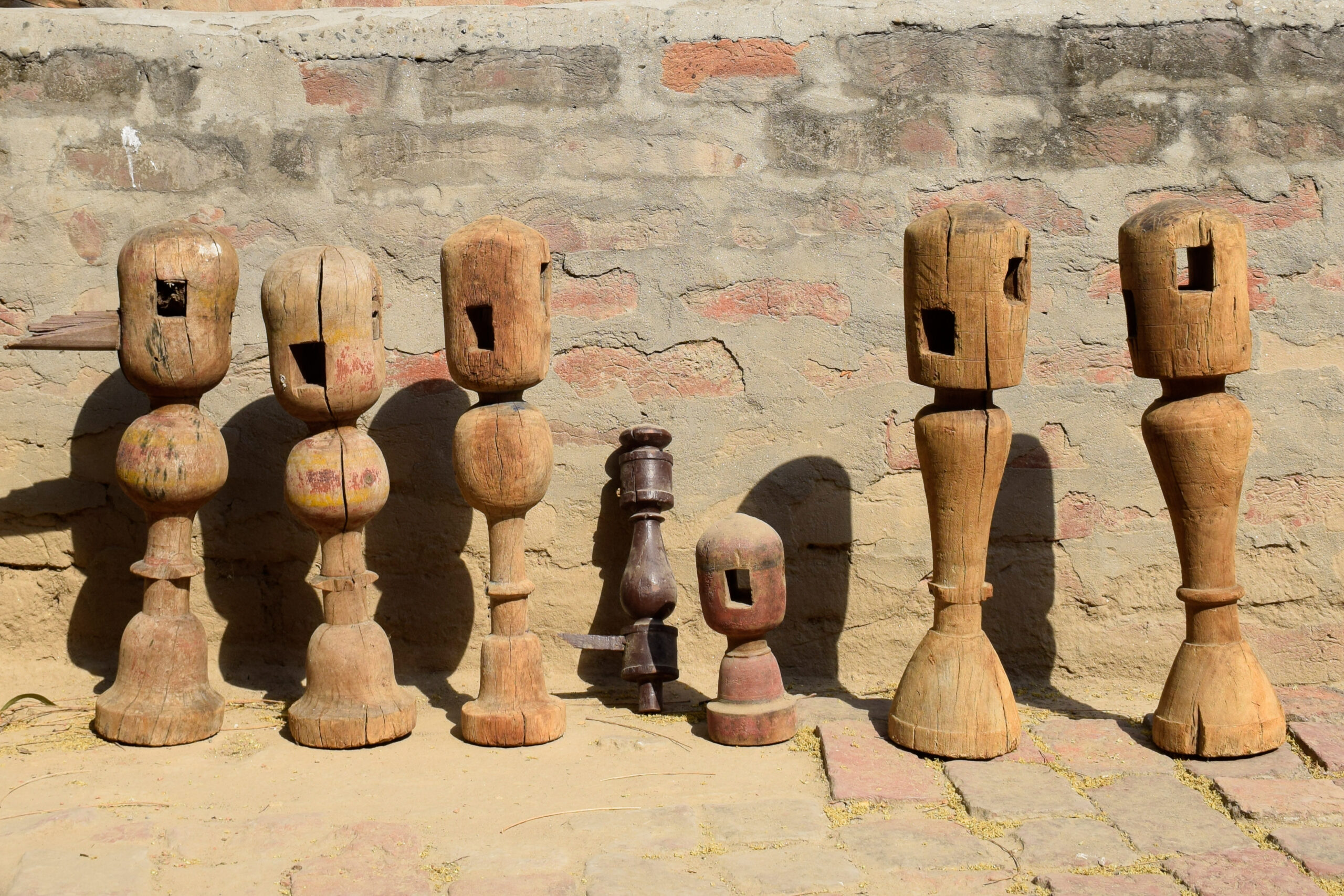
In the case of the Saurashtrian dholio and dholni, made today in only one workshop located in this field research, the legs are always turned rather than hand-carved, and are significantly thicker and heavier than those of the typical charpoy. In Punjab, lathe-turned legs are more common while in Haryana, most are made by hand. In both regions, the top section of the leg that attaches to the frame is usually cylindrical while the shaft below it begins as a bulbous or conical form and then tapers. The feet, while flat at the bottom, may take a range of shapes, including square or a pot-like circular form. A charpoy in a Rajput palace could be ornately carved and gilded in silver, or may take the form of a shikar (‘hunt’) khatlo. Historically carried by Rajput communities during hunting expeditions, the shikar khatlo has metal rings fitted at each of its corners to allow it to be hung from a tree, safe from wild animals at ground level.
Ornamentation
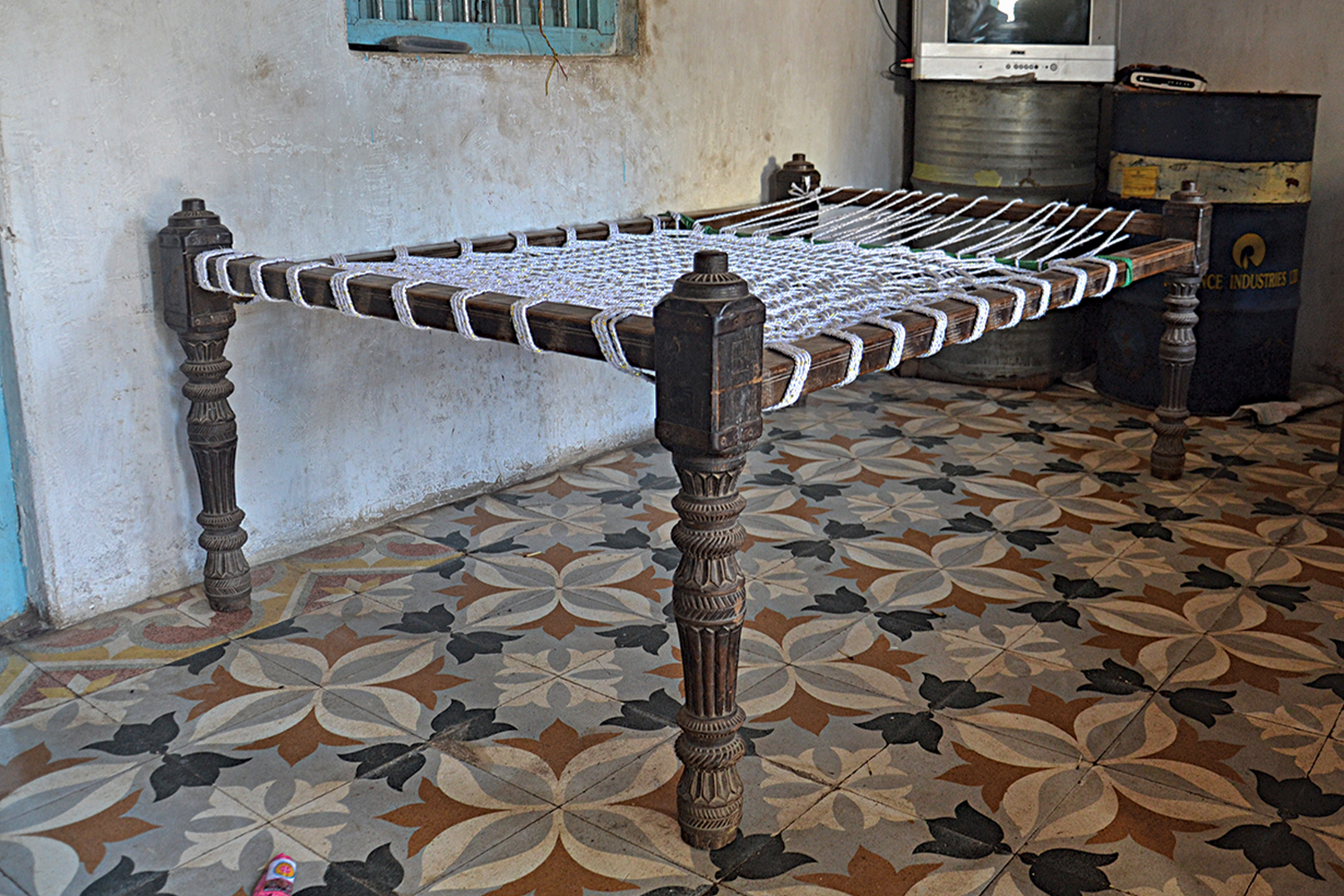
The charpoy’s ornamentation varies greatly depending on the community affiliation, status and wealth of its owners. Some charpoys, such as those of Adivasis in eastern Gujarat, are plain and unornamented; others are more ornate and may be polished, painted, lacquered, or carved with designs. The dholio and dholni of Saurashtra usually bear distinctive ornamentation: the former often features red lacquer on the legs, with yellow and green bands, and the latter is usually painted or varnished, and carved with designs intended to resemble the anklets worn by Saurashtrian women. Such carvings are also seen on wooden porch columns of homes in the region. More recent dholnis may also have bands of stamped brass or aluminium on the legs. In Punjab and Haryana, charpoy legs are often painted in red, maroon, green, orange, black, and yellow. Lacquered charpoy legs are seen more often in Punjab and were once imported from artisans in Kashmir; older specimens, mostly pre-Partition, also feature lacquering on the frame in addition to the legs. Some of these feature a red-and-black lacquer that was commonly used by Muslim artisans, many of whom migrated into Pakistan during Partition. In the Kutch region of Gujarat, charpoy legs are covered in intricate geometrical patterns made using the region’s distinctive chip-carving method, which is also used on other furniture and wooden architectural elements such as columns, doors or windows. The webbing of such charpoys, made with coloured cotton ropes, is woven to complement the patterns on the legs.
Webbing
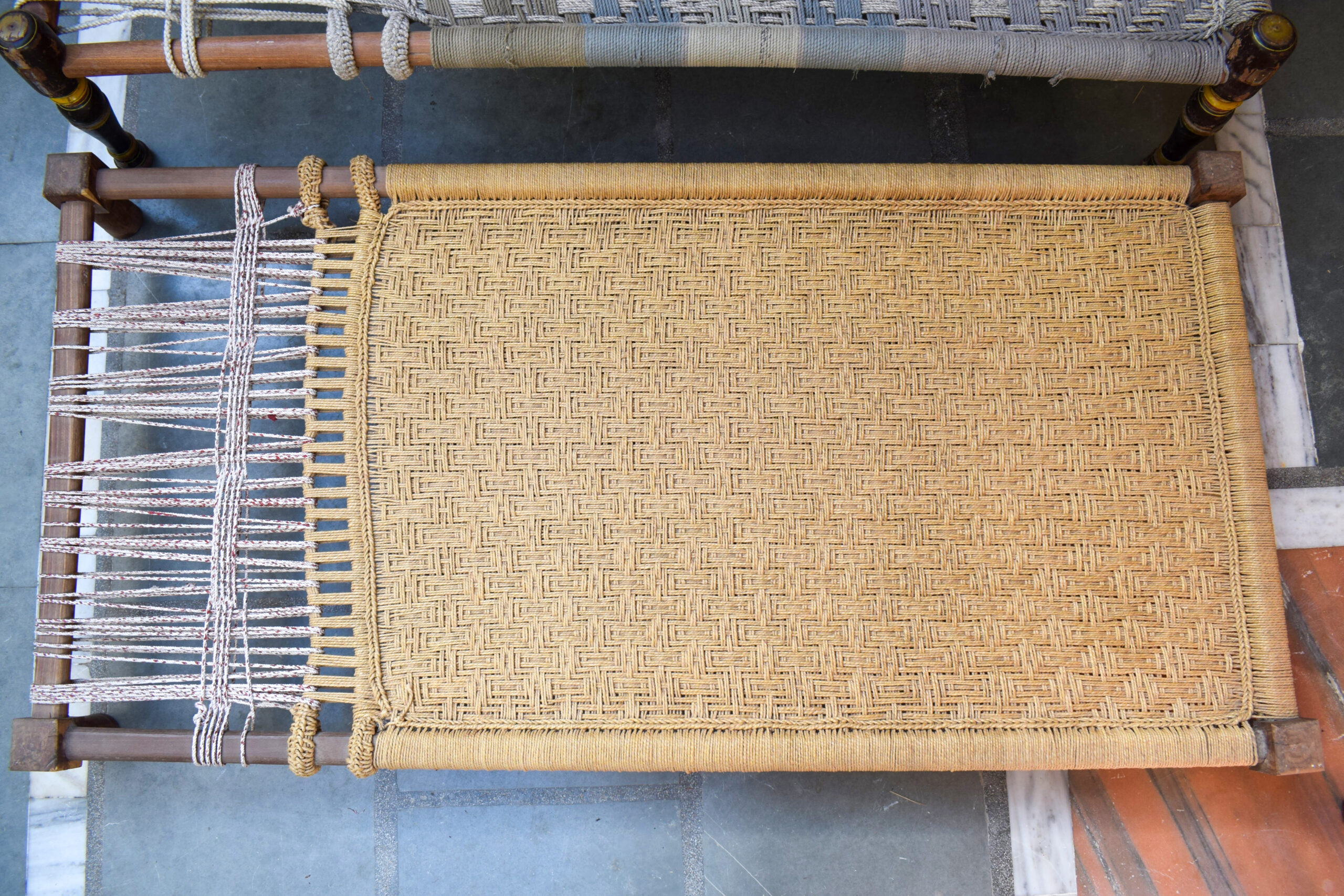
A tight webbing typically covers four-fifths of the charpoy frame. In the remaining space, which forms the charpoy’s ‘tail’, the warp or lengthwise ropes of the weave are exposed; these are used to adjust the tension of the webbing when it loosens from use. In certain variations of the Gujarati charpoy, the webbing covers the entire frame. The density of the weave may be tight, with little perforation, or relatively sparse, with larger gaps.
A range of materials may be used for the webbing. Older charpoys in Punjab and Haryana often feature webbing made of munjh grass (Saccharum munja), dried date palm leaves (Phoenix dactylifera), or leather. Common materials today are typically cotton or jute ropes, coir, and reed. Straps made of nylon or recycled waste fabric may also be used. In Gujarat, webbing may be made of tapes of cotton or silk yarn. The cotton yarn used for charpoy webbing is often spun at home using a spinning wheel and spool; thicker rope is made from this yarn using spindles and a frame loom. If done at home, it takes approximately five days to complete weaving a charpoy’s webbing and about five kilos of raw cotton is required. In Haryana, only men undertake this task. In Rajasthan, a twined rope (chitra) made from the stems of the aank plant (Calotropis gigantea) is often used for the webbing. The stems, cleared of all branches, are twisted together by hand to make them pliable, and then bundled together. The bundles are soaked in water and then sun-dried. The dried bundles are tied to a tool called dhero or takdi — comprising a wooden spindle with a metal rod — and spun to make the rope in different lengths, with the dhero also doubling as a spool for the rope. In Punjab and Haryana, the wooden members of the frame are sometimes covered with a cloth, and the webbing woven over it, to prevent wear and tear.
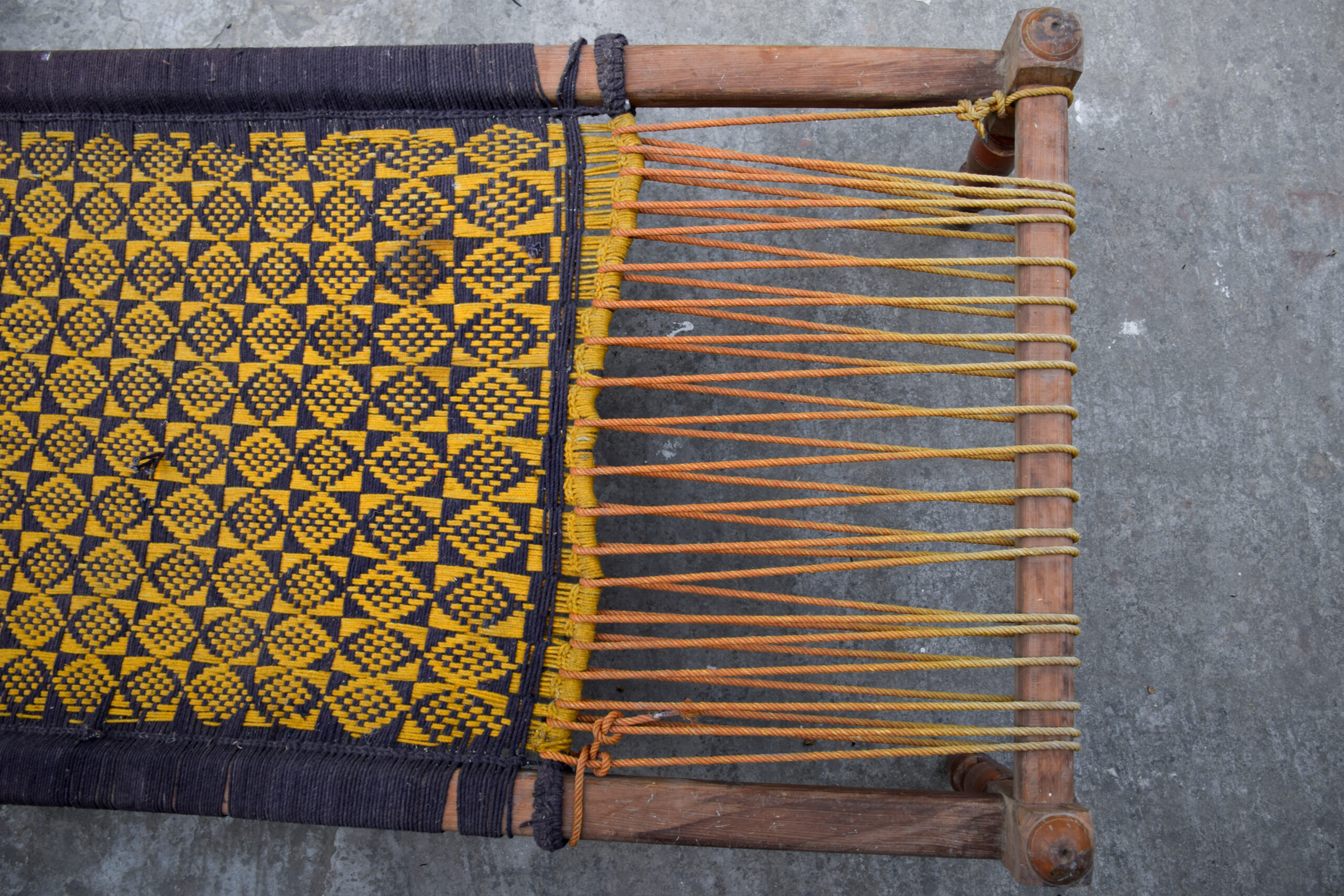
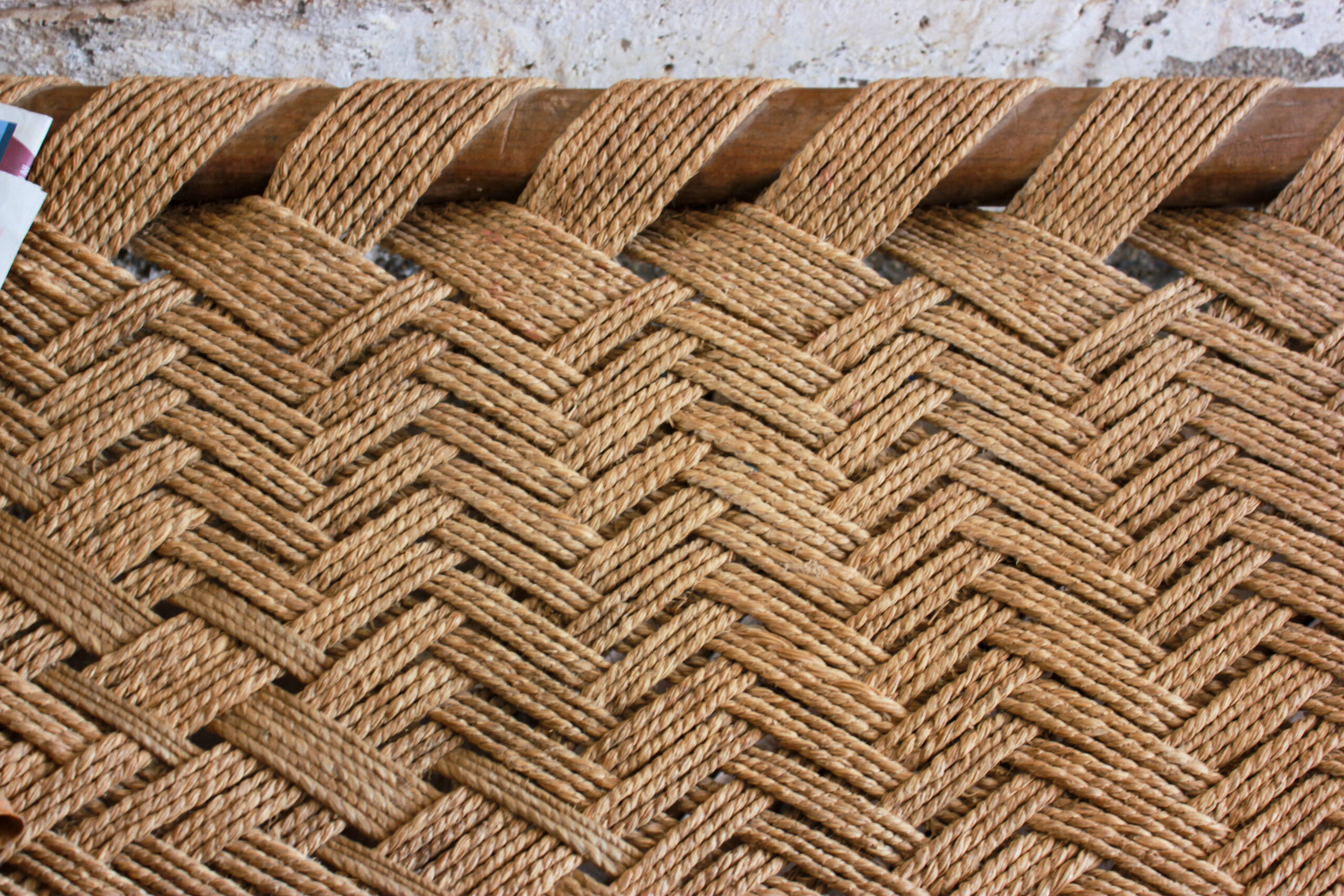
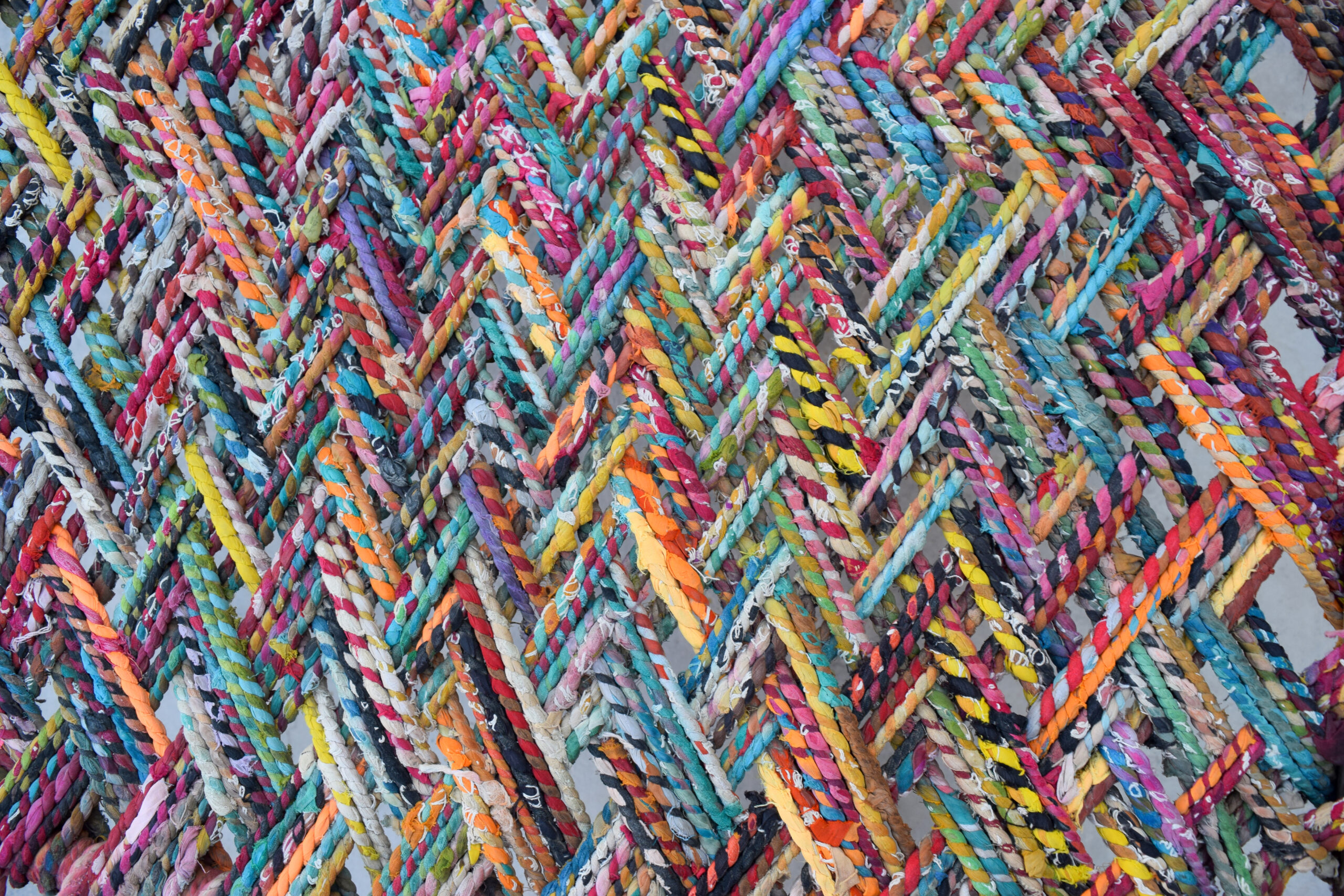
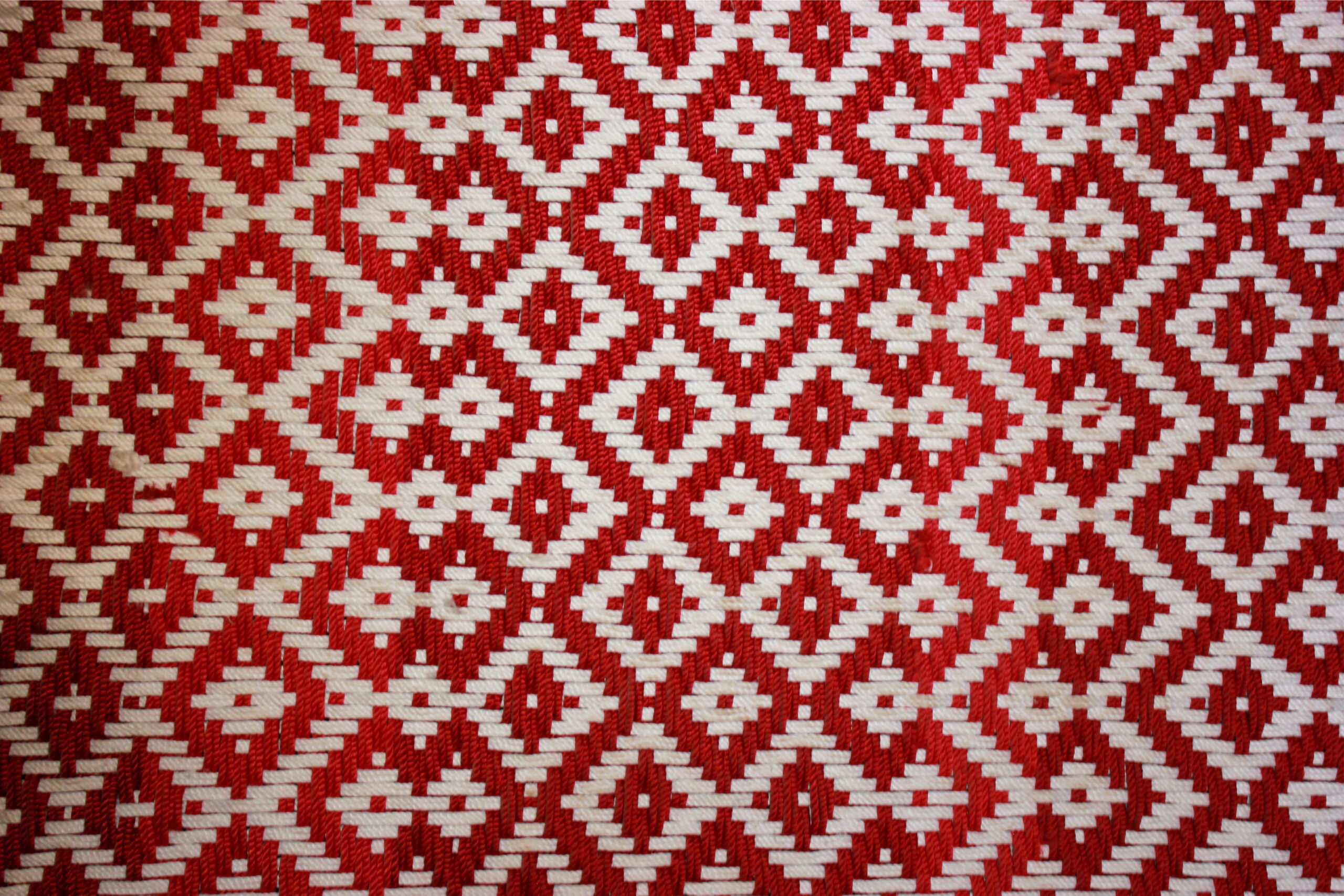
Generally, one of two weaving techniques is used to make the webbing. In the first technique, known as gundiwala, the ropes are secured with knots (gundi) along the edges of the charpoy frame; this webbing is considered stronger than most others; a charpoy made this way is also known as a singhadu (or singhdi) macha in Rajasthan, Punjab, and Haryana, after the horns of a black deer (singhadu) that was traditionally used as a weaving tool. Alternatively, the ropes are tied across the wooden members without knots and woven in a crisscross manner without a specific pattern in the warp and weft; in a variation of this technique, a single rope is used. While weave patterns differ by region and the craftspeople involved, there are generally four types of weave — diagonal weave, cross weave, singhadu weave and newar weave. The diagonal weave is fastest as it uses only one rope; along with cross weave, it is the most common type of weave found in charpoys across India. The singhadu looks similar to a cross weave, with the addition of jagged edges. The newar weave is a kind of diagonal weave that uses tapes of nylon or cotton and is often found in inexpensive charpoys and metal charpoys.
Designs may vary from simple patterns to complex figurative depictions of episodes from mythology or folklore. One common charpoy design is a chequered pattern known as chaupati that serves as a board to play chaupat, a popular board game.
Variants for children
Children of the household usually sleep on a smaller, shorter charpoy that is known by a variety of names — machli in the Marwar and Shekhawati regions of Rajasthan; khatli in Gujarat; manji in Punjab and parts of Haryana, and khatola in other parts of Haryana. A child too big for a cradle sleeps on the smaller charpoy until they have outgrown it; it is then used as a seat by all members of the family until another child needs it. Infants often sleep in a cotton or muslin hammock (jholiya in Rajasthan, jhalli in Haryana) tied along the frame of the caregiving adult’s charpai. In the Mewat-Brij region of Rajasthan, smaller than average charpais known as khatli or khatiya are used both by women and children.
Ownership and use
In a home, charpoys serve different purposes and people; other than sleeping spaces, they are also placed in open spaces such as verandahs and courtyards, where they may be used for napping, sun-drying food items such as papad and vadi, and socialising, typically by men. When not in use, charpoys can be stacked or propped against a wall in an upright position to save space; lighter ones can be hung from wall pegs.
As in other parts of the subcontinent, the domestic and public use of a charpoy in northwestern India is mediated by various social customs. These vary from place to place, but generally, in a group of mixed gender, caste, age or class, those with privileged status would be seated on the charpoy, while others would sit on the floor. Often the men and eldest women of a household may have their own charpoys that are not to be used by others; other members of the household — young women and children — use communal charpoys. In relatively affluent Saurashtrian homes, for example, each male member of the family has his own dholio, and it is common for a man to use a single dholio his whole life. In such cases, he is carried to his cremation on that dholio at the time of his death. The dholio is then donated to a low-income family, along with his other personal belongings. In less affluent families, the dholio is typically reserved for use by the eldest male member of the household. By contrast, the dholni can be used by anyone. The Girasia community of Rajasthan also observes a number of customs with regard to the use of the charpoy — a mother-in-law and daughter-in-law do not sit on the same charpoy; a male visitor is seated at the ‘head’ of the charpoy, while the man of the family receiving him sits at the tail; female kin of the men of the house or village are more entitled to sit on the charpoy than women who have married into the community, who would sit on the floor.
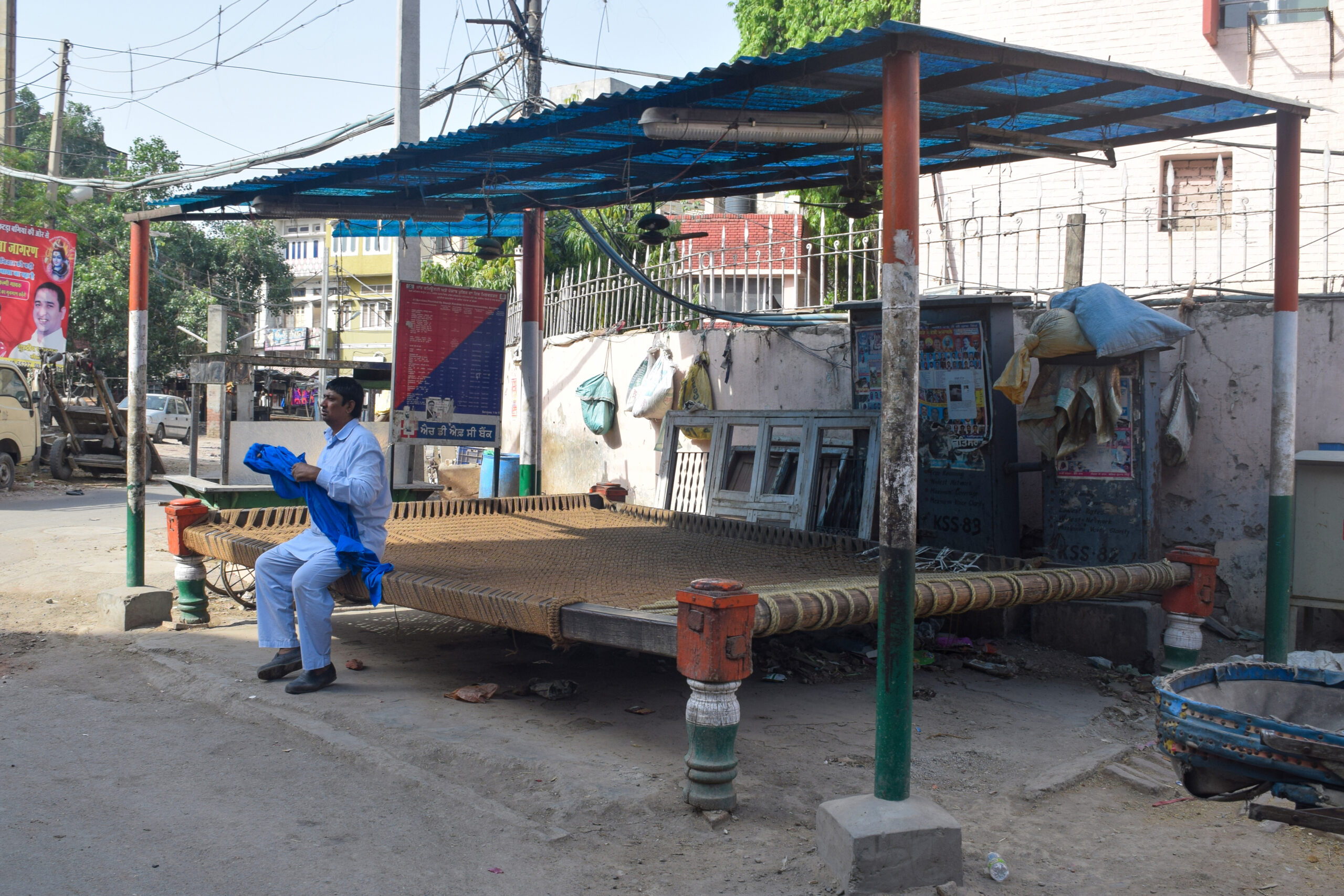
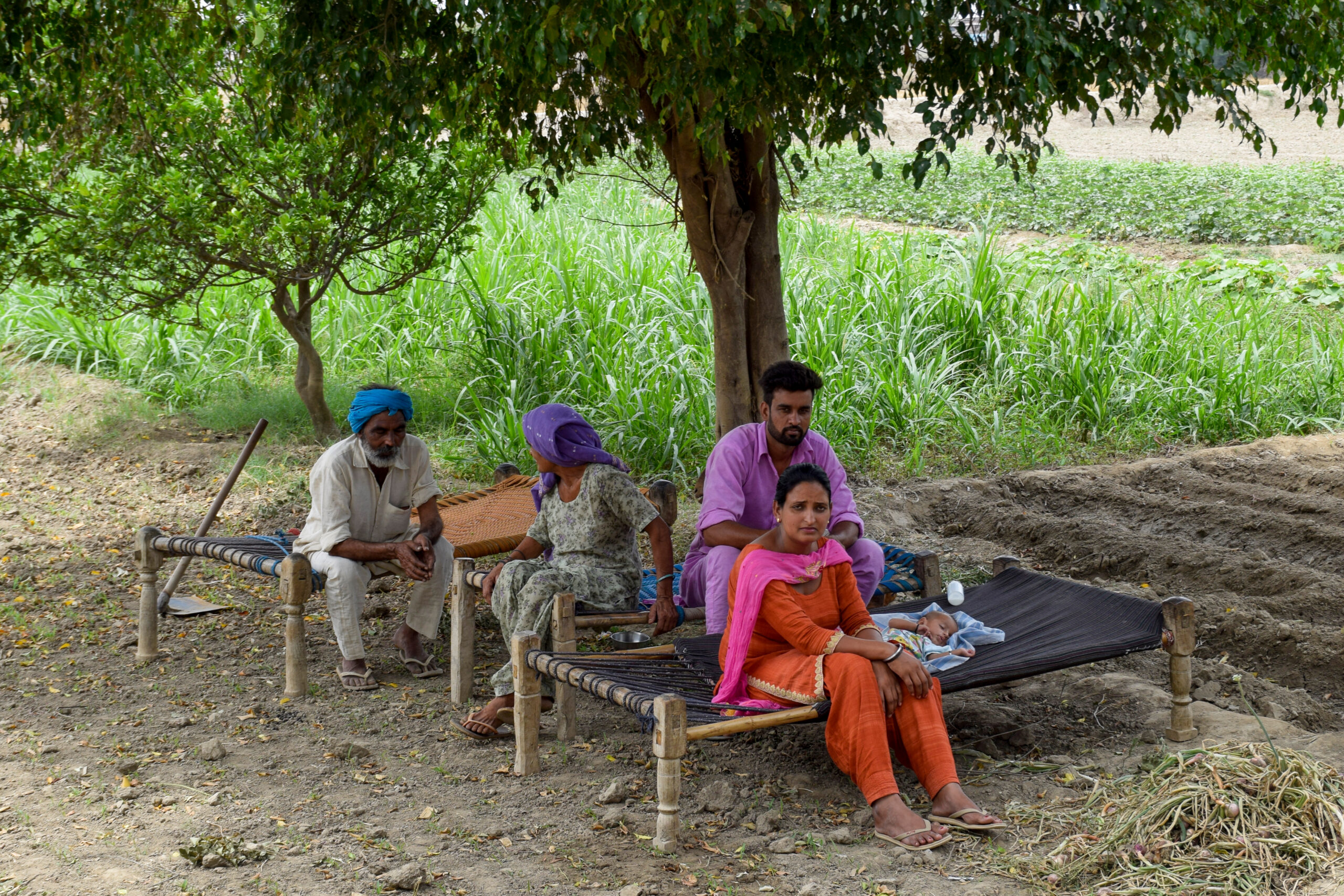
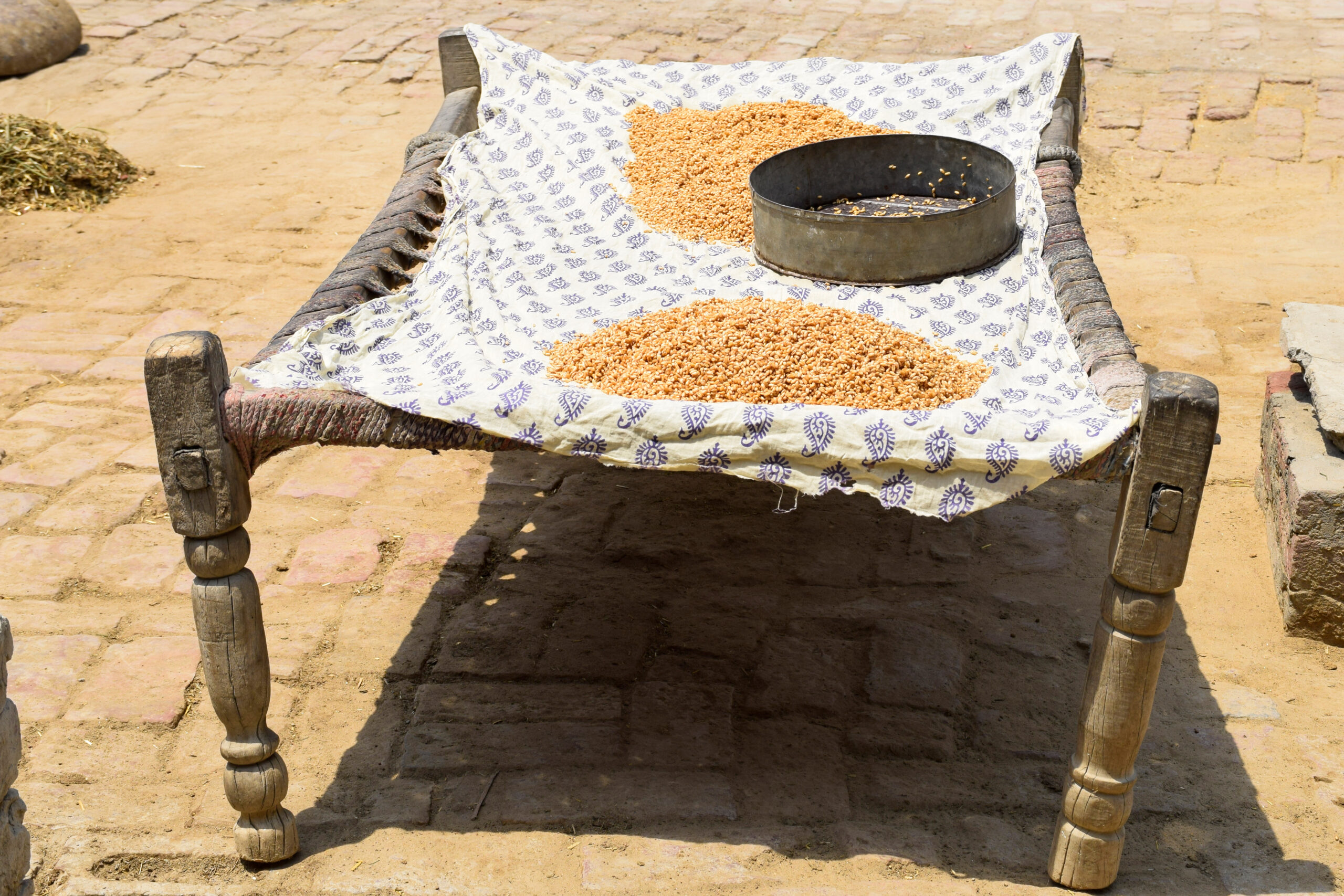
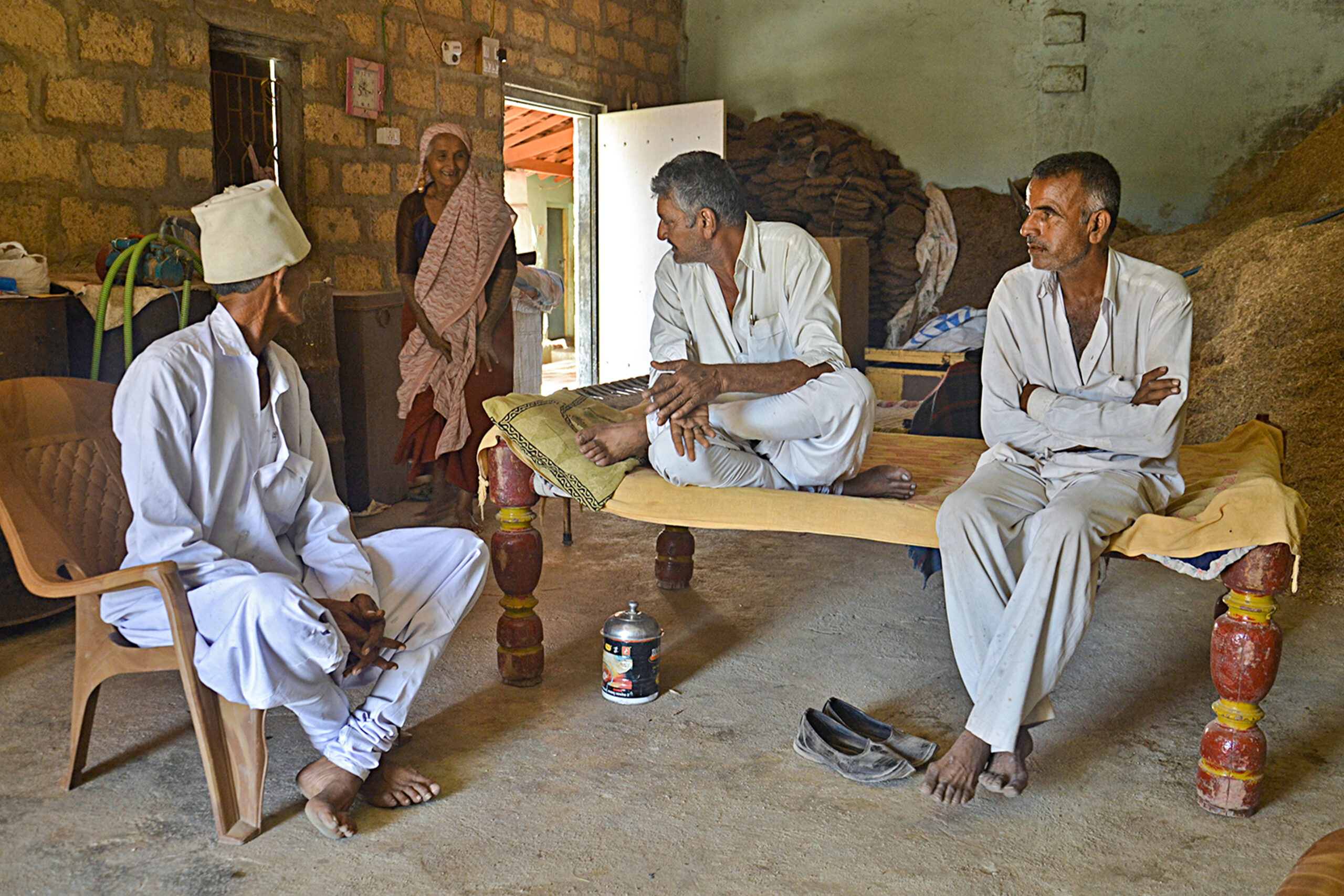
In Punjab and Haryana, a charpoy is often commissioned by a woman’s family as part of her bridal trousseau. In some wedding ceremonies in Punjab, the groom sits on a charpoy and the bride sits on a chair to perform various rituals; one of these involves tying a sacred thread to the leg of the charpoy by the bride’s sister, after which the bride departs for her husband’s home.
A common public use of a charpoy is in dhabas or roadside eateries, where they can be employed both for seating and as a table. In Punjab and Haryana, public charpoys which are larger than domestic ones are called macha. In Haryana, a community macha is made using money pooled by various families; it is maintained by a specific clan or community.
While traditional charpoys are still commonly found in rural parts of northwestern India, their demand has declined in recent years, with metal charpoys with plastic and newar webbing more popular, often sold as readymade units. Older charpoys with leather webbing have mostly been replaced with cotton or jute ones.
This article is adapted from the outcomes of Vernacular Furniture of North-West India — a collaborative research and documentation project by the Design Innovation and Craft Resource Centre (DICRC), CEPT University, India, and The South Asian Decorative Art and Crafts Collection Trust (SADACC), UK — shared with the Encyclopedia of Art through an Impart partnership. Explore more from this series in our Collection Objects Alive: Vernacular Furniture of North-West India.
First published: 15 May 2026
Image Gallery
Bibliography
Bais, Mitraja, Jay Thakkar, Samrudha Dixit, and Ben Cartwright. Sahaj: Vernacular Furniture of Gujarat. Ahmedabad: CEPT University Press, 2018.
Rao, Mansi S., Ben Cartwright, and Samrudha DIxit. Anaikya: Vernacular Furniture of Rajasthan. Ahmedabad: CEPT University Press, 2021.
Rao, Mansi S., Ben Cartwright, Jay Thakkar, and Abhishek Ruikar. Smarya: Vernacular Furniture of Punjab and Haryana. Ahmedabad: CEPT University Press, 2026.
Vernacular Furniture of India. Accessed February 20, 2026. https://vernacularfurnitureofindia.com/.
Feedback