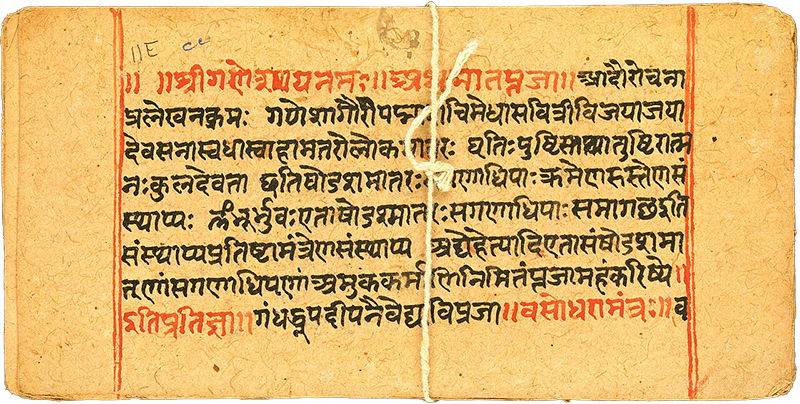
In scholarship, term most frequently referring to the Indo-Aryan family of languages and their scripts — including Sanskrit, Brahmi and Kharoshthi — or more generally to the classical, Sanskritic culture of the Indian subcontinent. Precursors of Sanskrit, known only through linguistic reconstruction, have been given names such as Old Indic and Middle Indic by specialists. The word ‘Indic’ derives from the Latin Indicus, meaning ‘of India’, and has been in use since the seventeenth century at least, often used loosely to mean ‘having to do with India’.
More Definitions
Karma
A philosophical concept in Hinduism, Buddhism, Jainism and Sikhism, and a spiritual principle of cause and effect wherein the actions…
Devi Upanishad
A minor Upanishad often classified as one of the eight Shakta Upanishads, it is one of the nineteen late-Vedic texts…
Mahakapi Jataka
One of the Jataka tales, it tells the story of the bodhisattva's life as a monkey king who stretched his…
Timurnama
A richly illustrated manuscript created in the sixteenth century during the reign of the Mughal emperor Akbar (r. 1556–1605), it…
Satyagraha
A form of non-violent resistance pioneered by MK Gandhi. It translates to "an appeal for truth" and is based on…
Laila Majnun
A seventh-century Arabic tale that narrates the love story of the poet Qays ibn al-Mulawwah and Layla bint Mahdi. Popularly…
Prakriti
In the Hindu religious tradition, it is a theological concept that describes the primary principle, or source, of matter. In…
Devi-Bhagavata Purana
Also known as Devi Bhagavatam, it is often categorised as a Mahapurana and revolves around the figure of the Devi…