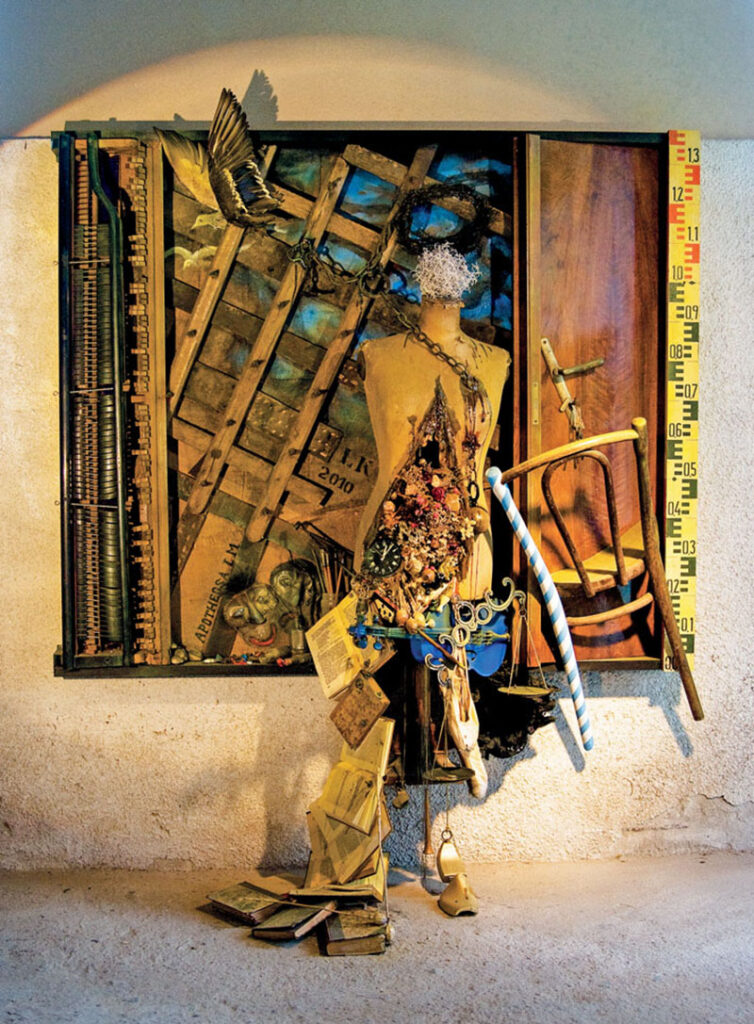
Art made by assembling disparate elements from everyday or found objects. Assemblages are often associated with movements such as Dadaism, Neo-Dadaism, Arte Povera and Young British Artists. The term was coined by the artist Jean Dubuffet in the 1950s and notable artists include Marcel Duchamp, Robert Rauschenberg, Kurt Schwitters, Joseph Cornell, Louise Nevelson and Jean Tinguely.
More Definitions
Glass Plate Negative
A photographic negative produced using a glass plate coated with a light-sensitive emulsion of silver compounds, in use in plate…
Hand Stencil
The technique of imprinting human hands on rock surfaces, found in Prehistoric cave paintings. The process involves placing one hand,…
Extra Weft
Also known as the supplementary weft technique, it is a design method where additional weft threads are added to the…
Lohori Running Stitch
A form of kantha embroidery that is characterised by running stitches that resemble waves. From the Persian word lehr, meaning…
Clamp-Resist Dyeing
A textile dyeing technique where wooden clamps are used to reserve areas of a fabric from receiving the dye. In…
Weft-Interlocked Technique
A form of tapestry weaving wherein weft threads of opposing colours are looped onto the same two warp threads to…
Naqshaband
The designer of the naqsha (map or design plan) of Banarasi brocade. They sketch and create the map of motifs…
Kinkhwab
Meaning “little dream,” it is a woven brocade, characterised by a dense and rich zari work on the surface that…