-
ChicagoChauhan, Kunal. "Forest Guardians: The ‘Bhutas’ of Bali and Tulu Nadu." Impart Perspectives, May 5, 2026. https://imp-art.org/perspectives/features/forest-guardians-the-bhutas-of-bali-and-tulu-nadu/
-
MLAChauhan, Kunal. "Forest Guardians: The ‘Bhutas’ of Bali and Tulu Nadu." Impart Perspectives, May 5, 2026, https://imp-art.org/perspectives/features/forest-guardians-the-bhutas-of-bali-and-tulu-nadu/. Accessed 16 Oct 2026.
-
HarvardChauhan, K. (2026) Forest Guardians: The ‘Bhutas’ of Bali and Tulu Nadu, Impart Perspectives. Available at: https://imp-art.org/perspectives/features/forest-guardians-the-bhutas-of-bali-and-tulu-nadu/ (Accessed: 16 October 2026).
Forest Guardians: The ‘Bhutas’ of Bali and Tulu Nadu
The terrifying representations of 'bhutas' in both cultures symbolise spirits or forces that have the unique ability to balance good and evil to maintain true cosmic harmony.
By Kunal Chauhan
Link copied!
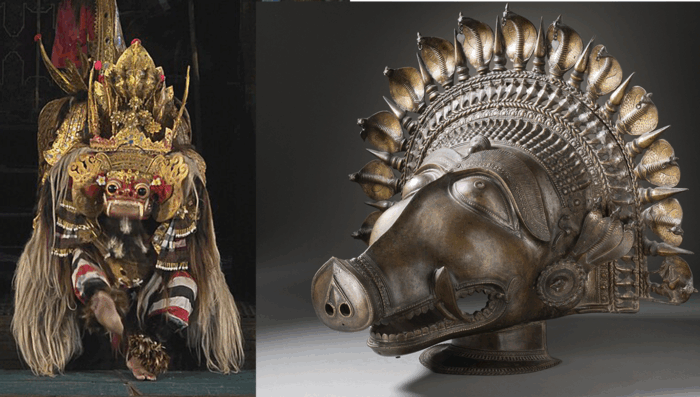
From L-R: Dancer wearing the 'Barong' mask and costume. Photograph: JyotiPN (2025), Wikimedia Commons. Dancer's headpiece in the form of 'Panjurli Bhuta'. Courtesy Los Angeles County Museum of Art
At first glance, the fanged masks of Bali’s traditional Barong performers and the attire of daiva patris (spirit mediums) in Bhuta Kola traditions of Tulu Nadu in India may seem intimidating to outsiders. But folktales, legends, and regional poems shed light on what the casual tourist often misses — these grotesque animistic representations channel “guardian” spirits or forces that have the unique ability to balance good and evil. Both traditions go back to antiquity. The Bhuta Kola of Tulu Nadu is believed to have ancient roots dating back to pre-Vedic, early Tulu tribes. Gradually, its folklore was blended into narratives of Vedic gods. Even now, it is traditionally performed by people from marginal castes, such as the Nalike community. Across the ocean, the Barong dance has flourished in Bali from approximately the 11th century and is a living practice, performed both in community gatherings as well as commercial performances for tourists.
Despite the vast Indian Ocean separating the shrines of Tulu Nadu and the temples of Bali, the spiritual pulse of these regions beats in unity. Both of these cultures operate on a foundational truth: harmony is not achieved by completely eradicating evil, but rather by balancing it.
As documented in the paddanas (oral epics) of Tulu Nadu, the cosmos is divided into three realms — gramya (cultivated lands), aranya (forests) and bhuta (spirits). The orderly, civilised realm of gramya is often in conflict with the untamed forces of aranya (forest), posing a persistent threat to agricultural life. To restore the balance and harmony amongst these realms, the spirits of bhutas are invoked by daiva patris (mediums) during the ritual of Bhootaradhane. These bhutas do not simply signify good or evil; instead they are a testament to the complex need of cosmic balance within everyday life and society.
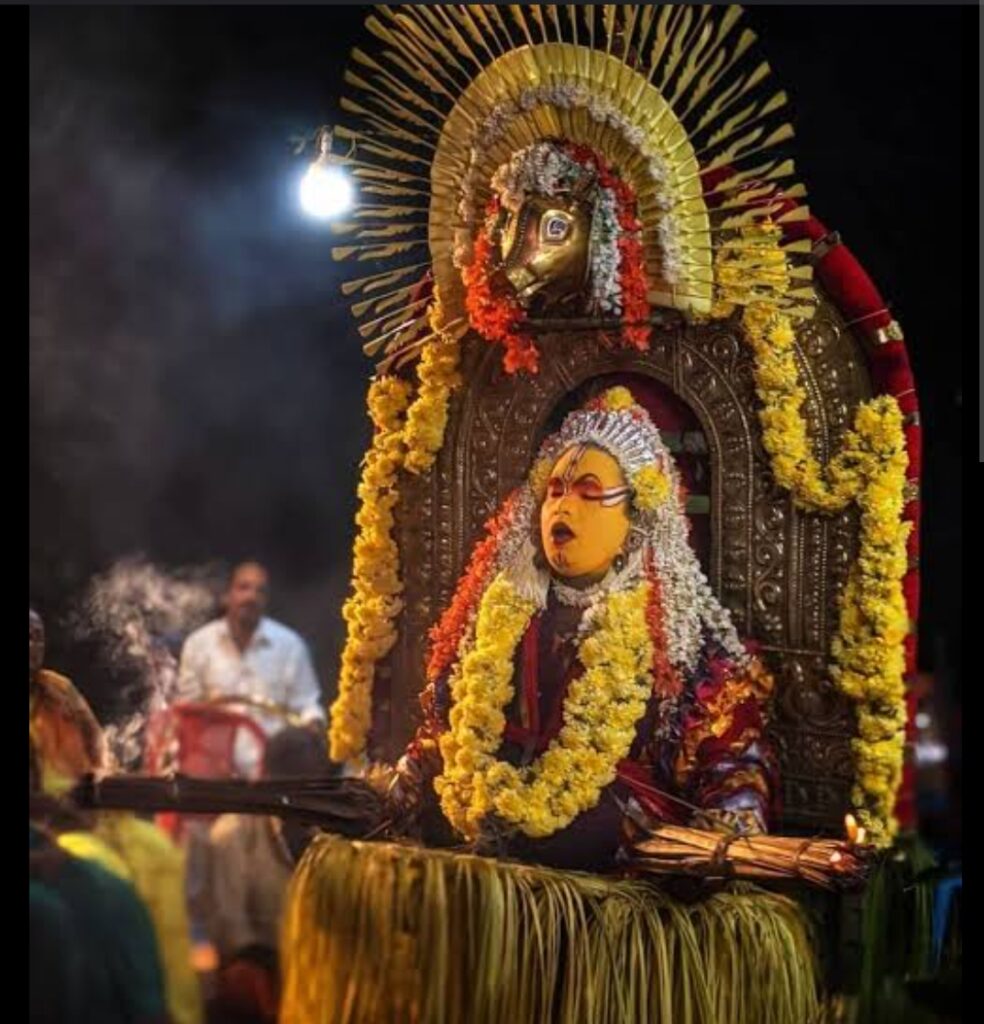
During the Bhuta Kola festival, a diverse pantheon of spirits are summoned, each having a different tale behind their conceptualisation and position in the community’s spiritual beliefs. Some, such as Kodamanitaya and Kukkinataya, are bound to specific patron communities like the Bunts, while others, like Dhumavati (also called Jumadi), have both masculine and feminine characteristics. Certain guardians take powerful animistic forms — for instance, Panjurli as a wild boar. The bridge between the human and spiritual realm is transcended with the daiva patri offering prayers and ritual offerings marking the commencement of the festival and re-affirming the community’s connection to guardian spirits.
In Bali, a similar cosmological framework is at play, governed by the philosophy of Rwa Bhineda, best captured by the expression “Bhuta ia, Dewa ia” (He is an evil spirit, He is a god). This concept upholds the principle of co-existence between the opposing forces of good and evil, and between sekala (seen) and niskala (unseen). Within this world view, exist the bhutas and the kalas. Often not distinguished from each other in Bali, they are referred to using the merged phrase “bhuta kalas”. They are not, however ‘demonic’ in the Western sense of the term. The original Sanskrit terms, “bhuta” (elemental spirits) and “kala” (time), represent destructive or chaotic forces, and the inevitable slide toward death and disorder if imbalances are not dealt with. The solution comes in the form of sacrifices or offerings.
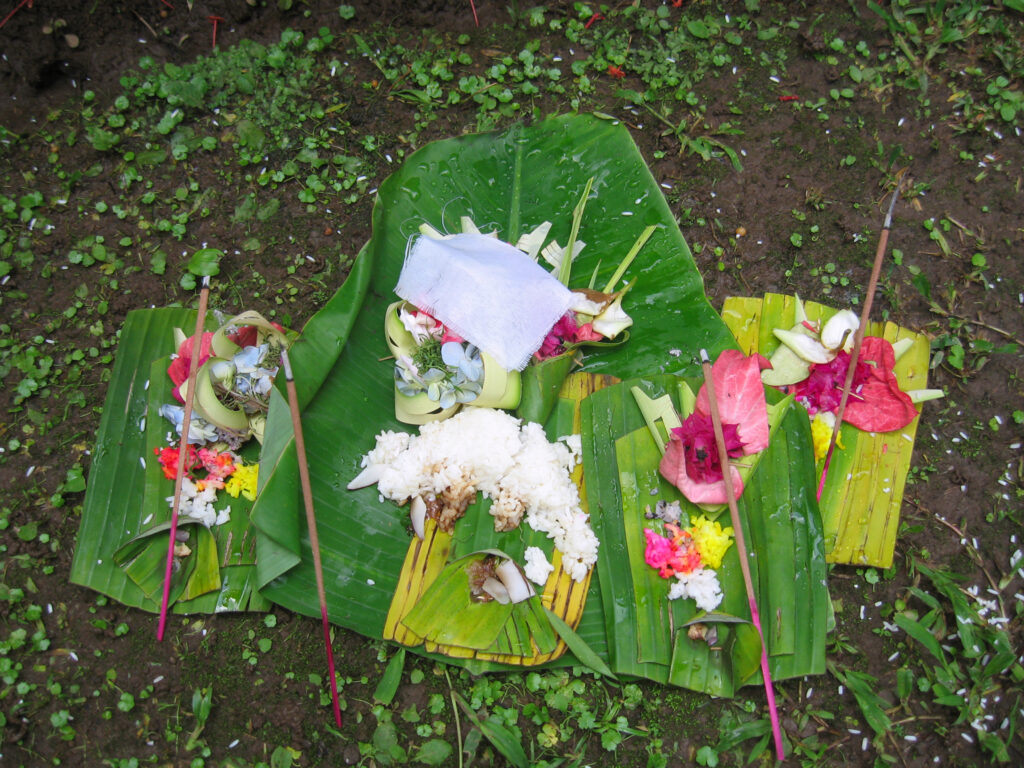
Caru, the blood sacrifice segment of the bhuta yadyna (Hindu-Balinese ritual), is performed seeking to satisfy these abstract negative energies. More basic offerings, known as Segehan, are often left at crossroads or in the cemetery, where these bhuta kalas are believed to exist. In annual parades on the eve of the Balinese New Year (typically in the month of March), the chaotic energies of bhuta kalas are physically represented through large, handmade, demonic-looking statues known as the “Ogoh Ogoh” that are paraded through the streets as a form of protection and cleansing. Similarly, Bali’s ritual theatre centres around an eternal war of balance, in which the queen of leyaks (witches), Rangda, is the dark and essential counterpart to the protective Barong entity. By transforming the philosophical idea of balancing good and evil into a community spectacle, such ritual events serve the purpose of purifying the village grounds and cementing ties among people.
A Shared Visual Language
Tulu Nadu’s Bhuta Kola rituals, taking place annually between December and July, are performed late in the night. The patrons or owners of the Guttumane — traditional manor households, which historically served as the administrative and social centres of wealthy landlords — typically sponsor these performances that are designed to commune with bhutas or daivas (guardian spirits). In contrast, the Barong dance is performed throughout the year on specific dates of the Balinese calendar, often in the morning or afternoon. Yet, upon closer inspection, one can observe that both cultures use a similar visual language — animistic and intimidating masks — to achieve the same goal: bringing harmony and cosmic balance within agrarian communities. The similarities between these traditions is not a coincidence; they reveal a story of cultural transmission.
During the first millennium, monsoon winds facilitated a vibrant exchange between the Indian subcontinent and the Indonesian archipelago. Maritime history notes fleets carrying merchants from Kalinga and the Coromandel Coast to Suvarnabhumi (modern-day Southeast Asia), literally meaning the land of gold. This eastward drive from the southern coasts of India was fuelled by an economic necessity — the merchants were travelling in search of gold as their traditional flow of bullion was interrupted after the decline of Rome. The immense significance of this connection is still remembered today in the Bali Yatra festival in Cuttack, where thousands gather on the banks of the Mahanadi River to commemorate the ancient departure of these fleets to islands like Bali.

Exchange was not limited to the trade of spices and commodities. Rather, it was part of a larger cultural nexus known as the “Sanskrit Cosmopolis.” Sages and scholars travelled alongside merchants, carrying with them epics like the Mahabharata and Ramayana, spreading ideas and philosophy that shaped a linguistically common and standardised form of Sanskrit political poetry across the sub-continent. However, this was no simple cultural importation — inhabitants of Bali adapted these ideas according to regional beliefs and community needs. This philosophical exchange embedded the Sanskrit vocabulary of “bhuta” in both of the regions, but its localisation differed.
In Tulu Nadu, the bhutas evolved as vocal, guardian deities acting as divine ancestors who conversed with the community through a spirit medium on various aspects of life. Meanwhile, an early indigenous belief in Bali acknowledged the existence of spirits living in the waters and trees. Local practices encouraged befriending benevolent spirits while appeasing the evil ones. By the time Hindu ideas reached there, bringing new rituals and Vedic offerings like kusa (grass) and tila (sesame) for the departed, they were imbibed easily in the pre-existent animist beliefs of the Balinese people. The only major difference though was that the bhutas in Balinese culture remained limited to abstract, chaotic energies to be appeased instead of beings that could be conversed with (through mediums) for moral advice and justice.
The profound Hindu-Balinese animist syncretism is vividly expressed through Rangda, who manifests the most terrifying aspect of the Hindu goddess Durga. Beyond representational parallels, the legend of Calon Arang validates the queen of leyaks as an empowered agent of Durga — one who strategically absorbs the destructive energies of indigenous spirits to shield the community from harm. Scholars note that if Kali represents the extension of Durga within the Indian tradition of expelling chaotic forces, then Rangda fulfills a similar role within the Balinese spiritual landscape.
This localisation was not only restricted to spiritual narratives, but it extended to the sphere of art as well. Scholars argue that the Hindu guardian motif of Kirtimukha and the broader cosmological concept of a fierce spiritual protector travelled across the ocean as well. In the Indonesian archipelago, this ‘Face of Glory’ first manifested in Javanese temple architecture as the Kala head, before transitioning into the fearsome carved head representing the protective Bhoma deity and often placed at the gateway of Bali temples. The Barong mask used by performers possesses similar features — wide fangs and bulging eyes — and can be said to act as the mobile, stylistic counterpart of Bhoma.
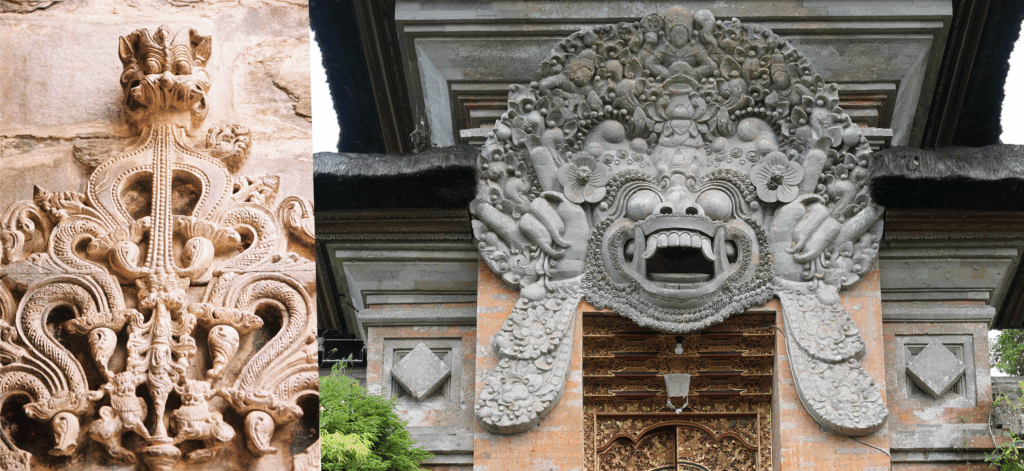
The daunting visual imagery is not meant to represent evil, rather the dichotomous nature of guardian deities. This ability to embody paradoxes is best represented by the king of the spirits, Barong, in Bali, and the protector deity, Panjurli, in Tulu Nadu. Despite being regarded as benevolent guardians, they also channel the chaotic power necessary to restore cosmic and ecological balance. In the sacred fire of Bhuta Kola, Panjurli takes up a fierce and terrifying form through a spirit medium, demanding justice as the saviour of the local community and addressing the grievances of villagers. Similarly, Barong’s monstrous appearance is necessary for warding off negative energies, protecting people from evil, and affirming the importance of taking on a terrifying visage to achieve this end.
Interestingly, both Barong and Panjurli have intrinsic forest roots, reflected in their performative and sacred masks. Barong is usually represented with masks of various animals ranging from the boar to the tiger, depending on regional folktale variations. Meanwhile, Panjurli is represented with a sacred mask of a boar. The paddanas mention Panjurli as a wild boar’s offspring that was cursed for its evil deeds, mainly for destroying crops, and subsequently banished by Shiva to protect the earth. Panjurli has also, over time, come to be associated with the protective Varaha (Boar) avatar of Vishnu that rescued earth goddess Bhumi, an anthropomorphic representation of cultivable land, from the depths of the ocean.
Parallel to this, the legend in Bali echoes Barong as a spirit guardian, similar to Banaspati (the lord of forests), who roams the forests and protects crops from animals and pests. This shared emphasis on the theme of a forest guardian and the protection of land and crops can be attributed to the heavy reliance on paddy cultivation in these geographic locations.
From an artistic perspective, the carved masks of these guardians are intricately designed pieces made by skilled craftspersons according to ritual specifications. Both Barong and Panjurli possess bulging and large eyes, a common stylistic element used in ancient Indian art to portray supernatural vigilance. Their ferocity is depicted through wide, curved fangs, which in both deities, protrude from the corners of the mouth. To soften their ferocity, Barong is covered with saput poleng (a black and white checkered cloth used to represent cosmic balance), while the spirit medium embodying Panjurli is draped in pingara (tender areca flowers). Another element of analogy found in these visual cultures is the halo-like illusion created through elaborated structure of the headgear, known as Ani in the sacred masks of Tulu Nadu. Correspondingly, the arched crown that is part of the Barong performer’s costume is intricately fashioned from carved buffalo hide and wrapped with a leaf. It is further embellished with minute shards of mirror glass, which evokes a shimmering, radiant ‘halo effect’ during performances.
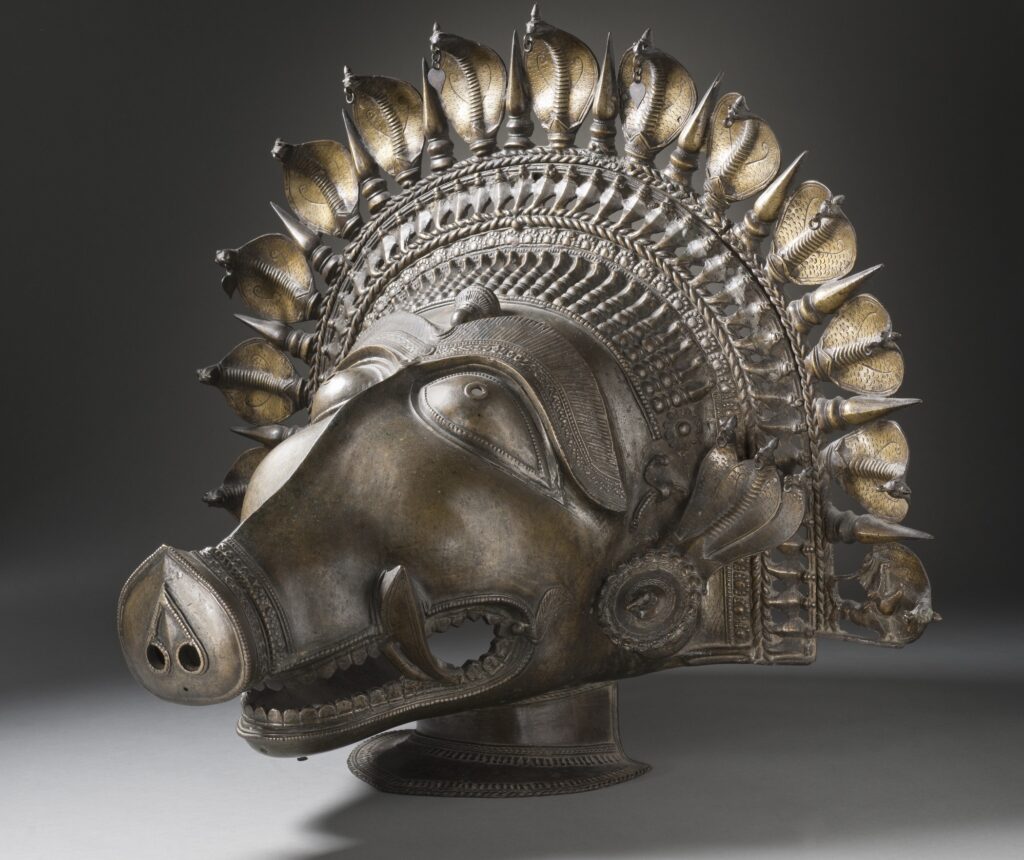
The regalia associated with spirit guardians are revered as sacred even after ritual ceremonies and events. In Tulu Nadu, the Daivakone (room of the spirit guardian) is constructed within the premises of the Guttumane. This room consists of ornaments like masks, shields, and statues made from bronze or silver. It is believed that it houses the spirits of royal guardians like Panjurli. Hence, offerings are made every month on the auspicious day of Sankranti, when the Sun changes zodiac signs. In Bali, the mask of Barong has to be consecrated by the sacred ritual of Pasupati, carried out by the meditating priests who invoke the guardian spirit to inhabit a newly carved mask. Once the mask embodies a spiritual entity, it is kept in temples and provided with offerings at regular intervals. To maintain this spiritual purity and respect, holy water is sprinkled over the Barong’s heavy attire immediately after every performance.
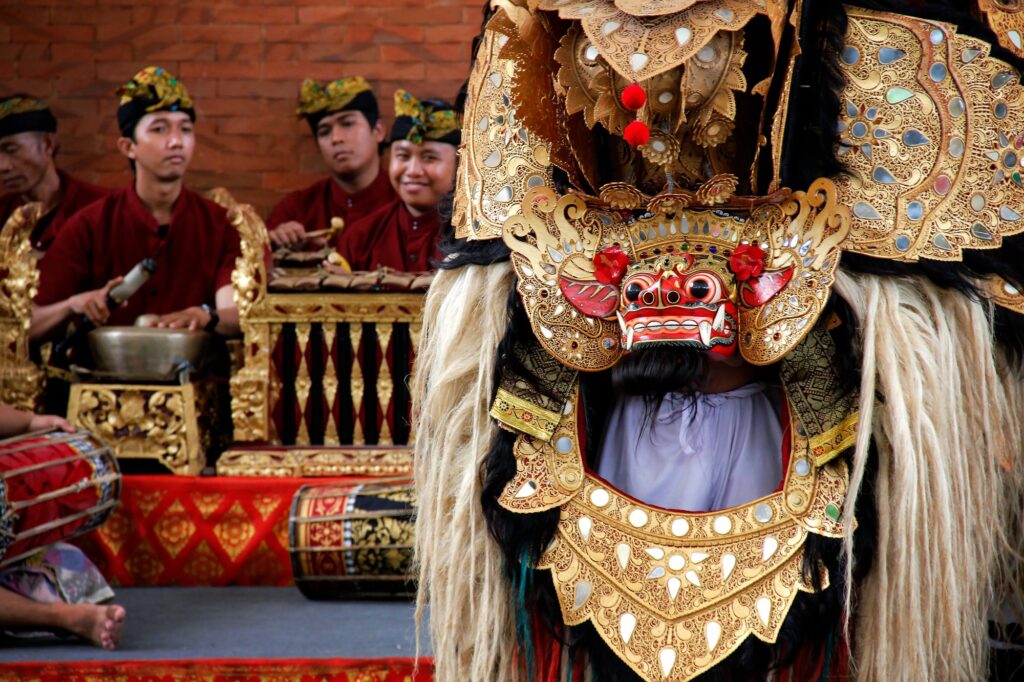
The sustained practice of these traditions to this day is a testament to the fact that they carry within themselves deep sentimental and social implication. The kabitas (poems) carrying the complex origin of Panjurli’s spirit are recited by women labourers of different castes working together on the paddy fields during the harvest period in Tulu Nadu, providing them with a sense of strength and unity. In Bali, village communities often celebrate the heroic tale of Barong through gamelan orchestra performances on auspicious occasions. The philosophy of balance, embedded in such everyday ritual and activity, ties both these cultures separated by sea, both visually and spiritually. The terrifying representations of the bhutas in both cultures is a reminder to consciously face the destructive, shadow aspects of existence to maintain true cosmic harmony.
First published: May 5, 2026