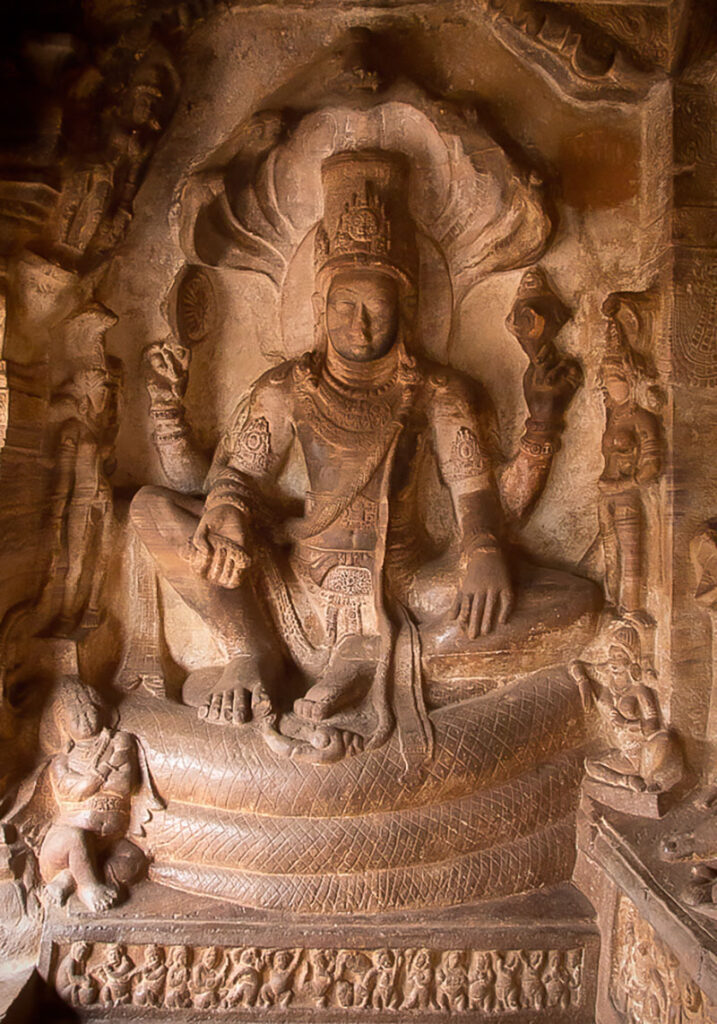
Also known as Para Vasudeva, it is a manifestation of the Hindu deity Vishnu. The conventional iconography of the form depicts Vishnu seated on the coils of the serpent Sesha, with his left leg folded and his left hand placed on his left knee. Sesha’s hood is shown to be covering his head, in the manner of a parasol. However, in the Tirumala Venkateswara Temple in Andhra Pradesh, Vishnu is depicted standing on the serpent, his head shielded by the snake’s hood.
More Definitions
Kaushalya
The seniormost queen of King Dasaratha, she appears in the Hindu epic Ramayana epic as the mother of Rama.
Bhagirath
The mythical king of the Sagara Dynasty who performed several years of penance in the Himalayas. He is known to…
Makara
The equivalent of the Capricorn Zodiac sign within Hindu astrology, it is a mythical sea creature that is believed to…
Vishwamitra
In Hindu Puranic and epic literature, one of the seven maharishis (great sages). He is also known as the royal…
Devasenapathi
One of the names of the Hindu deity Subrahmanya. The name derives from his role as commander (senapati) of the…
Shatananda
In Hindu epic and Puranic literature, a sage who is the son of the sage Gautama and Ahilya. In the…
Rudra
Minor deity in Vedic religion, generally associated with terrible or destructive natural forces, but also with various benevolent aspects. Rudra…
Gajendra
A figure in the Gajendramoksha episode of Hindu mythology, Gajendra was an elephant who was caught and bitten by a…