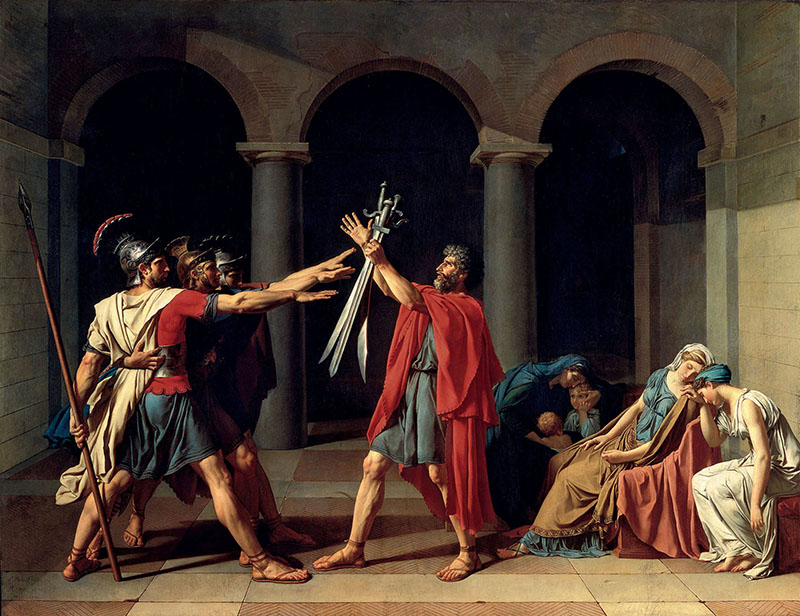
A style of painting that was influenced by European academies of art from the sixteenth century onwards. It was characterised by strict adherence to compositional techniques and thematic conventions that emphasised idealised depictions, allegorical themes on mythological and historical subjects, naturalistic colour and polished surfaces. Prominent artists of the style include Nicolas Poussin, Peter Paul Rubens, Jacques-Louis David and Eugene Delacroix.
More Definitions
Pointillism
Also known as Divisionism or Chromoluminarism, it is a technique in painting that involves applying small, distinct dots or strokes…
Neo-Impressionism
A late nineteenth-century movement in French painting that opposed the empirical realism of Impressionism. It used the scientific principles of…
Nagara Style
A style of Hindu temple architecture commonly found in northern and central India and characterised by a curvilinear or rectilinear…
Abstract Expressionism
An art movement that developed in New York in the 1940s and led to the formation of the New York…
Picturesque
An aesthetic category accorded to pictures that have an agreeable and appealing visual quality, and is particularly used for idealised…
Sarvatobhadra
A type of Hindu temple architecture characterised by a door in each of the four cardinal directions of the sanctum.…
Tachisme
A French style of abstract painting, characterised by random splotches and dabs, it gained popularity in the 1940s and 1950s…
Indian Modernist architecture
The adaptation of Western Modernist principles — functionalism, minimal ornamentation, and the use of industrial materials like reinforced concrete —…