-
ChicagoBaoni, Aadya. "More Than Meets the Eye: A Conversation with Artist Jyoti Bhatt." Impart Perspectives, March 24, 2026. https://imp-art.org/perspectives/interviews/more-than-meets-the-eye-a-conversation-with-artist-jyoti-bhatt/
-
MLABaoni, Aadya. "More Than Meets the Eye: A Conversation with Artist Jyoti Bhatt." Impart Perspectives, Mar. 24, 2026, https://imp-art.org/perspectives/interviews/more-than-meets-the-eye-a-conversation-with-artist-jyoti-bhatt/. Accessed 15 Oct 2026.
-
HarvardBaoni, A. (2026) More Than Meets the Eye: A Conversation with Artist Jyoti Bhatt, Impart Perspectives. Available at: https://imp-art.org/perspectives/interviews/more-than-meets-the-eye-a-conversation-with-artist-jyoti-bhatt/ (Accessed: 15 October 2026).
More Than Meets the Eye: A Conversation with Artist Jyoti Bhatt
For Bhatt, photography and painting are always in conversation, with the camera acting as an extension of the paintbrush, not a replacement.
By Aadya Baoni
Link copied!
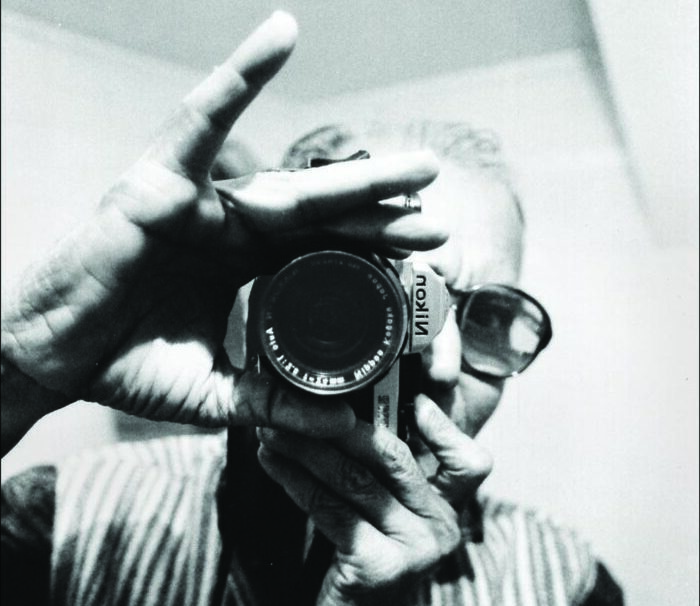
Self-portrait; Jyoti Bhatt; 1995; Digital file. Courtesy Museum of Art & Photography (MAP)
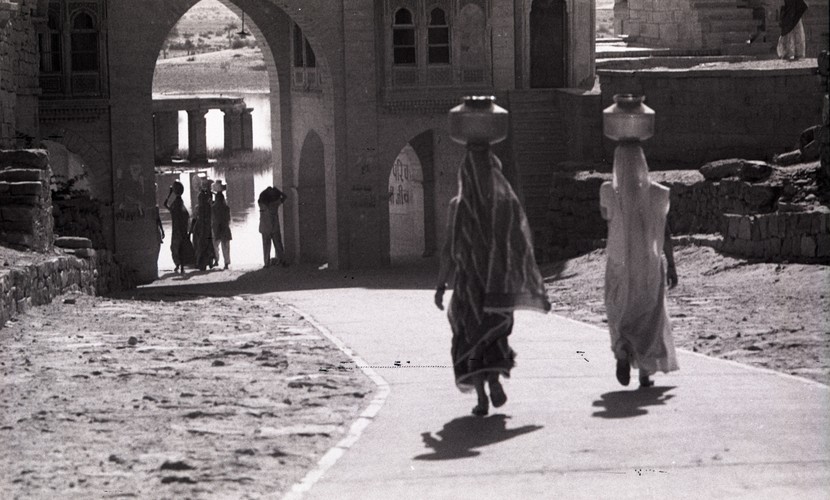
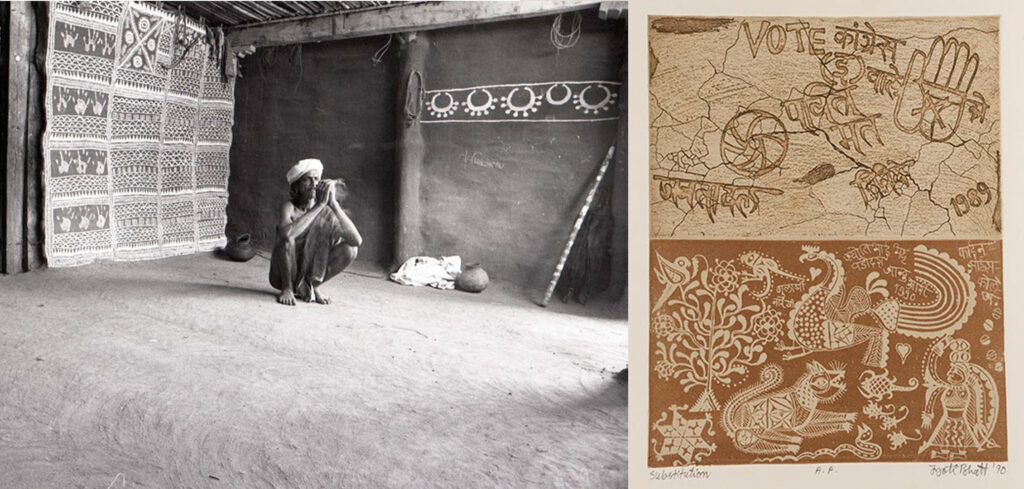
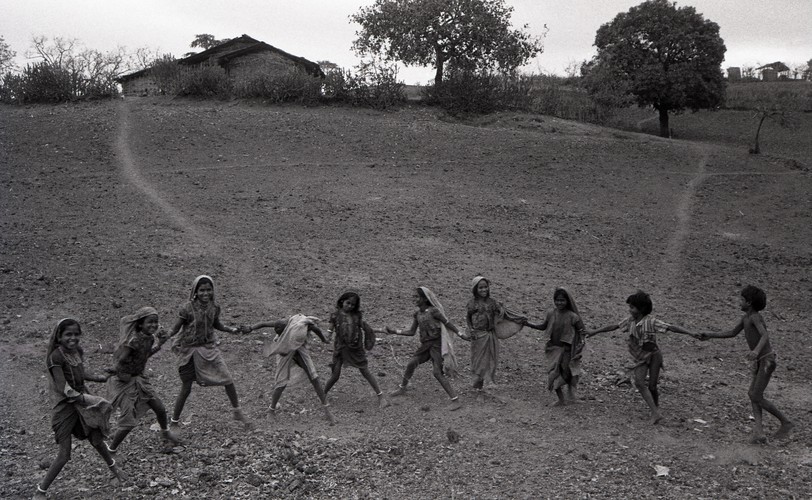
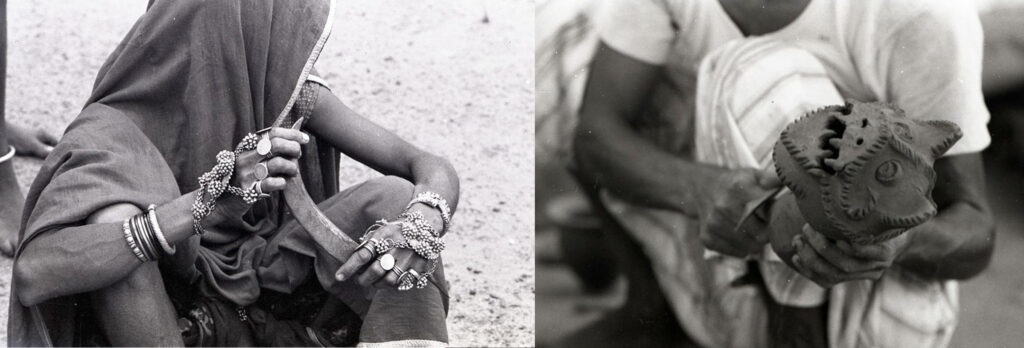
It was in the late 1960s, while documenting art in rural India, that Jyoti Bhatt became increasingly preoccupied with photography, adopting a realist, black-and-white approach, even as he continued to teach painting at the Faculty of Fine Arts, MS University in Baroda till his retirement in 1993. His photographs of rural, tribal, and folk spaces — initially from Gujarat, and later expanding to Rajasthan, Madhya Pradesh, Orissa and beyond — captured symbols of India’s cultural heritage: torans adorning doorways with ceremonial grace, elaborate drawings embellishing mud walls, painted clay cookware in kitchens, the careful decoration of bullocks with wooden block prints, women etching ink along the sleeves of their arms. Motifs and symbols from folk art would often feature in his prints and paintings — a form of visual conversation with the disappearing practices of rural India.
Privileging content over form, Bhatt’s documentary photographs became a celebration of ordinary life, reincarnated through his lens for onlookers to revel in. KG Subramanyan, his teacher, observed his work and remarked: “Here the human scene is equally attractive; its graceful villagers are much more striking in their daily wear than sashaying models in a fashion dress parade. Jyoti has an uncanny talent to discover beauty in the most unexpected places; a painter with a pronounced interest in technical means, who wanted to make the camera an artistic tool that mediated between what is seen and the artist’s imagination.”
Known for his unfaltering gaze, Bhatt, who turned 92 on March 12, 2026, had complained about his eyes “betraying” him as he gained in years when I met him in October 2020. The garba festivities at the Fine Arts department at MSU Baroda, an annual tradition initiated by Bhatt, had just come to a close. With my blistered feet as testament to the previous nine nights of revelry, I found myself navigating the labyrinthine lanes of Old Padra neighbourhood in Vadodara (formerly Baroda), armed with a tape recorder and the directions to Bhatt’s home. Before long, I stood before a wire mesh door that opened to the wafting aroma of roasted Gujarati food. Under the bright fluorescent tube light, the adornments on the walls stood out, thrown into stark relief. Each inch was covered generously with paintings and photographs by artists from every corner of the world.
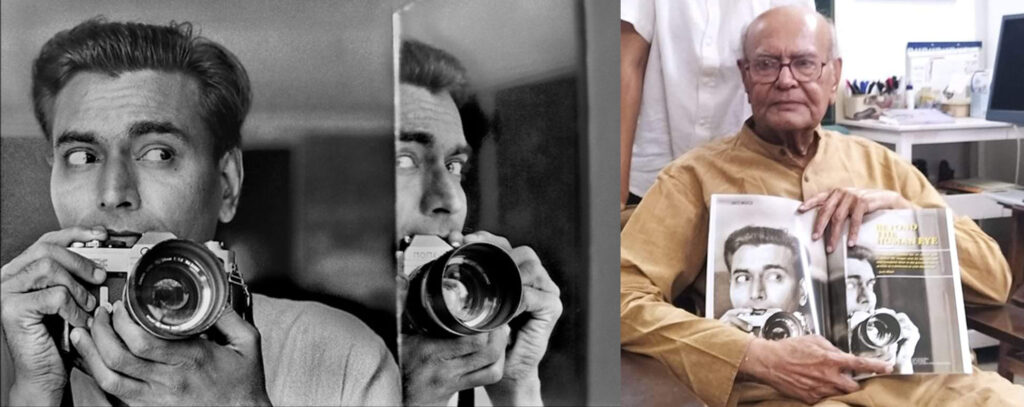
Dressed in nondescript clothing, Jyoti Bhatt, 86 years old at the time, stood at the edge of his home’s tiled interiors, patterned like the jharokhas of Champaner, bordering the smooth kaavi (red oxide) flooring at the entrance. The black leather Kolhapuris left his toes naked as he glided noiselessly across the floor to greet me. In the conversation that followed, Bhatt deftly laid out the fluid interweave of his shifting but complimentary practices as a painter, printmaker, and documentary photographer. He began with answering the simplest question of all — Why photography?
Aadya Baoni: How did photography first enter your art practice?
Jyoti Bhatt: Photography enabled me to record with a camera the images seen by my eyes and then transform them to the perceived ones that I desired — in a darkroom or with Photoshop. When I began, photography was a tool, a necessity to facilitate drawings. It allowed me to stubbornly linger a while longer in the place I would otherwise get only a brief glimpse of. Over time, I realised that the camera is impartial. The frame captures every detail irrespective of its significance. (Bhatt made a makeshift camera shaped from his forefingers and focused its lens with a gentle jerk of his hands around my face.)
If I am interested in making your face, I refuse to look at your feet or your hands. But I realised the camera recorded so many details that I sometimes opted to ignore and usually failed to notice. The camera started gradually replacing my pencil to make visual notes. It would capture all the nuances, all of the visual attributes, accurately. It is like that film by [Italian film director] Michelangelo Antonioni — Blow-Up — where a camera captures an ordinary photograph of a friend, nothing remarkable on first look. But when the same image gets enlarged, the zoomed in background reveals a murder. What the eye had passed over, the camera preserved. This idea has stayed with me.
Baoni: When you were making those early photographs, did you go in with certain intentions?
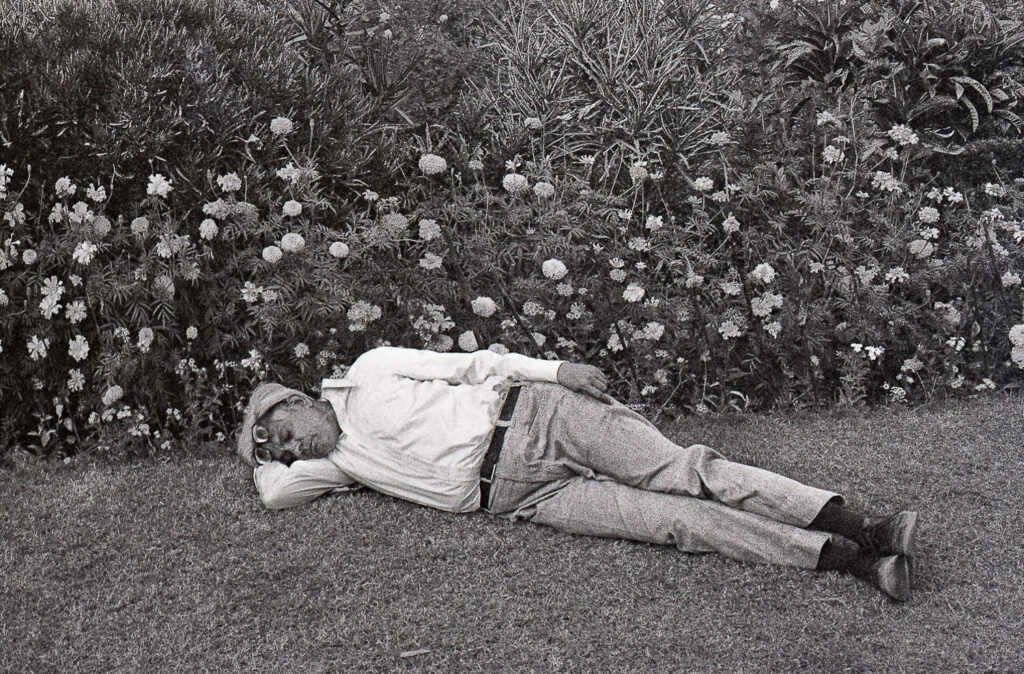
Bhatt: I had no intentions. I was recording what was happening, simply because I was a part of it. I photographed surfaces found at various places as if they were a kind of painting. Although I no longer make such paintings, I still cannot let go of photographing surfaces that suggest some metaphorical meaning; identifiable forms that evoke an emotional response.
It reminded me of what Alfred Stieglitz called his “Equivalents” — these nearly abstract photographs of his that sought to arouse in the viewer the emotional equivalent of his own state of mind at the moment of taking the picture. He wanted to show that the content of a photograph was different from its subject. An image is seldom about what it depicts. It is about what it makes you feel. I understood that distinction through my own hands.
Baoni: The French painter Paul Delaroche, on first seeing a photograph in 1840, said: “From today, painting is dead.” How do you understand the relationship between the two?
Bhatt: He was wrong. The camera contributed enormously to the non-stop development of art. For me, it became an extension of the paintbrush, not a replacement. What photography did was force me to appreciate the discord between a photograph and a painting, to value each for what was unique to its own medium. Because my career began in painting, I would view the world relative to a painting. But the two were never in competition. They were always in conversation.
Baoni: You’ve spoken about the camera seeing what the eye refuses to. But there is also the question of how we train the eye itself in our own limited ways of seeing.
Bhatt: I had a professor by the name of N S Bendre. One of his eyes had deteriorated due to smallpox. Then there was his friend, Benode Behari Mukherjee — he too had lost vision in one eye, at the age of thirty-five. Two great artists, each with half a field of vision between them. Bendre and Benode would often disagree about the world they lived in and the world they visualised. On one such occasion, Bendre asked Benode: “Why is it that what you feel is right, I find wrong? And what I find right, you find wrong?” Benode Babu laughed and said, “That is inevitable! What you see from your right eye, I cannot see because I don’t have it. And what I see from my left eye, you cannot see because you don’t have it.” It seemed as though the two men had only one good eye between them, which they used in turn. (Bhatt cupped one of his own eyes to demonstrate this ‘half-vision’ as he recalled the exchange with a smile.) It tickled me to think that this would become one of the most important incidents of my life. We all have a limited way of looking at the world. The question is whether we are honest about that limitation or whether we mistake it for the whole truth.
Baoni: So how do you push past that limitation? How do you train yourself to see more?
Bhatt: An American photographer, Minor White, would ask his students to sit on the floor, facing photographs placed on the wall. They had to look at a single image for three hours. Three hours. This ritual-like exercise was intended to sharpen their perception, their ability to see beyond the surface, to comprehend the layers of subtle and implied meanings that a quick glance cannot fathom. Looking is not the same as seeing. Seeing requires patience, and a willingness to stay with what you might otherwise overlook.
Baoni: And yet there is the argument for focus — take for instance Arjuna’s gaze, which sees only the eye of the bird.
Bhatt: Yes, Dronacharya was training the five Pandava brothers in the art of warfare, and when he asked each of them what they saw, Arjuna alone could see only the eye of the bird. That concentration was his genius. But contrary to what the mythology celebrates, I believe one must develop the ability to attend not only to the main subject — the eye of the bird — but to also grasp its significance in relation to the surrounding event. The bird. The branch. The tree. The whole.
I once accompanied my friend Raghu Rai for a photo shoot. I saw him crouching on a tarred road, clicking away. When I asked him why, he showed me: he was capturing a broken bus stand that had pipes jutting out of it. From that angle, down on the ground, the pipes looked exactly like a Christian cross. He had seen it. I, standing upright, had walked right past it. You have to be willing to get on the ground. You have to be willing to look foolish in order to see.
Baoni: Your village photographs have a quality of the prophetic, as though the images freeze something before it can disappear. Was that a conscious impulse?
Bhatt: The images held a certain novelty, no symptoms of having been seen before, even though you would have chanced upon those scenes countless times in the interiors of a household smeared with mud. I was not thinking about preservation when I made them. I was simply present. But looking back, yes, it felt as though the future was being prophesied by those frozen moments. What I was capturing was already disappearing, even as I stood inside it.
Baoni: Is there anything about photography that has surprised you?
Bhatt: It was during the last years at my school that I became aware that ‘FOTO’ was spelled P-H-O-T-O.
First published: March 24, 2026