-
ChicagoMaheshwari, Tanya. "The Corrupt Margins: The Club in 1950s Bombay Cinema." Impart Perspectives, April 7, 2026. https://imp-art.org/perspectives/features/the-corrupt-margins-the-club-in-1950s-bombay-cinema/
-
MLAMaheshwari, Tanya. "The Corrupt Margins: The Club in 1950s Bombay Cinema." Impart Perspectives, Apr. 7, 2026, https://imp-art.org/perspectives/features/the-corrupt-margins-the-club-in-1950s-bombay-cinema/. Accessed 16 Oct 2026.
-
HarvardMaheshwari, T. (2026) The Corrupt Margins: The Club in 1950s Bombay Cinema, Impart Perspectives. Available at: https://imp-art.org/perspectives/features/the-corrupt-margins-the-club-in-1950s-bombay-cinema/ (Accessed: 16 October 2026).
The Corrupt Margins: The Club in 1950s Bombay Cinema
The club in the 1950s Bombay crime-noir films evades easy categorisation. Far from being limited to its ‘perceived’ function as a den of vice and debauchery, the space is complicated by lived experiences of labour, care, and solidarity.
By Tanya Maheshwari
Link copied!
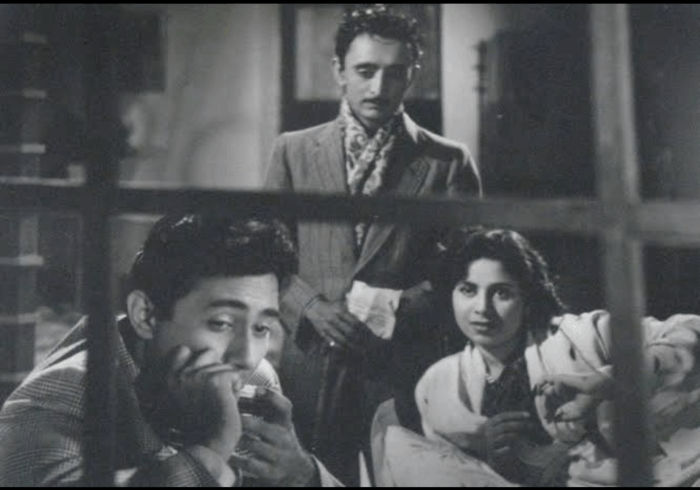
Madan (Dev Anand), Leena (Geeta Bali), and Pedro (Rashid Khan) at the club during its off-hours in a still from Baazi (1951). Courtesy Navketan Films, Wikimedia Commons
Bombay cinema of the 1950s is often dismissed as lacking nuance and complexity, and unfavourably compared to art cinema from the same period. Yet, film scholar Ravi Vasudevan makes a case for unpacking the complex articulations in these mass culture films that are often overlooked. In his 1996 essay Shifting Codes, Dissolving Identities, he observes that the (male) protagonist’s movement across urban spaces of various shades gives rise to moral contradictions, despite the films’ ultimate (and customary) restoration of virtue. One of these spaces is that of the nightclub. Following scholar Giuliana Bruno’s proposition to explore how filmic space is traversed and inhabited to illuminate the ways in which modernity is configured, the space of the nightclub in the crime melodramas Baazi (The Wager, 1951) and Aar Paar (This or That, 1954), both directed by Guru Dutt, is worth examining.
Baazi follows Madan (Dev Anand), a skilled, jaunty gambler who joins Star Club to afford treatment for his ailing sister, despite his qualms about the job. Aar Paar commences with Kalu Birju’s (Guru Dutt) release from prison, finding himself without home or employment, leading him to take up a job as a driver for a club. Madan’s job as a gambler, however, doesn’t permit him to remain ignorant of the undertakings at the club like Kalu, who is unwittingly made to participate in a crime plot. The club is portrayed as a counter-site to the more respectable domains of home and familial spaces where traditional societal norms are enforced. But the club can also be read as a space that displays the dynamics of labour and visibility, based on various kinds of social and workplace hierarchies.
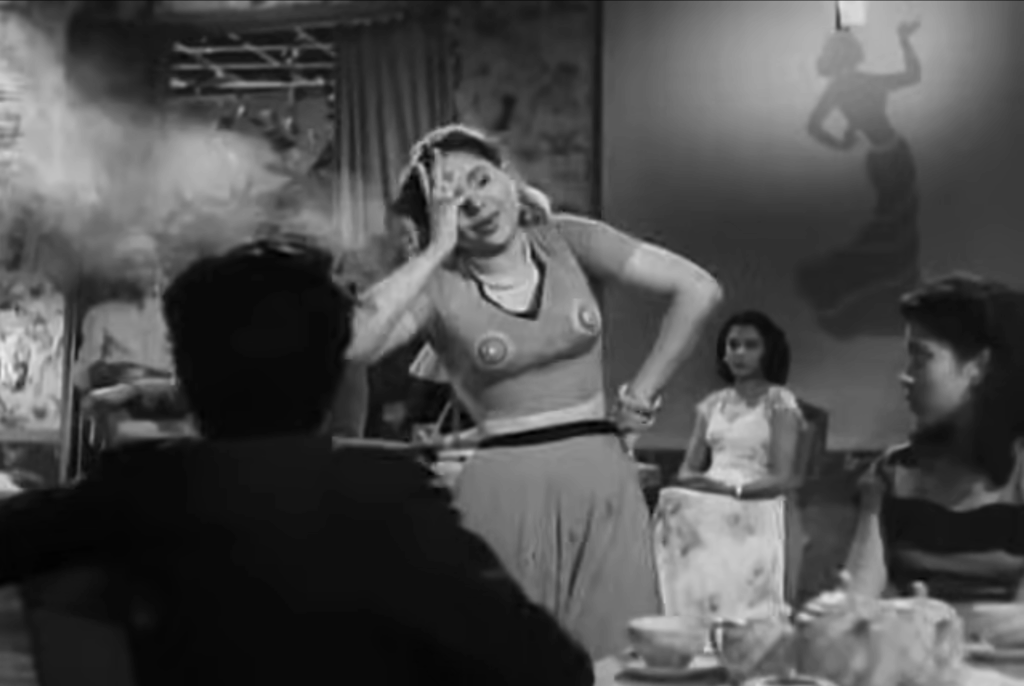
In both films, a dance sequence introduces us to the club’s environs with the male protagonist as the audience surrogate. A crescendo builds and falls once the dancers enter and meet the camera’s gaze, and the performance begins. Such a dance sequence, wherein the plot is briefly suspended, tends to reconfigure the space. Rather than a spectacle offered to the cinematic voyeur, it draws the viewer into the performative aspects of the dance that is being staged for the audience (on and off screen). Geeta Bali as Leena in Baazi and the vamp-dancer character of Shakila in Aar Paar dance their way through the club, from table to table. In doing so, they exhibit not only their performance, but also the contours of the space that doubles as the dancer’s stage in these scenes. The figure of the dancer becomes a sort of conduit through whom spatial continuity is maintained.
Interestingly, both spaces are adorned with visual motifs depicting the cavorting woman. This semiotic signalling not only echoes what is happening in the space, but somewhat diffuses the singularity of the dancer’s performance. Following the dance sequence in Baazi, the scene shifts to Leena, now changed out of her dancer’s outfit and dressed in her ‘Western-style’ work clothes, offering Madan a cold beverage, as he waits to meet the boss. In Aar Paar, the dancer takes her place behind the bar, wresting a bottle of soda from Kalu, and halting an altercation. Through this, the dancers are demystified, having taken up a new role in the space — that of workers. In the process, the space also undergoes a tonal shift.
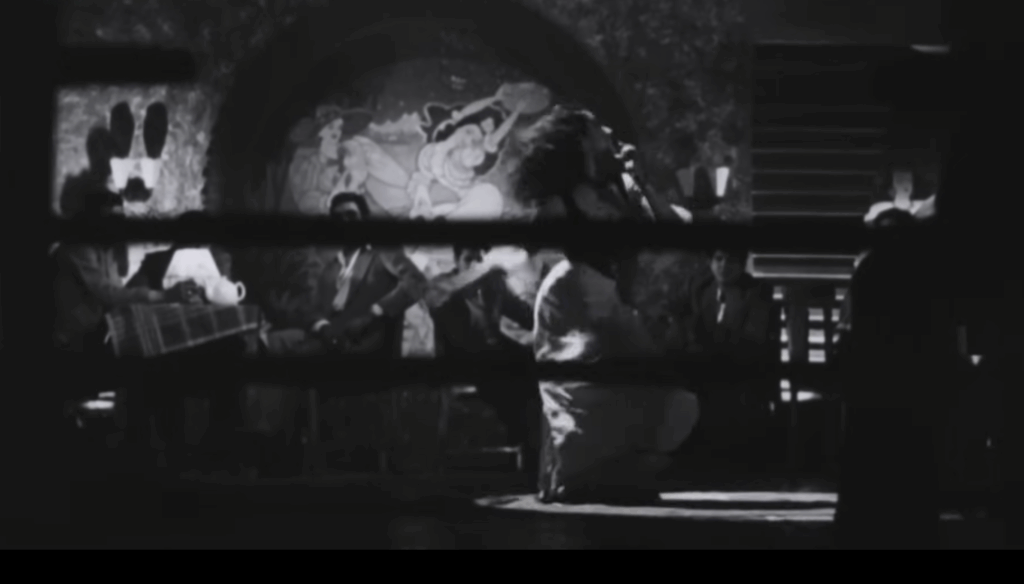
The figure of the dancer has been read as that of the ‘Other’ woman, in opposition to the women in Madan and Kalu’s lives outside the club. However, as film scholar Aarti Wani observes, despite narratives punishing this filmic archetype, her substantial diegetic role was not consistently coded moralistically. While she introduces us to the pull of the criminal underworld, the dancer’s songs also often warn the protagonists of its perils. Even though the dancer herself is introduced through a performance, she is also seen singing in reminiscence during the club’s off-hours, and fighting off a visitor’s unsolicited advances. Therefore, the club also becomes the site in which the dancer’s multiple movements resist any singular reading. This multiplicity encoded into the figure of the “vamp-dancer” and her various modes of being can also point to the fissures present in the gendered politics of space in the larger city, outside of the club.
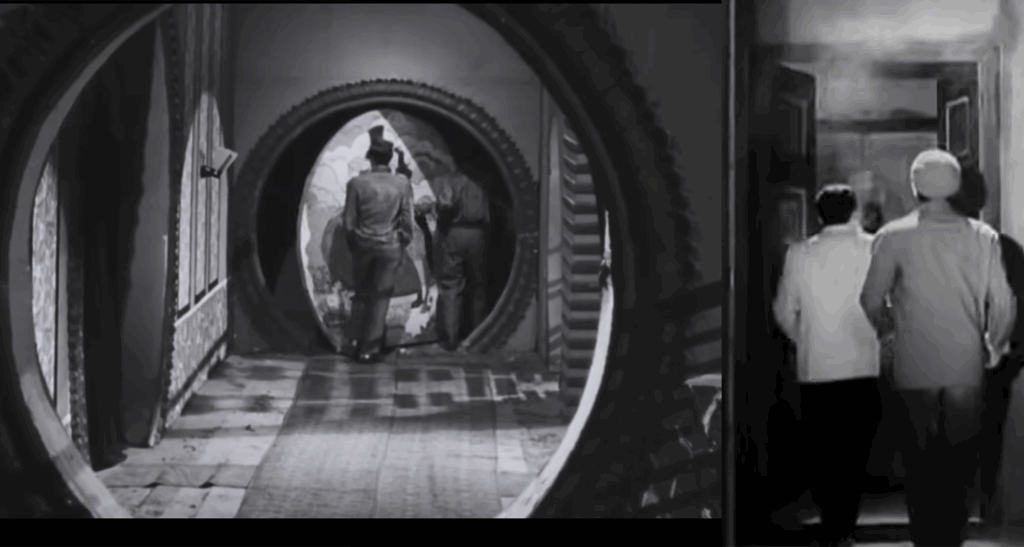
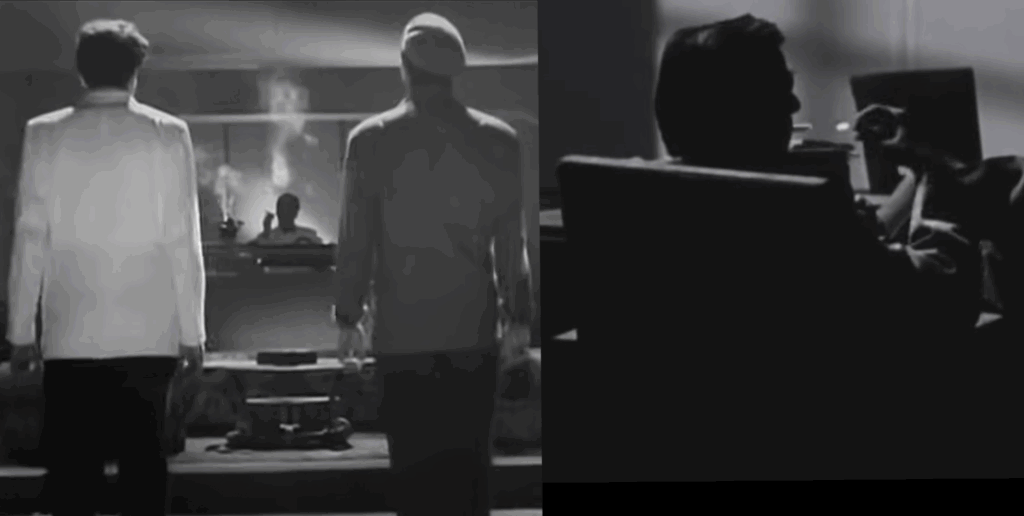
Interestingly, the layout of the club is sectioned three-ways in both films. Besides the dancing area, there is the site of ancillary commercial activity that is illicit. In Baazi, this takes the form of the gambling area, while in Aar Paar, the camera reveals a space stacked with wooden crates filled with guns and ammunition. Lastly, there is a section where the boss of the club sits, which also functions as the operational command centre. This area is cordoned off, requiring an elaborate system of automatic and rotating doors to pass through. The protagonists in both films are shown moving through these various points within the club, comparable to the gamified routes in single-player video games. As Madan and Kalu move across the club’s spatial layers, they not only physically enter the boss’ office but also, symbolically, enter the city’s criminal underground.
Meanwhile, the boss sits at his desk — a dark silhouette against light. The menacing figure appears threatening because his power, yet unmanifested on screen, operates outside the law and established societal rules. This segmentation invites a reading of French sociologist Henri Lefebvre’s spatial politics, who notes that walls, enclosures and facades serve to define both a “scene” for acceptable social actions, while simultaneously creating an “obscene” (off-scene) space for forbidden or hidden behaviours. Power then, in these films, moves inversely to visibility. Not only that, visibility (that of the workers of the club) act as a distraction to these hidden networks of authority that employ them. Through the segmentation, the club becomes a space of hierarchy, thereby conferring the status of an institution or workplace onto it, but it also displays varying levels of safeguards. Therefore, it is a space of employment and excitement, but also one of exploitation and danger. It mirrors the contradictions of 1950s Bombay (now Mumbai) and its urban order teetering toward chaos and unpredictability.
The club is often shown during its non-functioning hours. During these scenes, the absence of familiar elements actually connotes a presence — that of its underlying labour and consequent social relations therein. For instance, when Madan returns to the club during its off-hours, we see the dancing area with chairs stacked one upon another. The workers of the club, already dressed and ready in white tuxedos, stand out against the empty space. In the following scene, the cashier’s seat is empty in the gambling area. A man, likely the cashier, is seen sitting on another table, counting cash, perhaps the takings from the night before or in preparation for the night to come. He accidentally drops some money, and a cleaner tries to pocket it — a transgression he gets mercilessly beaten for. The camera then cuts to Madan, then Leena and Pedro (Rashid Khan), who are all standing in alignment at the same distance from the scene of the beating. As the three of them watch in distaste, Leena and Pedro, however, turn their glances towards Madan, as though trying to gauge whether he has changed his mind about working at the club.
Vasudevan observes that these cuts not only maintain spatial and visual continuity, but also indicate a mutuality. The scene utilises no dialogue but the cuts and expressions indicate an unspoken social contract that underscores their inferior positions within the space; while they grimace, there’s not much any of them can do to stop the violence. They have witnessed similar scenes before, and enough of it, to be somewhat inured to the customary brutality.
In Aar Paar too, the club during off-hours is a liminal space where workers can rest, wait, and authentically build a deep camaraderie among themselves, before they are ‘activated’ to play their designated roles during the club’s business hours. It is useful to think through Lefebvre’s triadic model of understanding space: as ‘perceived’ (how the space is physically experienced), ‘conceived’ (how space is imagined and planned), and ‘lived’ (how space is ‘felt’ or experienced emotionally). Reading the depictions of the club space in both films, it can be said that the physical space defined by enclosures and walls, and the perceived, functional space of transactions, gambling, and performance required by workplace roles, are undercut by the lived space of friendship, respite, and even melancholy.
The club in the 1950s Bombay crime-noir films evades easy categorisation. Far from being limited to its ‘perceived’ function as a den of vice and debauchery, the space is complicated by lived experiences, by the stories of labour, care, and even solidarity. Further, in reading the sequences of the club with those outside of it, we can understand how it mirrors the contradictions of the contexts it emerges from. Just one instance of this is in Baazi, which opens with a gambling scene in Madan’s proletarian neighbourhood. This contrasts with the sequences of gambling at the club, and its empty, shuttered look during the day, when it becomes a space for rest. The deliberate comparison of what is and what is not considered immoral, depending on the situated space of the activity, is a deliberate renegotiation of implied values in favour of the protagonist and the workers at the club. The multiplicity and contradictions inside the club can echo the unevenness and disavowals beyond it. Reading the spatial register of the club, with many similarities across both films, points us to the failures, successes, despair, joys, and anxieties of the post-colonial city.
First published: April 7, 2026