-
ChicagoDixit, Shubhra. "How an Awadh Court Play Shaped the Bollywood ‘Item Number’." Impart Perspectives, March 20, 2026. https://imp-art.org/perspectives/features/how-an-awadh-court-play-shaped-the-bollywood-item-number/
-
MLADixit, Shubhra. "How an Awadh Court Play Shaped the Bollywood ‘Item Number’." Impart Perspectives, Mar. 20, 2026, https://imp-art.org/perspectives/features/how-an-awadh-court-play-shaped-the-bollywood-item-number/. Accessed 16 Oct 2026.
-
HarvardDixit, S. (2026) How an Awadh Court Play Shaped the Bollywood ‘Item Number’, Impart Perspectives. Available at: https://imp-art.org/perspectives/features/how-an-awadh-court-play-shaped-the-bollywood-item-number/ (Accessed: 16 October 2026).
How an Awadh Court Play Shaped the Bollywood ‘Item Number’
Carrying the last flourish of the Awadh court’s sumptuousness and excess, the play 'Indar Sabha' codified the framework of the portable diegetic stage in popular theatrical and film productions in India.
By Shubhra Dixit
Link copied!
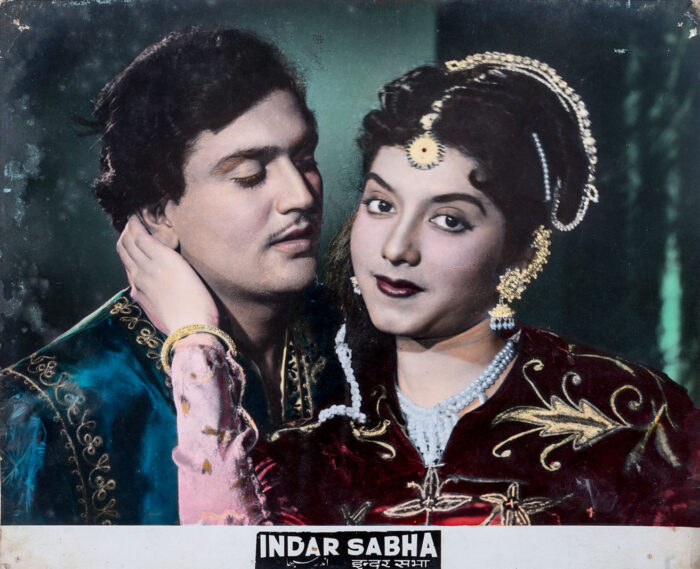
Publicity still for 1956 film Indar Sabha, Silver gelatin print hand-painted. Courtesy Museum of Art & Photography
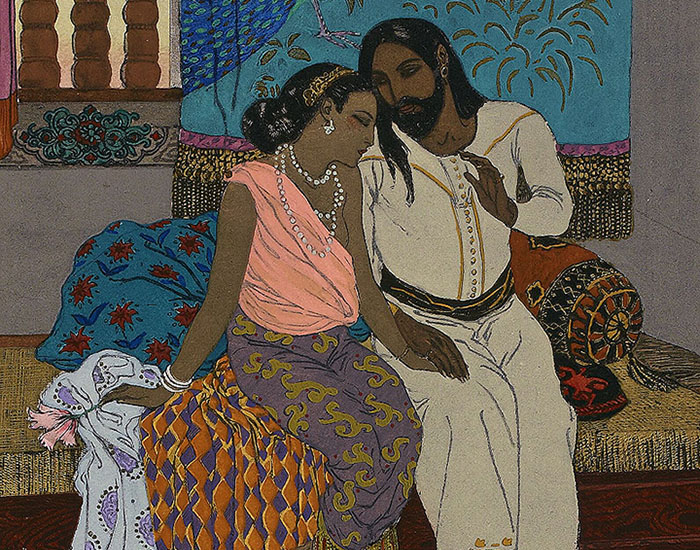
In 1853, Lucknow, then the capital of Oudh (Awadh), was a thriving centre for the arts encouraged by its aristocracy. The nawab of Oudh, Wajid Ali Shah (r. 1847-1856), was the royal patron of several poets, musicians, composers, and artists. In this milieu, the poet Agha Hasan Ali ‘Amanat’ (b. 1816, d.1859) wrote a play called Indar Sabha (The Assembly of Indra). By most accounts, the play was written for the Shah’s court and staged at the royal rahas khana (drama hall). Accomplished singers and dancers from the nawab’s pari khana (house of fairies), well versed in courtly performance styles like Thumri, Dadra, Ghazal and Kathak, are believed to have been Indar Sabha’s first actresses. Earlier royal performances had featured the Shah’s favourite dancers enacting the dalliances between Krishna and the gopis in the rasa lila theatrical tradition. It is not known if Amanat was expressly commissioned to write Indar Sabha, but Awadh’s courtly culture did influence the play’s narrative.
Set in the deity Indra’s realm, Amanat’s play depicts the divine pleasures of the heavenly court, particularly the presence of paris (fairies). Named after gemstones, Lall Pari (Ruby), Pukhraj Pari (Topaz), Neelam Pari (Sapphire) and Sabz Pari (Emerald) make appearances in the first act, dancing and singing at Indra’s court. The story then pivots to Sabz Pari falling in love with the mortal Gulfam who she helps sneak into heaven so they can be together. On being found out by Indra, her wings are clipped and she falls to earth. Here, she becomes a mendicant, roaming the world singing songs of loss and longing. Ultimately, her devotion moves Indra to forgive her and she is finally reunited with her love back in heaven.
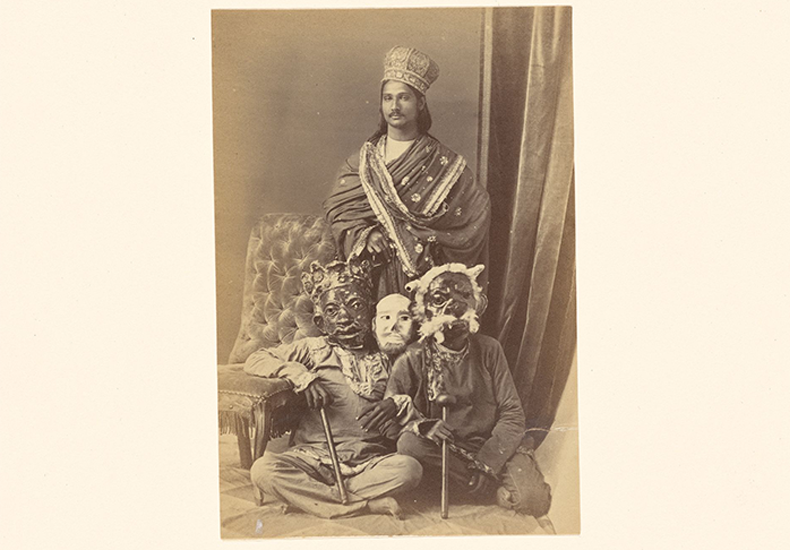
Written entirely in verse, the play’s operatic style, a blend of European, Persianate, and Hindu storytelling traditions, was possibly the poet’s way of incorporating the eclectic tastes of the Shah himself, who the character of Indra was supposedly modelled on. Scholar Kathryn Hansen in her article The Indar Sabha Phenomenon writes, “The language of the songs [in the play] moves back and forth easily between Urdu, Braj, Awadhi, and Khari Boli. ‘Hindu’ and ‘Muslim’ referents overlap as the king’s identity slips between Indar, Krishna, and Nawab. Whether one chooses to think of the IS (Indar Sabha) as a self-consciously syncretistic work or an unpremeditated reflection of the hybrid culture of the Lucknow court, the distance between it and its sectarian antecedents — the Vaishnava drama and poetry, the Sufi romantic allegories — is striking.”
Written a few short years before Awadh’s annexation by the British, the play — now regarded as the first original drama in Urdu literary history — soon became a pan-Indian cultural phenomenon, translated into several regional languages with localised theatrical variations. Amanat’s drama went from being performed in royal saloons to being staged at public arenas across India with the popularity of the play transcending medium. According to Hansen, the play was consumed “as a popularly printed text, a stage drama, a rare book, a set of recorded songs, and as film.”
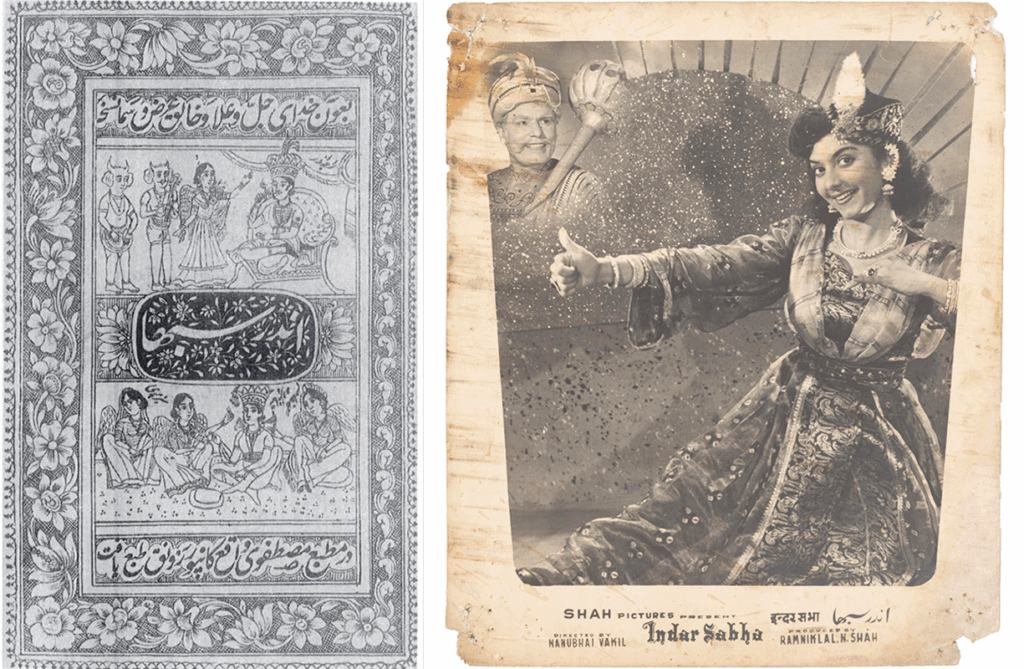
Staged numerous times by Bombay’s Parsi theatre troupes well into the 1930s, its mass appeal made it a prototext for early Indian films made in the city. At least four film versions of the play by the same name were released in 1925, 1932, 1936, and 1956. The 1932 version by Madan Theatre released one year after India’s first talkie Alam Ara holds a record, unlikely to be broken, for featuring over 70 songs. Carrying the last flourish of the Awadh court’s sumptuousness and excess, Indar Sabha also codified the framework of the portable diegetic stage in popular theatrical productions of the time, where the narrative world justified a stage-within-the-stage featuring dancing women. This story-telling device, utilising a self-contained performance space that is easy to lift and place in different contexts, became one of the core “formulas” used for dance productions in Indian cinema as well.
Scholar Usha Iyer, in her book Dancing Women: Choreographing Corporeal Histories of Hindi Cinema, presents the concept of the “choreomusicking” body, which the author defines as “the many bodies that produce the on-screen performing body.” She argues that dancing spaces in Indian cinema are produced by and productive of the bodies that move through them. Drawing on sociologist Henri Lefebvre’s notion that each space bears the marks of its own history, like rings in a tree trunk, Iyer explains how the kotha and cabaret dance numbers in Indian films echo older forms of performance and pleasure. In light of Iyer’s work, it can be said that dance performances where the film’s mise en scène utilises the stage within the story — from the tawaif pirouetting in her kotha to the vamp shimmying in a bar to the now ubiquitous Bollywood “item number” — trace a direct line to the song-and-dance spectacle first modelled by the Shah’s paris in Indar Sabha.
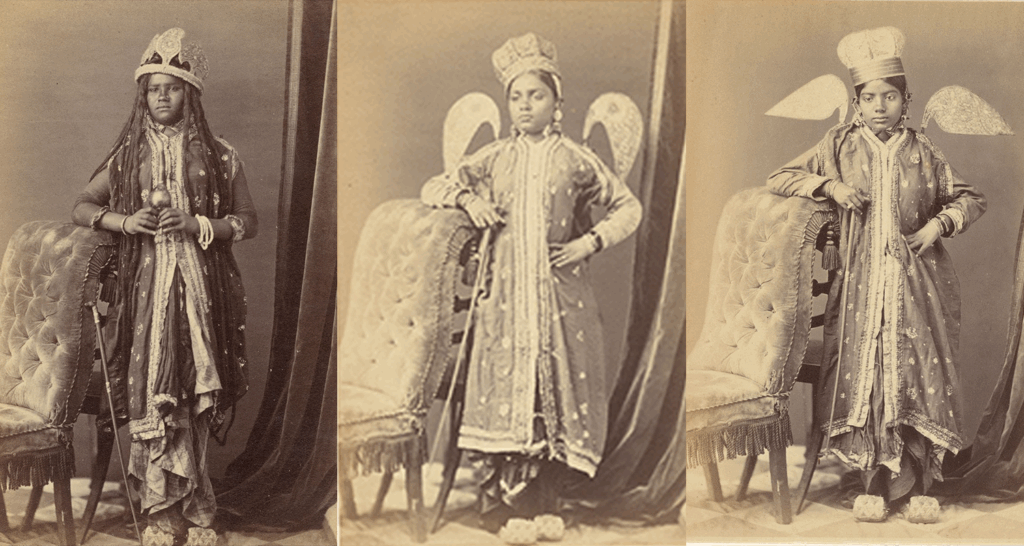
It is unclear when and how the play made its way from Lucknow, its origin city, to Mumbai (then Bombay), home to what was to become the Hindi film industry. But the first recorded performance of Indar Sabha in Bombay was by a Parsi theatre troupe Alfred Natak Mandali in 1864 — a decade after it was first staged in Nawab Wajid Ali Shah’s court in 1853. Parsi theatre companies would go on to play a crucial role in the drama’s spread across India and South Asia. While Parsi theatre had emerged from a failed European theatrical enterprise in Bombay, it mostly staged plays that were either European or stories from Persian myths. Hansen documents how Parsi companies sold such spectacles. Playbills advertised “white misses [gori-gori misen] who will present enchanting songs and dances” and promised “Houris from Iran, Fairies from Bombay.” Parsi theatre, with its promise of fantasy and desire, thus became the bridge between courtly performance and the cinema hall.
Indar Sabha was the first Urdu play to appear in Parsi theatre. In The Parsi Theatre: Its Origins and Development, Somnath Gupt recounts a stage production where an actress Latifa Begam, who played Sabz Pari (the Emerald Fairy), “made the playhouse on Grant Road reverberate, and spectators came just to see her. She would dance for so long that her socks began to tear. One day she was abducted from the wings by a spectator who wrapped her in his overcoat, seated her in his carriage, and whisked her away.” The episode highlights the intensity of the spectacle and the gaze that the play evoked.
The stage within the story of Indar Sabha has been replicated across genres and epochs of Hindi cinema, from apsara, tawaif, cabaret dancer to classically-coded heroine-dancers.
The fairies’ colours became cues for production: their costumes matched the gemstones they represented, and the stage was lit in the hues of their individual colours. Hansen writes, “As the pageant proceeds, the fairies assembled on stage form a rainbow. Their songs suggest an abbreviated barahmasa, a favourite nineteenth-century song form that depicts the erotic possibilities of the twelve months.” These performances, she notes, resembled an early fashion show, where singing, acting, and appearance converged. The play’s prologue, Hansen adds, also foreshadows the modern variety show, a format still central to South Asian popular culture, where performers and troupes take to the stage in an ordered entertainment lineup, presented before an audience or a dignitary for judgment.
This merging of spectacle, fashion, and performance finds an uncanny echo in later film songs. As Usha Iyer observes, the ramp introduced in the dance number “Ek Do Teen” in Tezaab (1988) turns the film set into a fashion runway, positioning the heroine as both performer and model. Raised above the crowd, the ramp — borrowed from the geometry of the vamp’s nightclub stage — elevates the heroine, who remains visible yet untouchable. Similarly, in Bunty aur Babli (2005), Aishwarya Rai’s nightclub mujra “Kajra Re” brings together the tawaif, the bar dancer, and the Bollywood “item girl” in what Iyer describes as a Kathak-derived performance staged in a nightclub.
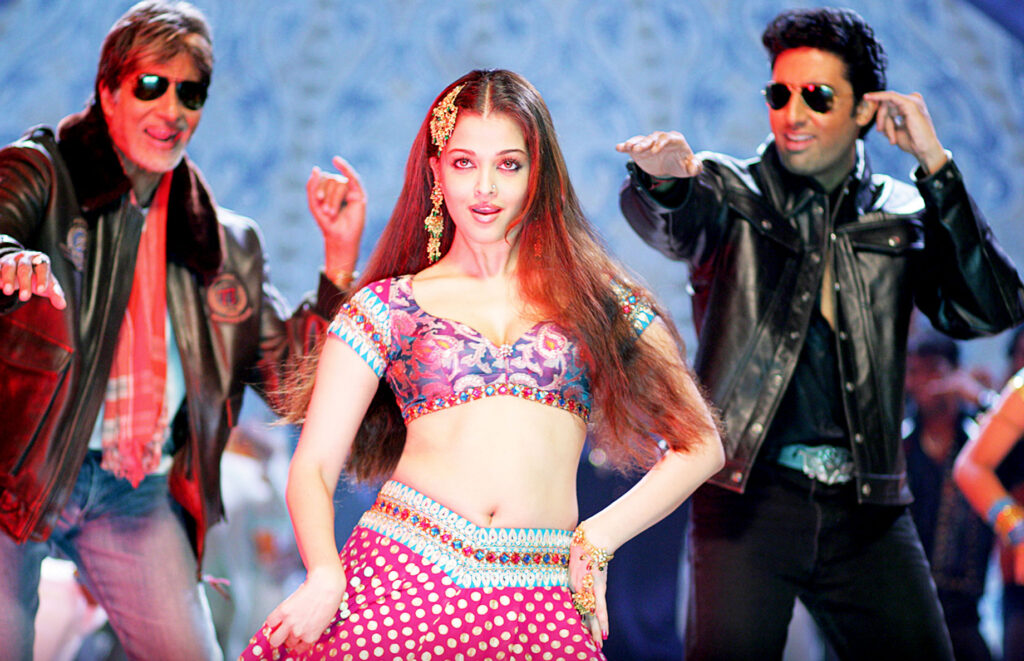
The stage within the story allows the audience to watch the performance, one place removed, and guided by the diegetic audience. This template has been replicated across genres and epochs in Hindi cinema — from apsara to the tawaif and cabaret dancer or the “vamp,” to the classically-coded heroine-dancers — to embody desire and agency like the “ashiq” fairies of the Indar Sabha. While the cultural valence of the dancing woman shifts, the structural function of this staging, to offer a spectacle of pleasure, stays the same. In this continuum, Sadhona Bose, Vyjayanthimala, Waheeda Rehman, Helen, Madhuri Dixit, and others stood in for the fairies of Raja Indar’s court. The dancer-actress is central to the cinematic architecture of Indian films. Her presence demands choreography and space, a set designed for the viewer’s gaze and the camera’s movement.
A century and a half later, as a Bollywood heroine steps onto a glittering set to the opening bars of an item song, somewhere in that light and rhythm and gaze is the shadow of a fairy with clipped wings, dancing her way back to heaven.
First published: March 20, 2026