Interior Worlds: Photography and the Studio in India
Writer and editor Varun Nayar explores the emergence and evolution of studio photography in India and its legacy in both professional and domestic spaces.
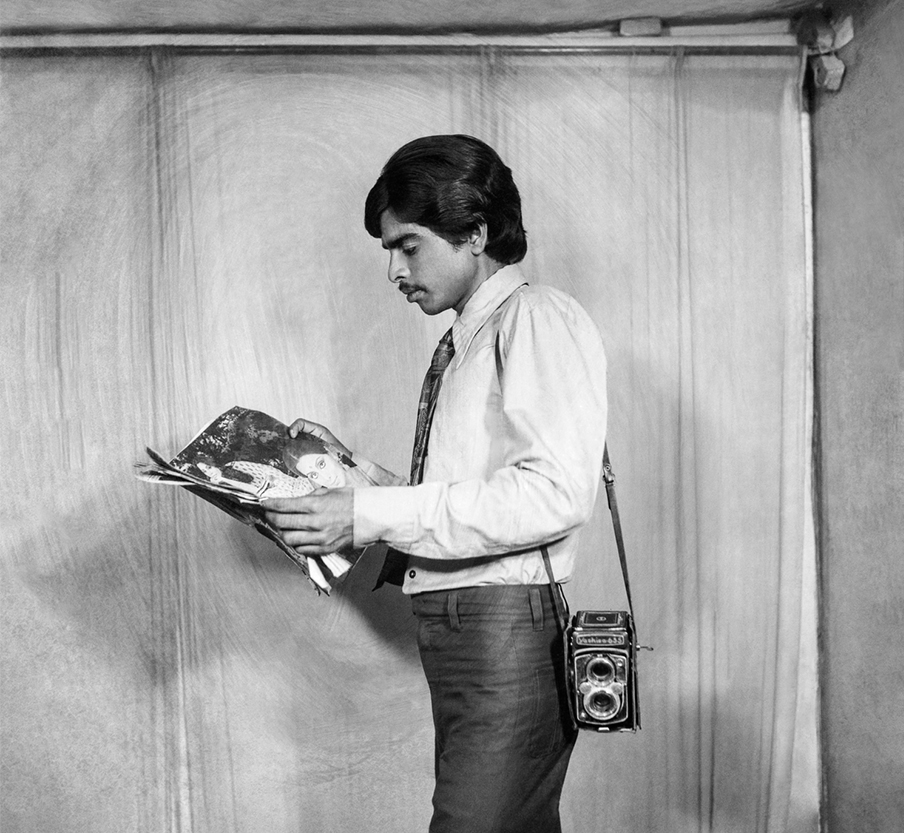
Untitled (Man with a camera); Suresh Punjabi; Suhag Studio, Nagda, Madhya Pradesh, India; 1985–1986; Celluloid negative; 6 x 6 cm. Museum of Art & Photography (MAP), Bengaluru
In 1866, British photographer Samuel Bourne trekked to Manirang Pass at an elevation of 18,600 feet in the Western Himalayas, to make this image.
The tiny specks you see here are people, trudging over a thick blanket of snow, amid towering peaks.
Bourne’s dramatic landscape view holds within it a story about early photography in the Indian subcontinent.
The making of that image was a grand logistical operation, including journeying with an entourage of eighty porters, several glass plates and chemical boxes, and even a mobile darkroom tent.
Journeys such as Bourne’s were the result of access to extraordinary resources and colonial infrastructures of power.
This access, and the commercial interest in such imagery, dictated what we see in photographs from the time.
The medium was both a colonial tool and a business opportunity. British administrators, wealthy hobbyists, and traders used it to either document and affirm imperial control, or depict colonies in an exotic light for economic and political gain.
There was money to be made in selling photographs. Bourne’s objective was clear: To capture a piece of the empire for a curious European public, and brand it as a product of his business: Bourne & Shepherd.
After its introduction in the 1840s, photography became a popular medium, giving rise to many vendors. India, and other British colonies, became an early testing ground, giving rise to a new set of businesses that soon defined the history of images in the region: photography studios.
In the nineteenth century, most photographs were being made, processed, and sold through studios. Bourne & Shepherd was one of the earliest.
Fixed in place, often situated in bustling colonial cities, studios became the epicentre of photographic production, offering efficiency, export opportunities, and commercial growth for its owners.
Studios were not just commercial spaces; they were melting pots of regional, political, and cultural influences, bringing diverse ideas, aspirations and identities into frame. Seen today, they help us understand the social structures, commercial practices, and popular attitudes that shaped photography’s growth in India.
Photography emerged at a time of great enthusiasm for European realism, empirical observation, rationality, and classification. Early photographs were broadly considered an extension of painted portraiture and a new way to document and represent people and cultures.
This perspective, and photography’s relative speed, made it a fitting vehicle for Victorian-era Britain’s global ambitions. Photography soon became instrumental to colonial statecraft.
Dr. John McCosh, a surgeon in the East India Company, was one of the earliest photographers in India and Asia, documenting British military campaigns and native people.
The new technology was quickly embraced by early photographers such as Linnaeus Tripe, who, as part of British government surveys, used photography to document architecture in its colonies of India and Burma.
Photography aided drafts of urban plans and records of India’s historical sites.
Images of railway construction, bridges, and cityscapes illustrated transformation under British rule. These images were often used in official reports and promotional materials, reinforcing the narrative of progress and control.
Photography was also used to supplement written and drawn representations of India’s various indigenous communities. To visually survey, categorise, and document the subjects of the empire, producing colonial knowledge and hierarchies of power, and race.
Colonial photographers constructed typological studies of caste, tribe, and community, reducing individuals to objects of study.
Even though these ethnographic portraits were meticulously staged, often through the affordances of studios, the men behind the cameras were seen less as photographers and more as “photographer-administrators,” serving a broader political and commercial vision.
In elite spaces, and with the rise of studio businesses and branding, photography was quickly adapted into commercial portraiture. These studios were not just sites of portraiture but also photographic supplies, selling equipment and chemicals. They also often hired Indian assistants who later on became photographers themselves.
In Bombay, civil servant William Johnson opened a studio in 1852 and helped found the Photographic Society of Bombay, working closely with Indian photographer Dr. Narayan Daji, a member of the society’s council.
Around the same time, photography classes began in Bombay and Madras, drawing in largely Indian students.
Hurrychund Chintamon was among the earliest Indian photographers to gain commercial success and was a student of photography in Bombay. He went on to photograph small, travel portraits of European officials and Indian royalty. He eventually established a studio of his own. Indian photographers were no longer just technicians; they were also becoming entrepreneurs and visual narrators.
Lala Deen Dayal, once a Public Works Department employee, established one of India’s most successful studios in Indore in 1874. Throughout the concluding decades of the nineteenth century, Deen Dayal was an official photographer for several viceroys, made images for the Archaeological Survey of India, and was the court photographer for royalty such as Tukoji Rao II, Maharaja of Indore.
In the studio, Deen Dayal used Victorian visual codes—three-quarter profiles, regal drapes—to project Indian sovereignty and elite status within colonial hierarchies.
Indians would often adopt these codes while retaining cultural attire and regalia, marking a duality of identity.
Indian studio portraits drew heavily from the British aesthetic of ornate chairs, dramatic lighting, and illusionistic backdrops. This was because Indian and British colonial officers occupied the same institutional and social spaces. In many cases, they also had similar buying power.
The inherently British props and aesthetics allowed Indian sitters to construct aspirational elite personas. A studio portrait was not just documentation; it was performance, manipulating and projecting desired identities.
Indian royalty like Ram Singh II, then-king of Jaipur, picked up photography out of personal curiosity. Many believe that he was first exposed to the medium by the British photographer T Murray in the 1860s.
He photographed himself, his court life, and most notably the women of his palace’s zenana, a rare act that challenged traditional norms of visibility, yet was also steeped in hierarchy.
These women lived almost entirely out of the public view, and so, the act of photographing them was yet unprecedented. The portraits serve as unique records of the regime of invisibility and domesticity imposed on many Rajput women at the time, and draw heavily from European influences to express a reformist attitude towards traditional forms of representation.
However, it must also be said that Ram Singh’s transgression of these social divisions was mostly limited to an aesthetic fascination. The subjects—often unnamed—had little agency in their representation. His use of the camera illustrates both the liberating and limiting potential of the studio particularly with female subjects.
The British-trained Parsi photographer and studio practitioner Shapoor Bhedwar exhibited a deep interest in photographic pictorialism while practicing in Bombay in the late nineteenth century. He approached photography more like a painter than a technician, using strategic lighting and soft focus to give his images a dreamlike quality.
By the early 1900s, as cameras and photo materials became more affordable and commonplace, the idea of the studio as a creative space began to spread further. Within the first half of the century, there were thousands of studios scattered across India, serving a growing demand for portraiture. This accessibility allowed both clients and photographers to experiment.
One major regional innovation was painted photography—where hand-painted details were added to portraits. Blending elements of European-style portraiture with Indian miniature painting, these hybrid compositions reflected a general ambivalence, in which local, commercial and cultural modes took precedence over a fidelity to any single dominant artistic tradition.
In the 1920s, photographers and painters Khubiram and Gopilal Govardhanji worked out of a studio near the Shrinathji Temple in Nathdwara, Rajasthan, where artists sold painted mementos for visiting pilgrims. Their studio merged photography with the local manorath painting tradition, which let pilgrims depict themselves as spiritually present in temple scenes.
The studio employed local painters who hand-painted devotional backdrops, then pasted in clients’ photographed faces. This method followed an earlier practice of artists like Ghasiram Hardev Sharma, who painted over photos. But, Khubiram-Gopilal’s cut-and-paste technique made such keepsakes more affordable and popular, turning religious self-representation into a widely accessible form.
The fusion of studio photography and painting continued well into the twentieth century. Clients were depicted as mythic figures, cinematic heroes, or idealised selves.
These hybrid portraits suggest that Indian studio photography was always more than mimetic, it also was aspirational and reflective of styles of the time.
Beyond elite, courtly, and religious spaces, ‘Jhatpat’ studios, named for their speed, were also becoming popular at the time.
These employed a box camera with an in-built darkroom where photographic paper was exposed, developed, rinsed, and sold on-site.
These makeshift studios predominantly served working-class clients who didn’t have access to a full urban studio. Positioned on sidewalks or near fairs, they offered quick portraits for IDs, applications, or keepsakes. These were often portraits of necessity, and the studio operators saw their work more as a vocation than an artistic practice.
In the waning decades of British rule, photography became more prominent in anti-colonial movements, and studios also acquired an added dimension as spaces for resistance. Members of the revolutionary Hindustan Socialist Republican Association (HSRA) would often have their photos taken in studios before life-threatening missions that deviated from mainstream Gandhian non-cooperation. Such images were intended to iconise them as martyrs.
The anticolonialist Bhagat Singh’s tilted hat and piercing gaze, became a powerful symbol of nationalist resistance. Unlike typical studio photos meant for private use or administrative study, these portraits were made to be shared, circulated in posters, newspapers, and paintings to inspire India’s independence struggle.
By the mid-20th century, India had gained independence, and photography continued to change. Cameras were becoming smaller and easier to carry, but they remained costly for most people.
Cities like Delhi and Bombay became centres of photojournalism. Pioneering photographers like Kulwant Roy and Homai Vyarawalla had already captured key moments from the independence struggle, including appearances by political figures like Mahatma Gandhi, Jawaharlal Nehru, and Muhammad Ali Jinnah for the national press.
They were followed by a younger generation that included Raghu Rai, Pablo Bartholomew, and TS Satyan, who became increasingly engaged in photography’s capacity to express the country’s cultural history and sociopolitical present.
While urban photographers focused on the nation’s changing political and cultural landscape, studio photography found new life in India’s small towns and villages. Studios became essential in documenting everyday life in a country in flux.
They saw clients navigating shifts in family structures, jobs, and migrations. Across thousands of such studios, photography remained a tool for memory and performance, used in everything from ID cards and resumes to festive portraits and ritual celebrations.
The small-town studio became a site of personal expression as well as formal documentation.
Families commissioned portraits of eligible bachelors and brides-to-be to share with relatives and potential matches. Wedding portraits and photographs of newborns soon followed.
Festivals like Raksha Bandhan, Karva Chauth, and Eid brought people to the studio dressed in their best, seeking images to mark joyful moments.
These sessions were often staged with fantastical painted backdrops showing props like telephones, cameras, and clocks — visualising modernity in small-town India and capturing the aspirational mood of the times.
Women who were traditionally required to maintain modest and meek appearances in public, especially in presence of male family members or community elders, negotiated agency and individual desire in the studio.
In the second half of the twentieth century, the emergence and growing commercial popularity of India’s post-Independence film industries was consequential to how people saw themselves as studio subjects.
By the 1950s and 60s, people were presenting themselves as film stars, with carefully posed portraits echoing what they saw on screens. Studios began offering cinematic self-presentation as a service through backdrops and props. Photographers played with lighting to create shadows and moods.
Fantasy merged with reality in creative, accessible ways, allowing people to step into a version of stardom, however fleeting.
By the 1990s, cameras were increasingly being made and marketed as a take-home technology—both film and digital. As the Indian economy liberalised, affordable digital and foreign-made cameras flooded the consumer market.
Many studios embraced new tools, shifting from film to digital photography, but with cameras becoming easier to buy and use, people no longer relied on studios the way they used to. Image-making became an individual exercise.
This shift caused a sharp decline in traditional studio photography. Studios began focusing more on image processing rather than portrait sessions. Many struggled to stay afloat, while others adapted with expanded services like printing, framing, or e-commerce.
Some studios survived through constant reinvention. GK Vale & Co. of Bengaluru, established in the early 1900s, was one of the first to offer colour photography in South India. It later grew into a franchise, remaining successful by adapting early-on.
Others weren’t so lucky. In 2016, Bourne & Shepherd in Kolkata closed its doors, over a century after its founder passed away.
More recently, scholars and artists have started to rediscover studio photography’s cultural and aesthetic value. Anthropologists like Christopher Pinney and Zoé Headley are preserving photo archives from small-town and regional studios.
Contemporary photographers like Ketaki Sheth and Pushpamala N have also responded to the legacy of studios. Sheth’s work documents fading studio spaces to highlight what she sees as a forgotten aspect of Indian photographic history.
Pushpamala uses satire and performance to critique colonial-era studio photography in TK series.
Composed of “fantasy” studio photographs, the project features her in the role of the sitter, deliberately uncovering the artifice of the colonial gaze through a pronounced and nakedly satirical style of photo-performance.
Efforts such as these reclaim the studio as more than a backdrop or context. They show it as a layered space of power, memory, and performance — a place where India’s visual history was created, contested, and preserved.
Looking at the evolution of photography studios in India is like holding up a mirror to the country, reflecting the many changes that it witnessed and embodied over two remarkable centuries.
Varun Nayar is a writer, editor, and the Director of Impart. He has a background in journalism and art publishing, with a particular interest in the global histories of photography. His work has appeared in Aperture, ArtReview, FOAM, Words Without Borders, Himal Southasian, and National Geographic, among other publications and catalogues.
Ashirwad Mahaprashasta, Ajoy. “Identity Narratives.” Frontline, November 14, 2014. https://frontline.thehindu.com/arts-and-culture/identity-narratives/article6544816.ece.
Gaskell, Nathaniel, and Diva Gujral. Photography in India: A Visual History from the 1850s to the Present. Munich; London; New York: Prestel, 2018.
Mahadevan, Sudhir. “Archives and Origins: The Material and Vernacular Cultures of Photography in India.” Archives 4, no. 1 (2013). http://hdl.handle.net/2027/spo.7977573.0004.103.
Mitter, Partha, ed. The Artful Pose: Early Studio Photography in Mumbai, c.1855–1940. Ahmedabad: Mapin Publishing, 2010.
Nayar, Varun. “The Business of Dreams: Photographs from the Studio of Suresh Punjabi.” Impart, December 11, 2020. https://imp-art.org/perspectives/dispatches/the-business-of-dreams-photographs-from-the-studio-of-suresh-punjabi/
Narendra Luther. Raja Deen Dayal: Prince of Photographers. Hyderabad: Creative Point, 2003.
N. D. Goswamy, B. “The Photographer Prince.” The Tribune (Chandigarh), March 12, 2017. https://www.tribuneindia.com/news/archive/arts/a-photographer-prince-376061.
N. Dutt, Ishita Ayan. “Studio Stories.” Business Standard, June 25, 2016. https://www.business-standard.com/article/beyond-business/studio-stories-116062401251_1.html.
Pinney, Christopher. Camera Indica: The Social Life of Indian Photographs. London: Reaktion Books, 1997.
Pinney, Christopher. “Stirred by Photography.” In Allegory & Illusion, 12–29. Ahmedabad: Mapin Publishing, 2013.
Pinney, Christopher, and Suresh Punjabi. Artisan Camera: Studio Photography from Central India. Chennai: Tara Books, 2014.
Pushpamala N., and Clare Arni. Native Women of South India: Manners and Customs. New Delhi: Nature Morte, 2007.
Rahaab Allana. “The STARS Archive and an Upcoming Photography Symposium on South Asia.” PIX. http://www.enterpix.in/pix-post/discussing-the-stars-archive.
Sampson, Gary D. “The Success of Samuel Bourne in India.” History of Photography 16, no. 4 (1992): 336–347.
Sudha, Laura Weinstein. “Exposing the Zenana: Maharaja Sawai Ram Singh II’s Photographs of Women in Purdah.” History of Photography 34, no. 1 (2010): 2–16.
Thomas, G. “The First Four Decades of Photography in India.” History of Photography 3, no. 3 (1979): 215–226. doi:10.1080/03087298.1979.10441106.
Ullas, Shruthi Susan. “Sepia to Colour: 100 Years of G.K. Vale.” The Times of India, March 21, 2010. https://timesofindia.indiatimes.com/city/bengaluru/Sepia-to-colour-100-years-of-gk-vale/articleshow/5706945.cms.