Awadh Reimagined: A Painter’s Perspective
Archi Banerjee examines how eighteenth-century Awadh’s painted cityscapes reflect the art, architecture, and politics of the period.
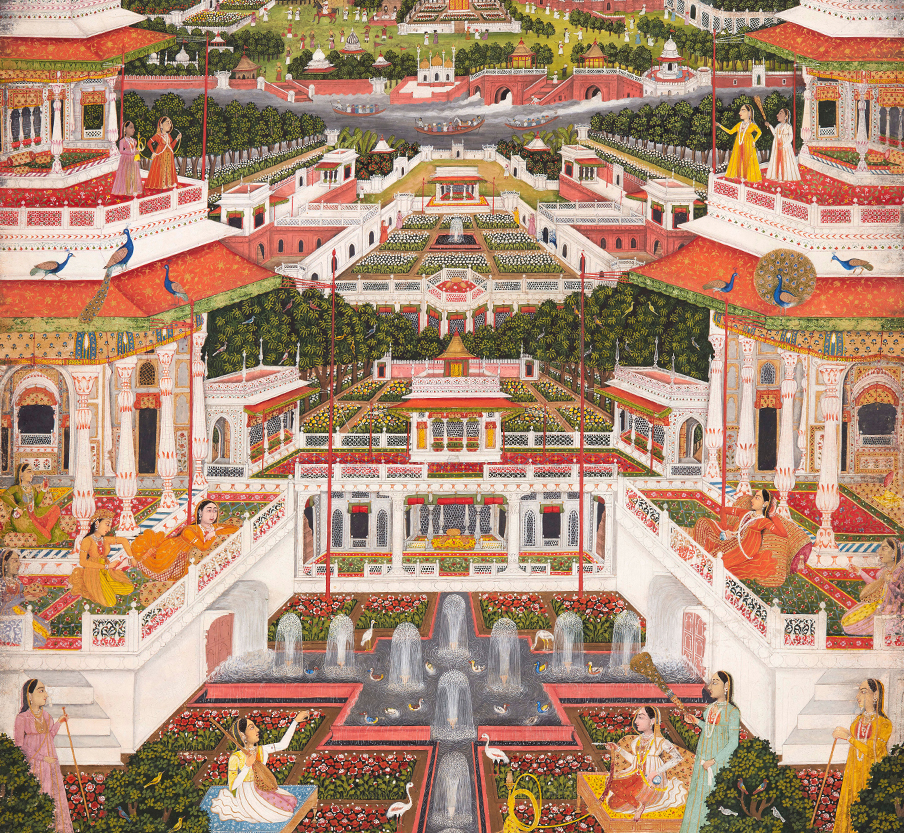
Palace complex with harem garden (detail); Attributed to Faizallah; Faizabad or Lucknow, India; c. 1765; 45.5 × 31.8 cm. David's Collection, Copenhagen
Red-roofed buildings stretch into the distance interspersed with well-maintained palatial gardens in the foreground and the city’s public parks in the background. The waterways and ghats outside the palace grounds teem with boats and traders.
A grid of bridges and roads complete the scene in this artist’s take on the Nawab’s city — a vision of urban symmetry and planning.
It is another day in a bustling eighteenth-century city in Awadh, northern India. Our eyes are drawn to the richly-dressed denizens of the Nawab’s harem and little scenes from their lives.
This exquisite, dynamic artwork, with its multiple horizon points, and a rich, multi-layered composition, belongs to a group of topographical paintings created between 1765 and 1775 at the Nawabi court of Awadh in Northern India. At the time, Shuja ud Dawla was on the throne of Awadh and the capital city was Faizabad.
The most distinctive feature of this group of paintings is the use of a perspectival technique.
The method creates an illusion of a three-dimensional space on a flat surface where countless scenes unfold simultaneously.
A visual trick — one that provides an almost gravity-defying view of the entire city.
The artist leads our eyes from the foreground — the inner courtyard of the palatial complex — to the background — where daily life unfolds. This is achieved by using architectural elements such as angled rooftops and also figurative elements like the ladies of the court placed at different levels of the buildings.
This particular painting, and indeed many others of this style, have been attributed to the painter Faizallah.
Faizallah’s artistic lineage can be traced back to his father, Faqirallah Khan, and grandfather, Muhammad Afzal, who were both artists at the Delhi court, trained in the imperial Mughal style.
Around the 1760s, the family migrated to Awadh and began adapting their styles to suit their new patrons.
They were not the only painters migrating away from Delhi.
As the central Mughal authority began to weaken, especially after Nadir Shah’s invasion in 1739 and subsequent raids, the imperial atelier was dismantled.
Artists who were masters of the Mughal painting idiom dispersed to new centres of patronage, moving to the erstwhile provincial courts of Murshidabad, Awadh, Hyderabad and Punjab hills. The nawabs of these regions had by then started asserting their autonomy.
In Awadh, a growing political centre, successive nawabs sought to establish a distinct sovereign identity, distinguishing them from the crumbling Mughal Empire and rival regional powers.
But the Mughal cultural idiom — reflected in the empire’s architecture, art, literature, music, courtly customs, dress, and jewellery — still held sway.
Provincial rulers initiated a frenzy of building activities that rapidly transformed the landscape of their territories.
Like the Mughal emperors, they used urbanisation as a way of asserting and projecting their authority and dominance.
Faizallah’s topographical paintings, with their ambitious spatial scope, serve as historical artefacts that document the rapidly changing spatial and socio-political landscapes of Awadh in the late eighteenth-century.
An aerial perspective — which is a hallmark of these topographical paintings — was already introduced into the Mughal style of painting by the late sixteenth century, during Akbar’s reign. Examples of such artwork, with expansive views, sought to highlight the sovereign’s command over space.
In early eighteenth-century paintings, a top-down, bird’s-eye view re-emerged, especially in the royal ateliers of regions challenging Mughal authority.
The Mewar Ranas, from the province that covered the southwestern portion of present-day Rajasthan, for example, commissioned large, sprawling topographical paintings of palaces, lakes, and cityscapes as early as early eighteenth-century
In Awadh, the first group of artists that had arrived from Delhi in the 1740s, such as Mir Qalan Khan, had already begun expanding the spatial depth in their paintings.
They incorporated elaborate terrace scenes, showing receding views of enclosed gardens and cityscapes in the background.
Faizallah belonged to the second wave of artists who moved to Awadh from Delhi and developed the style further.
Art historian Dr. Kavita Singh proposes that he was influenced by Mughal spatial traditions, while also selectively borrowing from European architectural prints circulating at the time.
As a result, he used ‘perspective as a tool to convey space’. In essence, he crafted a uniquely complex genre with its own conventions. Messages were conveyed in layers, both in composition and meaning, much like the buildings his paintings depicted.
Many similarly arranged paintings — in the style popularised by Faizallah — were made around this period (1765–75). All of them use multiple lines of perspective, making the eye move from the front to the back.
As a result, the viewer discovers magnificent details of the activities happening both within the palatial complexes, and outside them, in the sprawl of the cities that surrounded them.
The background and foreground is often separated with the use of a horizontally flowing river.
There is a direct contrast between the leisure activities and luxuries depicted in the inner chambers of the palace in the foreground, as compared to the busy outer landscape.
The depiction of life outside the palace grounds is replete with references to trade and other laborious daily activities of ordinary subjects of the princely state.
Some paintings depict sieges, captured forts, figures fighting on horseback or elephants and troops going to war in the far distance but always outside the city limits.
The use of space in the imagery was not just an aesthetic choice. Themes such as pleasure and danger, comfort and struggle, private leisure and a productive society were depicted in the paintings.
Such subject matters allude to the complex circumstances that shaped the experiences of both the artists and their patrons during this time period.
Although Awadh’s newfound autonomy had resulted in a rich cultural and artistic renaissance in the region, Shuja ud Daula’s plans of expansion were halted by his defeat to the British East India Company (EIC) at Buxar in 1764.
Thereafter, he relocated his capital from Lucknow to Faizabad and focused on rebuilding his prestige. This included extensive architectural projects in Faizabad.
At the time that these paintings were created, Faizabad was still developing.
While these paintings represented the architectural ambitions of the Nawab, the ground realities of Faizabad may have been far less orderly and grand.
Poets from Delhi who had migrated to Awadh were critical of the emerging cities in the region in their poems. Yet, painters continued to depict Awadh’s cityscapes as visions of idealised order under the ruler’s protection.
This was most likely at the instruction of the Nawab wanting to rehabilitate his image after his humiliating defeat.
In the technical choices made by the artists, political aspirations are apparent.
Walls bend to expose arches, windows, and stairs, while rooftop canopies lean downward to display costly gilding and plush seating.
Incorporating such details, which would otherwise be hidden or blurred with distance, helped the artists emphasise the opulence and grandeur of the city and by association, the Nawab’s rule.
Artistic tropes around the leisurely pursuits of elite women within the palace walls and vast idealised spaces of life and labour beyond the river reinforced the idea of a peaceful and productive urban landscape that flourished under the Nawab’s rule.
In addition, scenes of war featured in the background in some depictions, alluded to changes in the political climate.
They reflected the Nawab’s involvement in many battles and negotiations to keep the encroaching EIC at bay.
Elite circles in Awadh at this time also included a number of Europeans who were in the service of either the Nawab or the EIC. They too collected and commissioned paintings by Awadhi artists.
Of them, Antoine Polier and Jean Baptiste Gentill exerted significant influence on the further development of this style of painting.
Polier, a French-Swiss army man and military engineer, was appointed by the EIC as the chief architect and engineer in the Nawab’s court. He helped design buildings and fortifications in Faizabad. Lacking formal training in architecture, military engineers like him often used manuals such as Colen Campbell’s Vitruvius Britannicus (1715-1725) as a design reference.
Awadhi painters may have seen such prints with depictions of architectural vistas.
When comparing these prints with the topographical paintings, striking similarities emerge in the overhead angles, symmetrical structures and gardens.
Gentill was a French military man who was hired by Shuja to modernise his military.
He was actively engaged in producing maps of Awadh and topographical views of the region.
He would often employ Awadhi artists to draft overviews and maps that were surrounded by miniature vignettes of local flora, fauna, and customs, derived from older Mughal images.
It is likely that such interactions made Awadhi painters more receptive to further fusion in styles.
Most importantly, they would have become familiar with a variety of cartographic and spatial representation techniques.
In the paintings commissioned by these European collectors of Awadh, the visual style of the topographical paintings transformed, keeping the European patrons’ interest in the spatial grandeur and sweeping vistas in mind. Here, the Nawab and other human figures appear miniaturised. Instead, the focus shifts to the vast spaces surrounding him and his subjects.
The paintings take on a diagrammatic quality, meticulously documenting courtly customs and grandeur with scientific precision rather than glorifying the ruler or commemorating important events at court.
This, perhaps, serves as a commentary on the dwindling power of provincial rulers during this period as the EIC increased its influence in the subcontinent.
Despite being patrons of art and architecture themselves, in these paintings commissioned by European collectors, the Nawab and his courtiers serve as sources of visual pleasure to the viewer rather than figures of power.
The topographical paintings done in the style that Faizallah perfected and Mihr Chand’s renditions of sweeping vistas, reflect how various social, cultural, and technological factors shaped visual experience, perception, and spectatorship in eighteenth-century Awadh society.
Archi (she/her) has a master’s degree in Entrepreneurship and Innovation from the London College of Fashion, University of the Arts London (UAL), and a bachelor’s degree in Design from National Institute of Fashion Technology. She was awarded the MEAD fellowship by UAL to study the impact of Partition on the handicraft cultures of Bengal. Through fieldwork, curatorial-projects and critical writing, she explores craft and textile heritage, cultural continuity, and the evolving narratives of displacement and identity in South Asia. She works with the Impart’s Special Projects for research and production of image-forward writing on South Asian art history.
Akshaj Awasthi, “Mihr Chand – The Awadhi Master,” The Heritage Lab, last modified October 30, 2025, accessed November 17, 2026, https://www.theheritagelab.in/mihr-chand-the-awadhi-master/
Chakraverty, Anjan. Indian Miniature Painting. Delhi: Lustre Press, 2006.
Chauhan, Arundhati. “Traversing Linear Perspective: Awadh through Faizallah’s Eyes.” Impart, September 27, 2021. Accessed August 26, 2025. https://imp-art.org/perspectives/dispatches/traversing-linear-perspective-awadh-through-faizallahs-eyes/
Cummins, Joan. Indian Painting: From Cave Temples to the Colonial Period. Boston: MFA Publications, 2006.
Di Pietrantonio, Natalia. “Desiring Landscapes: Two Paintings from Avadh, India.” The Metropolitan Museum of Art, August 25, 2015. https://www.metmuseum.org/perspectives/desiring-landscapes.
Kossak, Steven. Indian Court Painting, 16th–19th Century. New York: Metropolitan Museum of Art, 1997.
Losty, J. P. The Art of the Book in India. London: British Library, 1982.
Roy, Malini. “Idiosyncrasies in the Late Mughal Painting Tradition.” PhD diss., SOAS University of London, 2009. https://eprints.soas.ac.uk/33847/1/11010637.pdf.
Roy, Malini. “Mughal Painting by Faizallah Recently Acquired by the British Library.” Asian and African Studies Blog, British Library, May 2013. https://blogs.bl.uk/asian-and-african/2013/05/mughal-painting-faizallah-acquired.html.
Singh, Parul. “Building Worlds: Reading Spatiality, Power, and Gaze in Eighteenth-Century Paintings.” In Eighteenth-Century Indian Muraqqaʿs, edited by Friederike Weis, 370–91. Leiden, The Netherlands: Brill, 2024. https://doi.org/10.1163/9789004715837_016
Sotheby’s. “A Prince on a Terrace with Attendants, Faizabad or Lucknow, India, circa 1765.” In Arts of the Islamic World, auction catalogue, 2024. https://www.sothebys.com/en/auctions/ecatalogue/2005/arts-of-the-islamic-world-l05221/lot.40.htm .
Welch, Stuart Cary. India: Art and Culture, 1300–1900. Munich: Prestel; Chidambaram: Marg Publications, 1993.
Welch, Stuart Cary. Room for Wonder. New York: American Federation of Arts, 1978.
YouTube. “Endless Prospects, New Perspectives: View from a Terrace in 18th Century Awadh,” by Kavita Singh. Video, accessed March 3, 2025. https://www.youtube.com/watch?v=pkwbIR4KD5A.