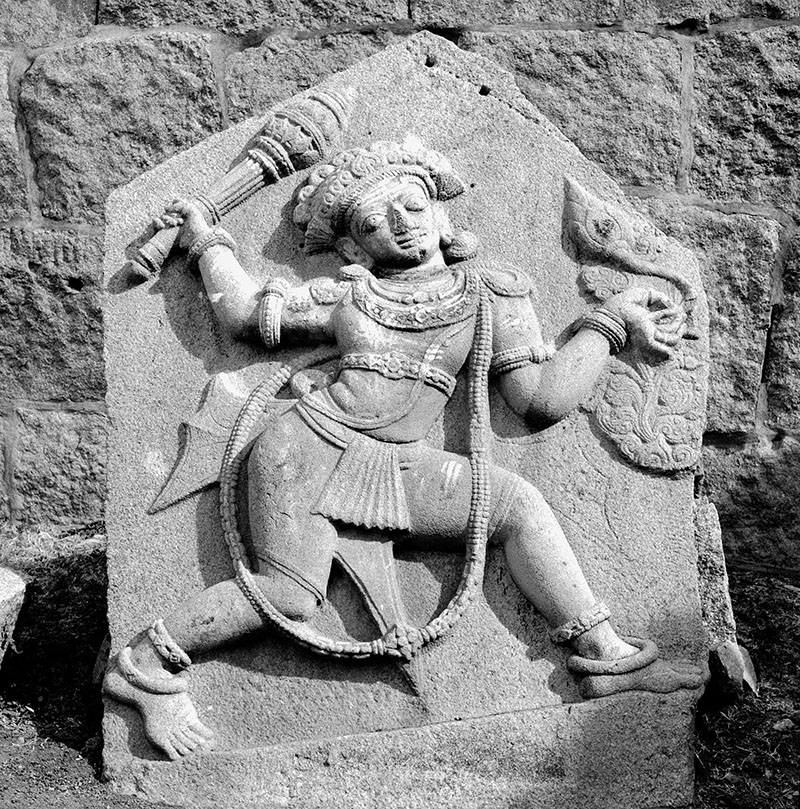
Second of the five mythical Pandava brothers and protagonists of the Sanskrit epic Mahabharata, known for his heroism, exceptional skills as a warrior, passionate loyalty, and voracious appetite. Bhima in Sanskrit means ‘formidable’ or ‘fearsome’. His superhuman strength is at times attributed to his conception through his mother Kunti’s invocation of Vayu the wind god. Early in the Mahabharata, Bhima marries the rakshasi Hidimbi and has a son, Ghatochka, who also becomes a great warrior. Bhima plays a pivotal role in the epic’s narrative: he effectively ends the Kurukshetra war by killing all hundred Kaurava antagonists. Notably, he fulfils a vow to kill Dushasana, drink his blood, and wash Draupadi’s hair with it, as vengeance for her humiliation at the Kaurava court; this episode in particular has been widely depicted in Indian art. Outside South Asia, legends of Bhima are especially popular in Indonesia.
More Definitions
Vajrasattva
A bodhisattva in the Mahayana and Vajrayana traditions of Buddhism, he is primarily associated with the Akshobhya Buddha. Iconographically, he…
Samavasarana
In Jain theology, it is a heavenly pavilion built by the gods for a Tirthankara’s (enlightened spiritual teacher) sermon after…
Pithora Dev
A deity of marriage, worshipped in parts of Madhya Pradesh and Gujarat, and the principal deity in Pithora paintings.
Samsara
The concept of the continuous cycle of birth, death and rebirth, fundamentally seen in most Indian religions, including Buddhism and…
Adimurti
Also known as Para Vasudeva, it is a manifestation of the Hindu deity Vishnu. The conventional iconography of the form…
Mahayogi
An epithet for the Hindu god Shiva where he is represented as an ascetic, sitting with his legs crossed and…
Jataka
A large collection of approximately 550 stories about the Buddha’s former lives in both human and animal form. The stories…
Devi-Bhagavata Purana
Also known as Devi Bhagavatam, it is often categorised as a Mahapurana and revolves around the figure of the Devi…