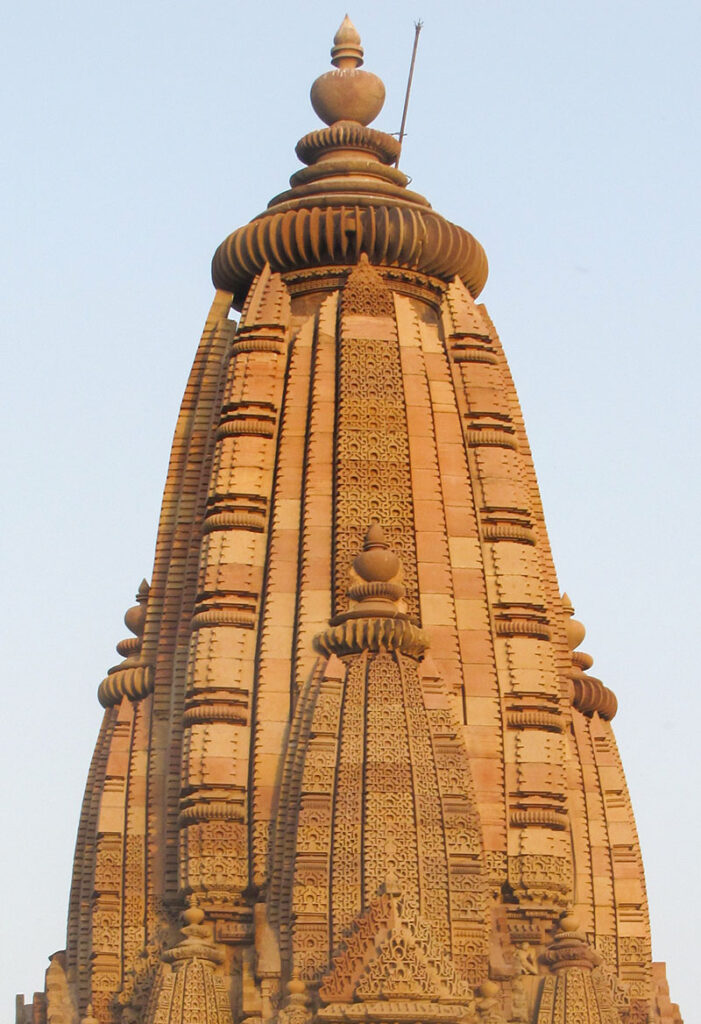
Ribbed or notched stone disk that is part of the crowning segment in Kalinga and Nagara temple architecture. The amalaka is placed on top of the temple’s superstructure or shikhara, and surmounted by a kalasha or vase finial. It is said to be named after the Indian gooseberry, amala (fruit of the tree Phyllanthus emblica), and symbolises either a lotus — the seat of the temple deity — or a gateway to the heavens.
More Definitions
Torana
Meaning ‘gateway’ or ‘arched entrance’ in Sanskrit and Pali, torana refers to a free-standing gateway marking the entrance to a Buddhist shrine or…
Shala
Derived from the Sanskrit word broadly meaning "house" or "shelter", shala may refer to a covered pavilion, often oblong; a…
Dado
In architecture, it is the space between the base and the pedestal of a column. It is also used to…
Dormer
A triangular or cylindrical projection from a roof that usually contains a window. It is an architectural motif commonly found…
Peristyle
A row of pillars surrounding an enclosed space or enclosing an open space, taking the form of a porch or…
Shikhara
A superstructure, tower or spire characteristic of North Indian temple architecture, it usually rises above the innermost sanctuary or the…
Stucco
A type of fine plaster or coating material used to cover walls and ceilings with decorative patterns, it is also…
Capital
In architecture, uppermost member of a column or pilaster, wider than the shaft and often distinctively carved or decorated in…