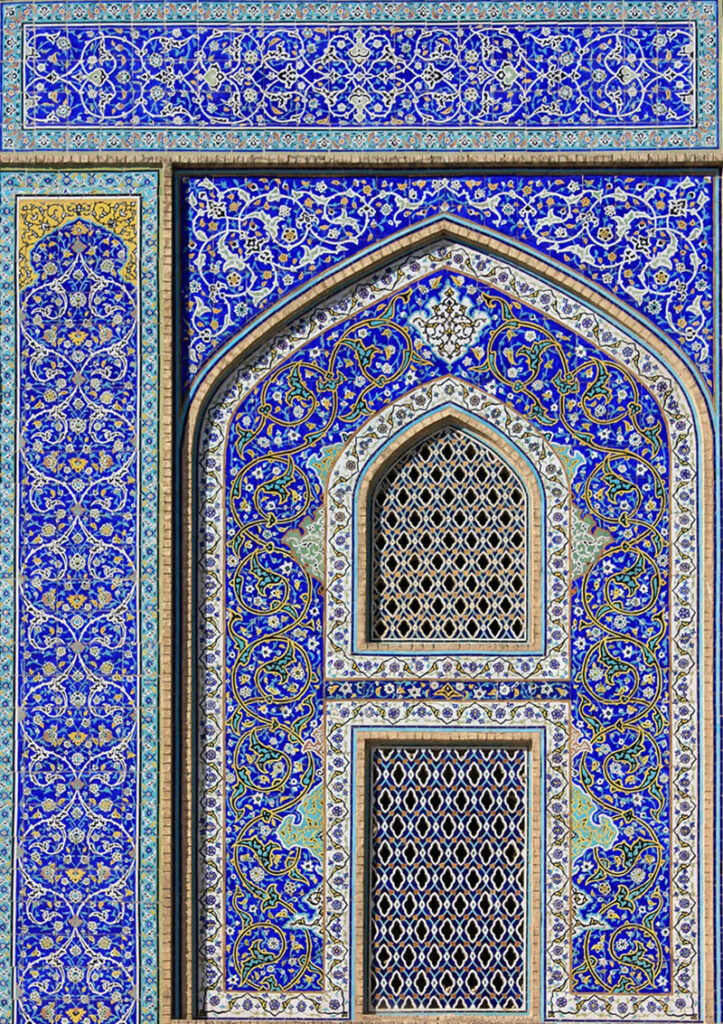
Painted and glazed ceramic ware, particularly tiles, common in the Islamic world, typically featuring colourful arabesques, floral and geometric motifs, and calligraphy on a white background. Shades of blue, green and yellow are commonly used. Kashikari (or simply Kashi) is widely seen on the cladding of buildings such as mosques, shrines and tombs in West, Central and parts of South Asia. The craft is thought to originate in Kashan, Iran — influenced by Egyptian and Chinese painted ceramics — from where it spread elsewhere, today being practised in Sindh, Punjab and Multan in Pakstan. It may derive its name from either Kashan, or kasi, Arabic for ‘glass’; Kashi artisans are known as kashigars — which is also adopted as a family name for ancestral practitioners of the craft.
More Definitions
Combination Printing
An early photographic technique wherein two or more negative images are combined to create a single image. This technique allowed…
Pietra Dura
A form of mosaic work wherein hard semi-precious stones are inlaid onto stone to form images. The decorative technique flourished…
Kasavu
The gold zari used in the border of a traditional white Kerala textile, such as a sari or a mundu…
Selvedge
The edge of a fabric that does not require additional finishing work and prevents the textile from fraying and unravelling.…
Back Stitch
A variety of the stem or split stitch, wherein individual stitches are made in the opposite direction of the embroidery.…
Rib Weave
A variation of the plain weave, it is created by passing the weft over and under the warp threads in…
Chain Stitch
A decorative embroidery technique in which the stitch consists of consecutive, interconnected loops that resemble the links of a chain.…
chamfer
A slope or bevel, typically at 45º, at the intersection between planes in woodwork, architectural and engineering detailing, and other…