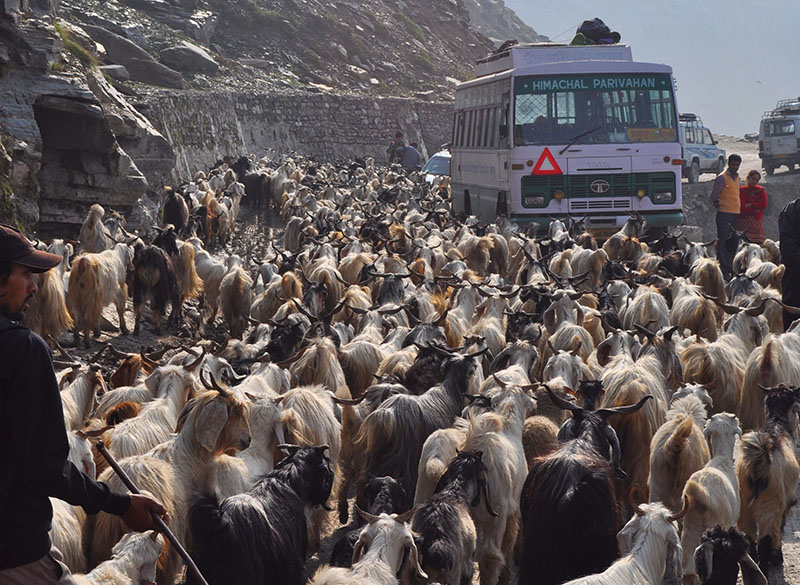
Seasonal movement of pastoral groups over long distances, between higher and lower altitudes, or other climatic zones, for the grazing of livestock. Masses of livestock are herded to pastures at high altitudes or in colder regions in the summer, and brought back for the winter when the former are uninhabitable. Often entire communities migrate, establishing temporary settlements along the route; however, they typically have one permanent settlement and also engage in agriculture. The practice draws on ecological knowledge developed and transmitted over generations, and is closely linked with various sociocultural and economic activities including specific handicrafts, food cultures and seasonal festivals. Derived via the French from the Latin trans- ‘across’, humus ‘ground’.
More Definitions
Shaliya
A traditional Indian artisanal community of weavers, known for their skills in crafting cotton saris and — since the twentieth…
Rajput
A ethnic community from the north-west region of Rajasthan, which was historically known as Rajputana. Rajputs regard themselves as descendants…
Vaniya
A community, with historical roots in the precolonial Indian subcontinent and now predominantly based in India, consisting of merchants, bankers,…
Siddi
Culturally and linguistically varied community of African descent in South Asia, mostly concentrated in the Sindh province of Pakistan —…
Hephthalite
Also known as the White Huns, they were a predominantly nomadic set of people living in Central and South Asia…
Adivasi
Member(s) of any of the heterogenous Indigenous communities of India and Bangladesh, whose social formations, cultures and religions are distinct from…
Ajivika Sect
An early sramana (ascetic) sect led by Makkhali Gosala in the fifth century BCE, it was a nastika (heterodox) school…
Digambara
Meaning “sky-robed” in Sanskrit, it is one of two major ideologies within Jainism, the other being Svetambara. The two streams…