-
ChicagoImpart Encyclopedia of Art. "Pihiya Kattha." February 25, 2025. https://imp-art.org/articles/pihiya-kattha/.
-
MLA"Pihiya Kattha." Impart Encyclopedia of Art, Feb. 25, 2025, https://imp-art.org/articles/pihiya-kattha/.
-
HarvardImpart Encyclopedia of Art (2025) Pihiya Kattha. Available at: https://imp-art.org/articles/pihiya-kattha/ (Accessed: 16 October 2026).
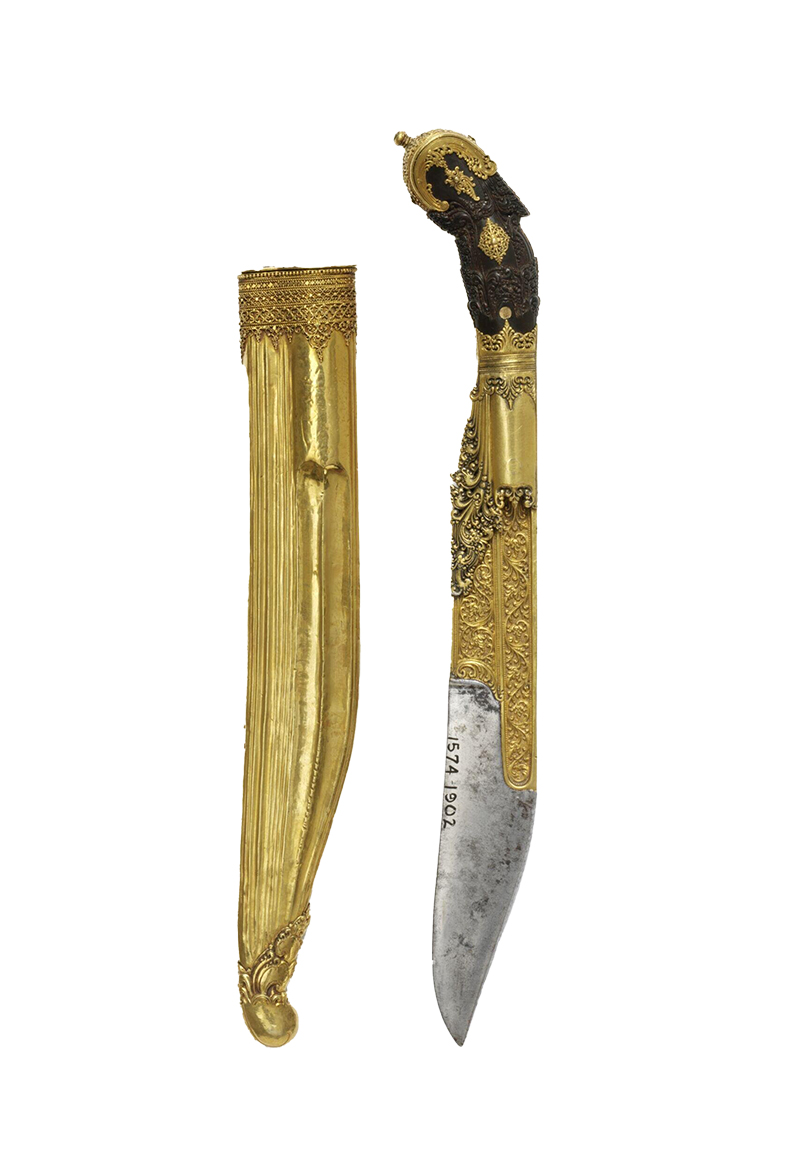
Also known as the Kandyan knife, the pihiya kattha is a type of single-edge, chopper-style knife from the Kandyan Kingdom (1469–1815 CE) of Sri Lanka. As well as being used as everyday knives and sometimes in combat, intricately crafted pihiya katthas also served as status symbols in the Kandy court.
Nomenclature
The Sinhala term pihiya kattha — also romanized as piha kaetta — has been loosely applied to a number of different Sri Lankan pihiyas (‘knife’) housed in museums. According to recent research, however, the term refers specifically to chopper knives with somewhat rough, heavy blades. The term kattha, likely derived from the Tamil kattari, means ‘beak’ or ‘billhook’ in Sinhala and also refers to sickles, though not all pihiya katthas are billhook knives. Other pihiyas include the curved vak-pihiya; the gal-mita pihiya — a chopper with a stone or crystal handle; and the ul-pihiya — a slim, acute-pointed knife typically made in a set with a palm-leaf stylus that was also carried in the scabbard.
Design
There is considerable variation in the design of knives classed as pihiya katthas, but a feature common to all is a heavy, single-edge iron blade that made them useful as choppers. The blade may measure ten to thirty centimetres in length and two to five centimetres in width. Some specimens of pihiya kattha feature single or double fullers — grooves along the spine or back of the blade that lighten and strengthen it.
In the largest pihiya katthas, the spine or back of the blade is sometimes up to a centimeter thick. It begins straight and then dips to meet the gently recurved sharp edge in a point; the blade is generally widest a little beyond halfway down its length, at the point where the spine dips. This type of pihiya kattha is often compared to the Nepali chopper knife known as the gurkhi. Smaller pihiya katthas are often mostly straight with only a small curve at the end — the sharp edge might curve up to meet a straight spine; or both edges might curve downward to make the slight billhook shape which the knife has come to be named for.
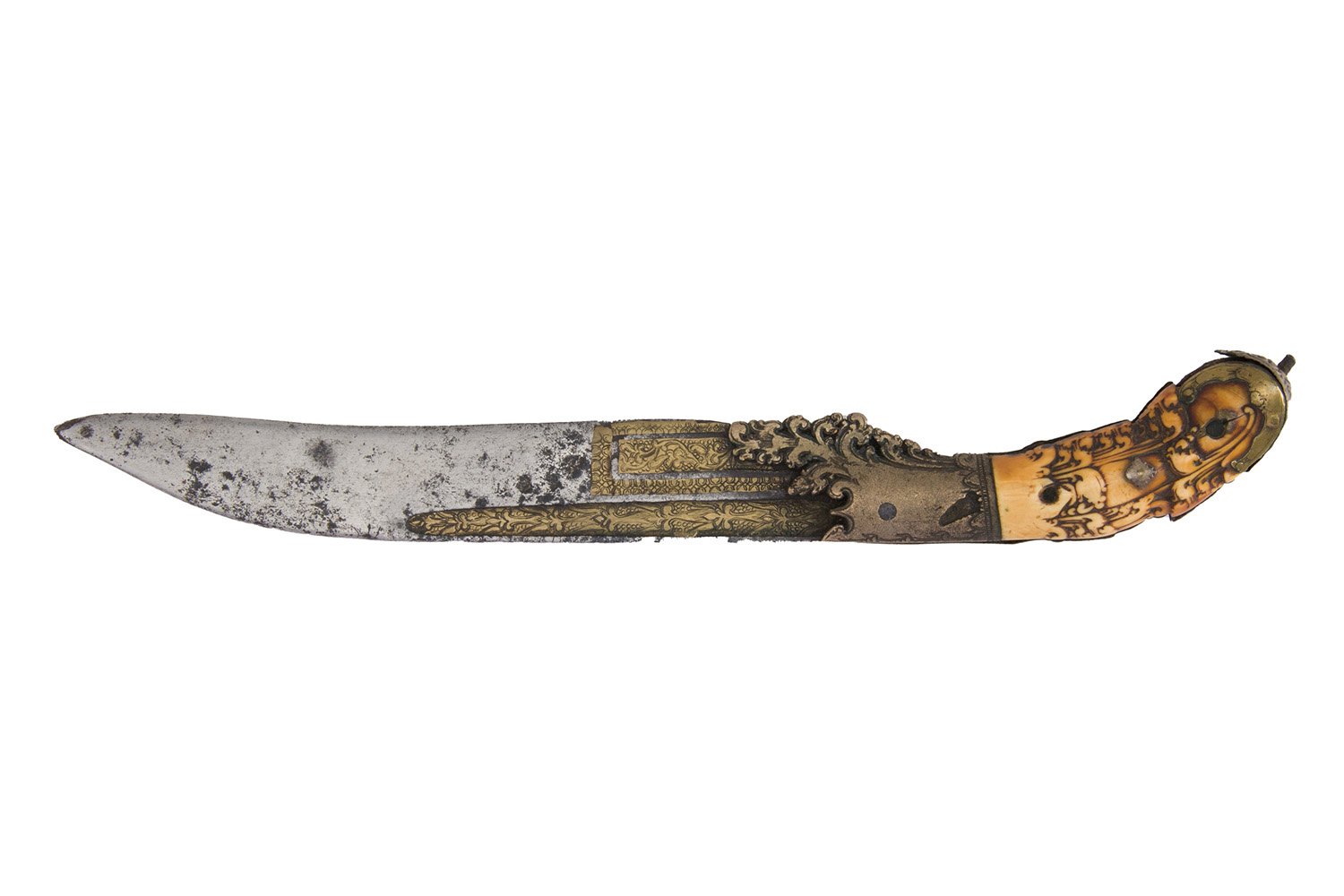
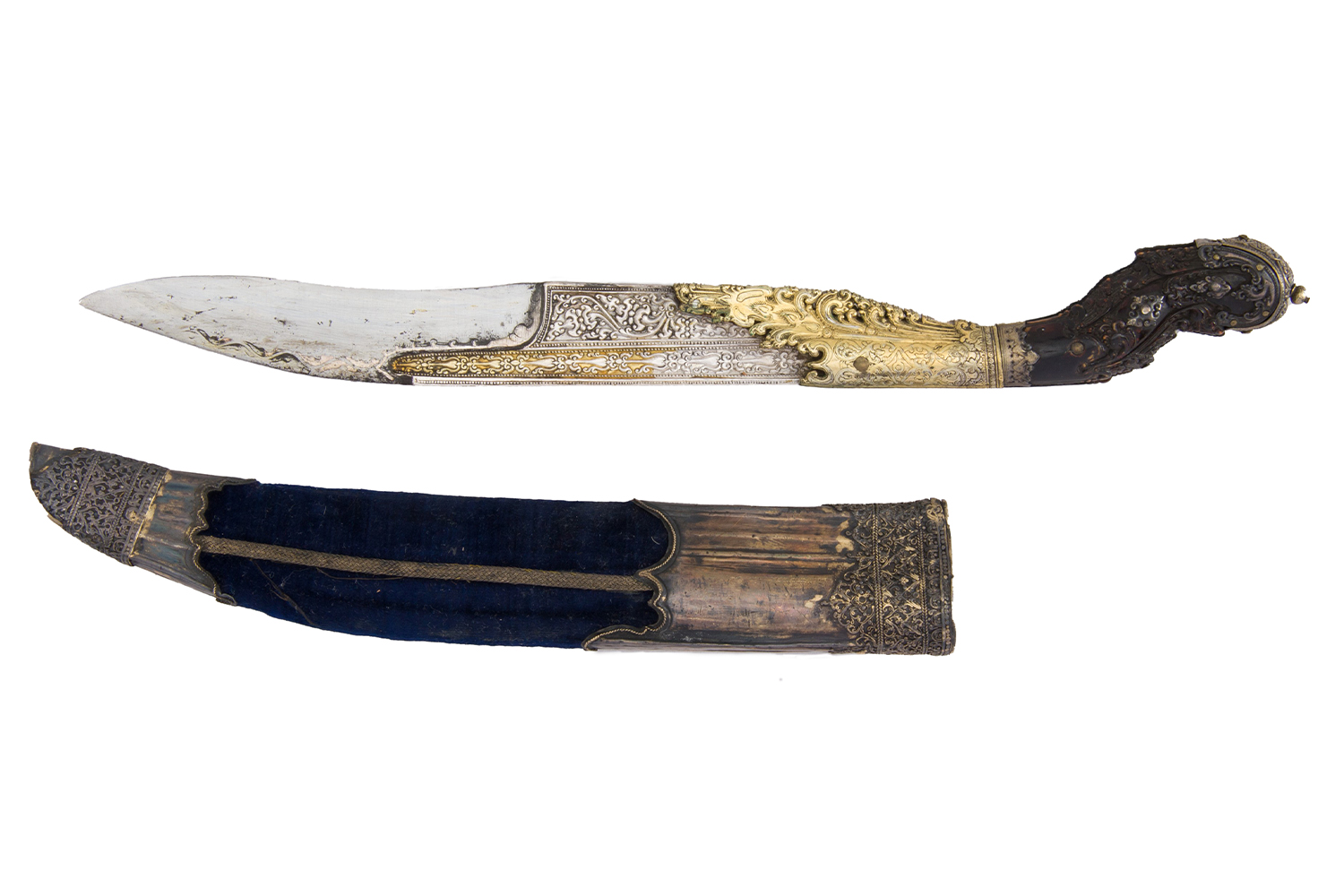
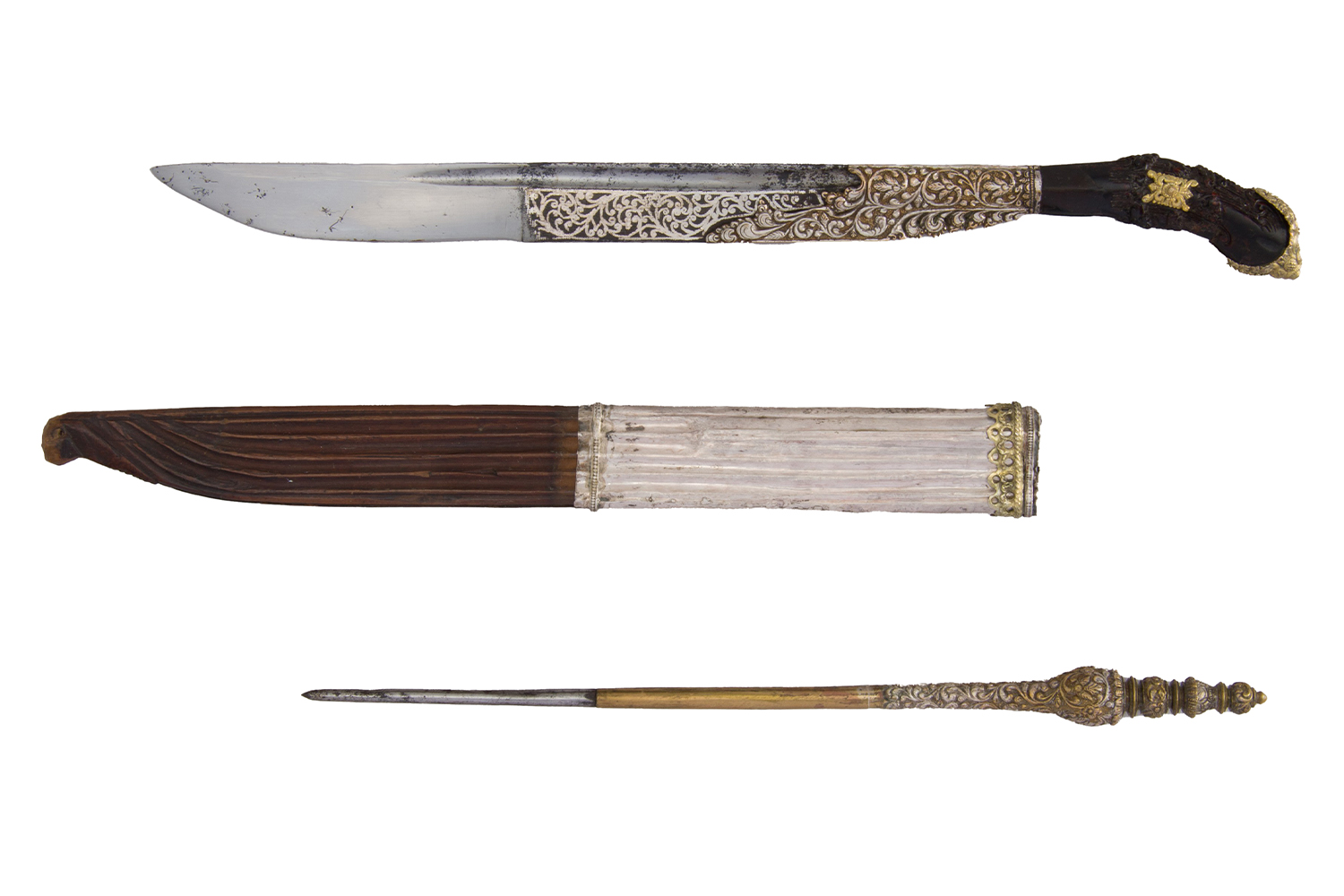
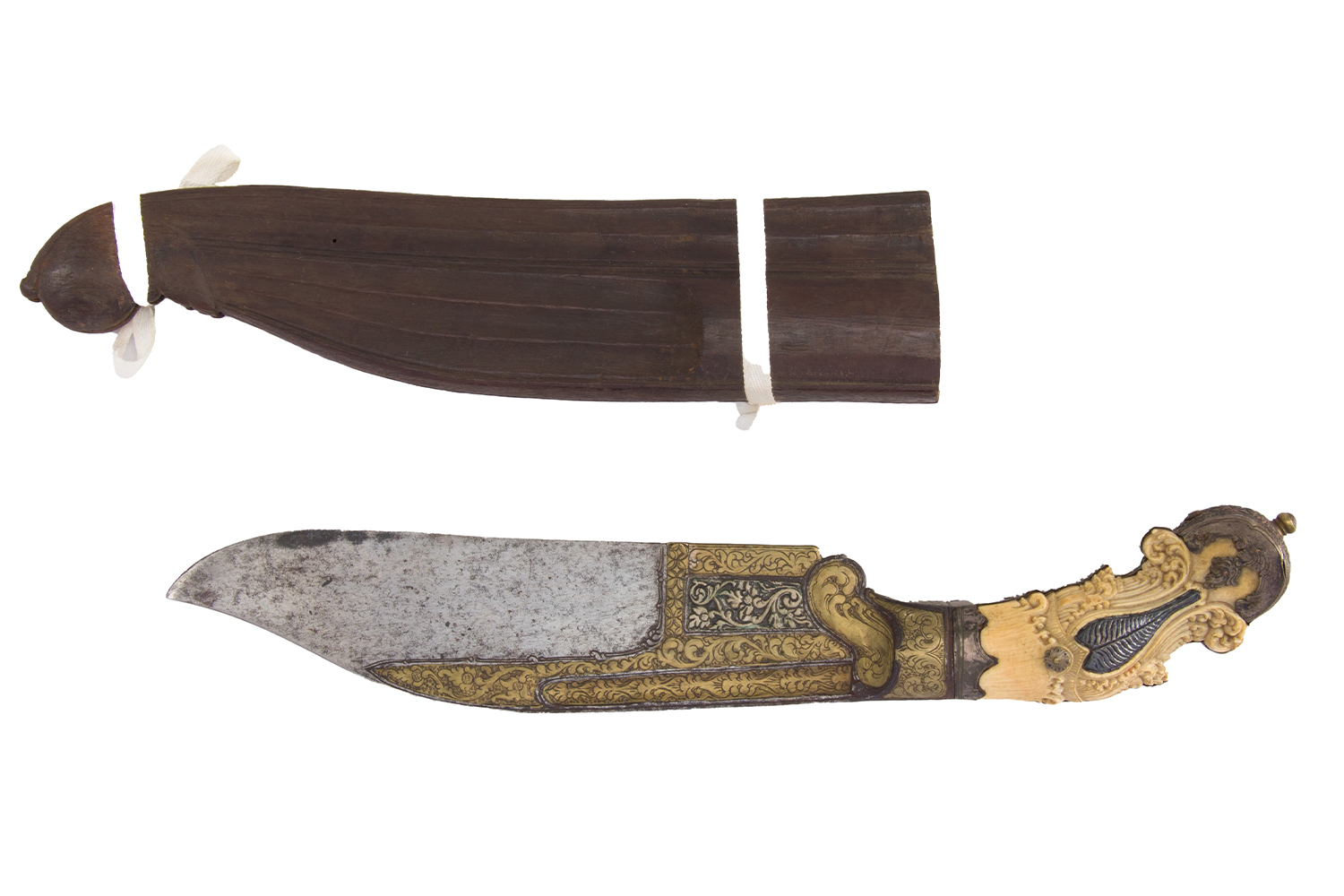
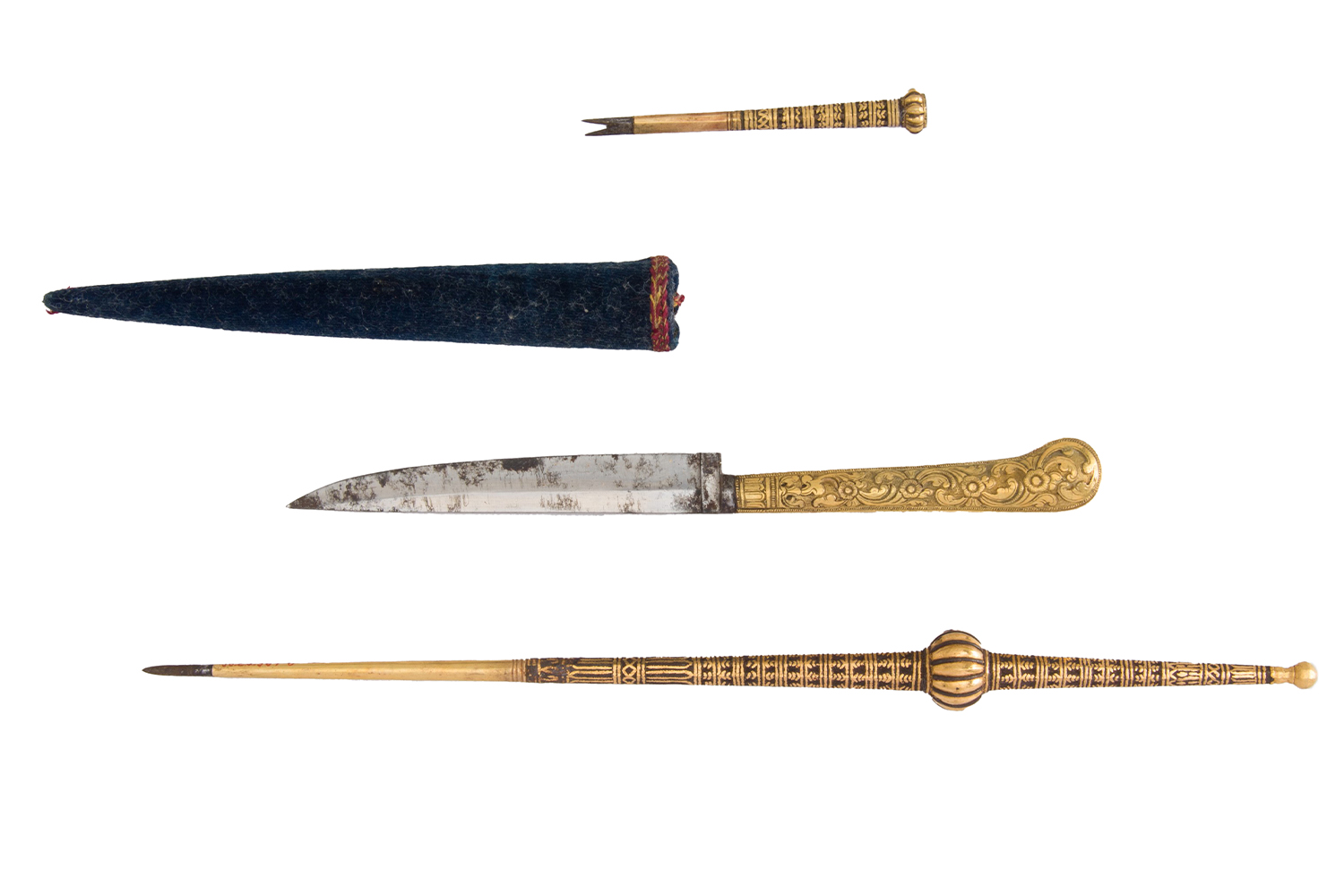
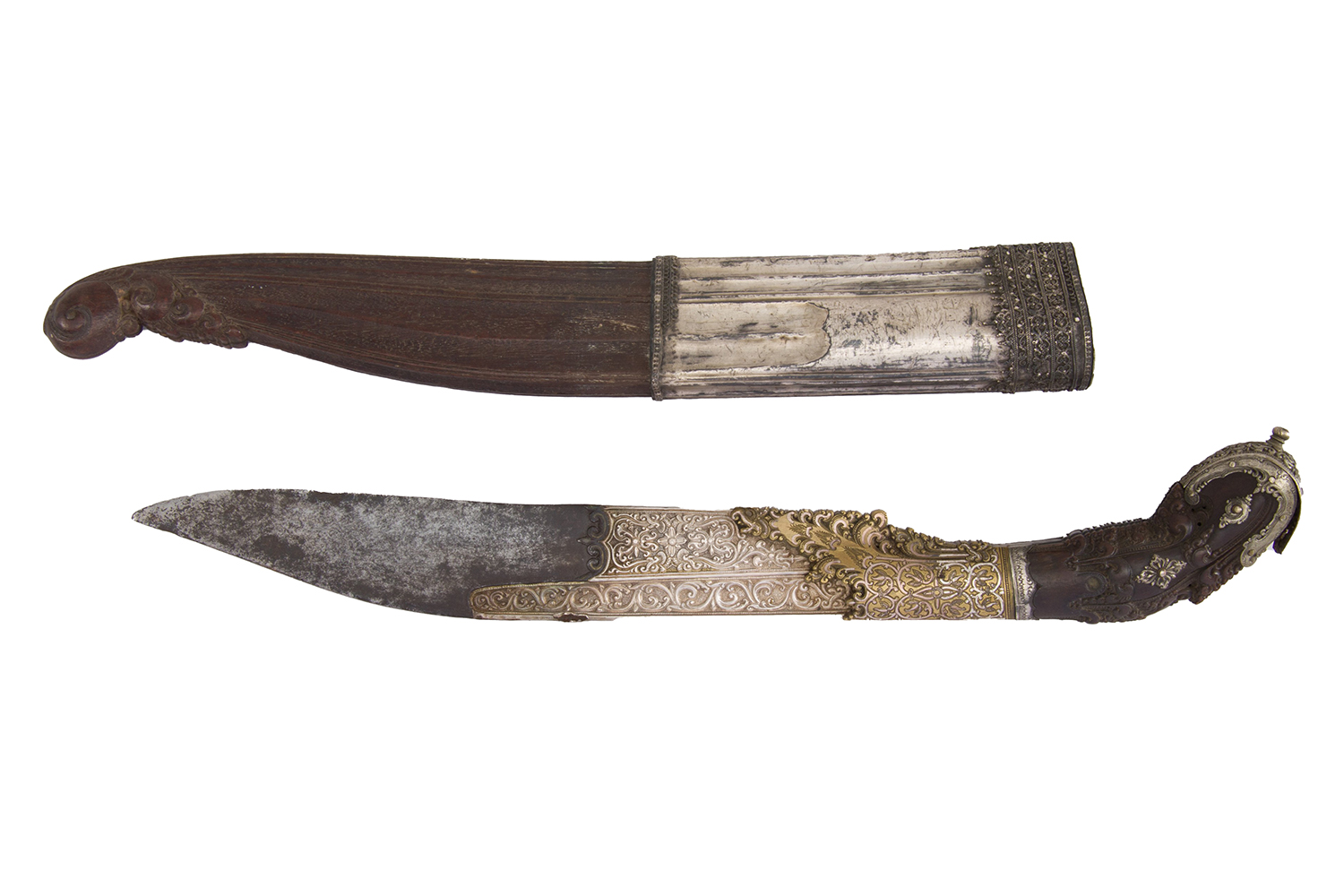
Most pihiya katthas feature a short hilt that is narrower than the blade. The pommel or knob at the end of the hilt is typically shaped to curve inward towards the sharp edge of the blade, and in some cases recurves towards the spine. The hilts of simpler knives meant for daily use were generally made of wood, though one example features a hilt made from a piece of bone and decorated with a simple geometric motif. Other more ornate specimens feature hilts made of silver, green marble, jade, ebony, ivory, lead glass, buffalo or rhinoceros horn, or from Antipathes orichalcea, a species of keratinous black coral native to Sri Lanka. Some of these are fitted with a pommel-cap of silver or gold, which may be a relatively simple knob or more elaborately stylised, for example, in the form of a lion’s head. Many examples of pihiya katthas have brass, gold, or chased silver latticework sleeves — panels with scrolling foliage motifs that extend from the pommel and partially cover the blade. The scabbard of most pihiya katthas is typically made of wood, often fluted and covered with silver or gold, and sometimes inlaid with precious stones and tortoise shell.
Production and influences
Along with other objects meant for royal use, the pihiya kattha was crafted in workshops called pattal hatara (‘four workshops’, referring to the four major crafts practised there), established by the Kandyan administration to patronise artisans. Between the sixteenth and nineteenth centuries, artisans in the Kandyan kingdom were organised in caste-based guilds which represented their interests to the state department of craft. Talented artisans were selected from these groups to work in the pattal hatara in exchange for land grants. Craftsmen were also invited from Tamil Nadu in southern India in this period, who are likely to have influenced design and techniques in the Sinhalese workshops. The scholar Ananda Coomaraswamy suggests that this could also be a reason why some Sinhalese craft objects bear names derived from their Tamil counterparts, such as kattha from the Tamil billhook chopper knife kattari; the Victoria and Albert (V&A) Museum, London even classifies the pihiya kattha as a Tamil hand knife.
Significance and use
The design and material of the pihiya kattha and its scabbard connoted the status of its owner. High-ranking officials and nobles in the court carried embellished pihiya katthas, which were also given as gifts to visiting diplomats or esteemed guests. In the 1765 war between the Kandyan kingdom and the Dutch East India Company, pihiya katthas were looted by the Dutch as spoils. One exceptionally ornate specimen housed at the Rijksmuseum, Amsterdam is thought to have formed part of the royal attire of the Kandyan king Kirti Sri Rajasinha (r. 1747–82).
In general, the weight and thickness of all types of pihiya kattha made them useful knives for daily tasks beyond their ornamental value in the royal court. Ordinary citizens of the kingdom used simpler pihiya katthas — those with a more pronounced billhook may have been used for clearing foliage on a small scale.
Pihiya katthas produced in the seventeenth and eighteenth centuries are housed in the Metropolitan Museum of Art, New York; the V&A Museum, London; the Rijksmuseum, Amsterdam; and the National Museum of Galle and the Kandy National Museum, Sri Lanka.
First published: 25 February 2025
Image Gallery
Bibliography
“A Late 1600’s Very Fine Black Coral Handled Sinhalese King’s or Noble’s Knife: A Piha-Kaetta (Pihiya).” The Lanes Armoury. Accessed June 21, 2024. https://www.thelanesarmoury.co.uk/shop.php?code=22534.
Christie’s. “A Large Singhalese Knife (Piha-Kaetta).” Accessed November 2, 2023. https://www.christies.com/en/lot/lot-1318288.
Coomaraswamy, Ananda. Medieval Sinhalese Art. Colombo: Government Press, 1908.
Dekker, Peter. “Pihiya Kättha.” Mandarin Mansion Antiques. May 14, 2019. Accessed November 2, 2023. https://www.mandarinmansion.com/glossary/pihiya-kattha.
Dekker, Peter. “Pihiya.” Mandarin Mansion Antiques. Accessed June 21, 2024. https://www.mandarinmansion.com/glossary/pihiya.
Dekker, Peter. “Sinhalese Knife.” Mandarin Mansion Antiques. Accessed June 21, 2024. https://www.mandarinmansion.com/item/sinhalese-knife.
Deraniyagala, P. E. P. “Sinhala Weapons and Armor.” The Journal of the Ceylon Branch of the Royal Asiatic Society of Great Britain & Ireland 35, no. 95 (1942): 97–142. http://www.jstor.org/stable/45385041.
Gahir, Sunita, and Spencer Sharon, eds. Weapon: A Visual History of Arms and Armor. New York: DK Publishing, 2006.
The Metropolitan Museum of Art. “Dagger (Piha Kaetta) with Stylus and Sheath.” Accessed November 2, 2023. https://www.metmuseum.org/art/collection/search/32248.
The Metropolitan Museum of Art. “Knife (Piha Kaetta) with Sheath.” https://jstor.org/stable/community.27382057.
National Museum of Colombo. “Press Release.” Accessed June 21, 2024. https://museum.gov.lk/web/index.php?option=com_content&view=article&id=143:press-release&catid=35:latest-news&Itemid=57&lang=ta.
Parker, H. Ancient Ceylon. London: Luzac & Co, 1909.
“Photo Gallery: Galle National Museum.” Wisdom Library. Accessed June 21, 2024. https://www.wisdomlib.org/gallery/galle-national-museum.
Schrikker, A., and D. van den Boogaart. “Provenance Report Regarding Singalees Mes [knife] or Piha-kaetta Met Schede.” PPROCE Provenance Reports, no. 47 (2022). https://pure.knaw.nl/ws/portalfiles/portal/488990493/RAP_PPROCE_ProvenanceReport_47_Piha_kaetta_NG_NM_7114_v10_202203.pdf.
Stone, George Cameron. A Glossary of the Construction, Decoration and Use of Arms and Armor: In All Countries and in All Times. New York: Dover Publications, Inc., 1999.
Sudyka, Lidia. “The Chejarla Temple Myth Revisited: Self-Decapitation in Medieval Andhra.” Indologica Taurinensia, 40 (2014): 318–40. http://www.asiainstitutetorino.it/indologica/volumes/vol40/17_SUDYKA.pdf.
Victoria and Albert Museum. “Piha Kaetta.” Accessed November 2, 2023. https://collections.vam.ac.uk/item/O474758/pha-kaetta-unknown/.
Feedback