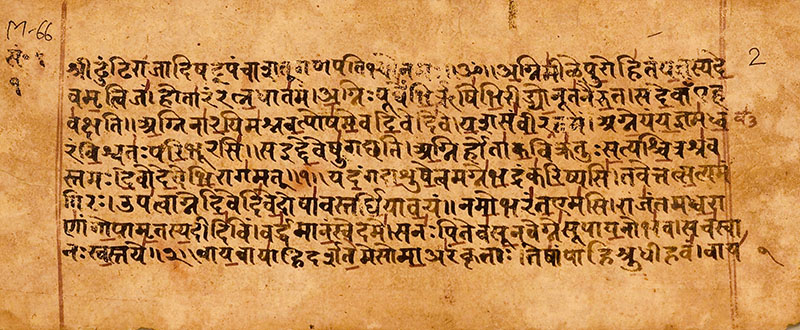
Earliest extant text from the Vedic corpus, dated roughly between 1700 and 1200 BCE. Like the other Vedas, the Rigveda was orally transmitted in archaic Sanskrit for generations and considered to be the direct word or sound of God rather than authored by man. The text comprises ten books of 1,028 mantras in praise of various devas, or deities, the most prominent of which are Indra, the king of the gods, associated with thunder or lightning; Agni, the fire god, who especially represents the sacred fire of the Vedic yajna or ritual sacrifice; and Prajapati, the creator or father of the universe, known as Brahma in later texts. The Rigveda also contains the earliest textual reference to the four varnas of Brahmanical society, which later develop into what is now known as the caste system.
More Definitions
Domingo Paes
Domingo Paes (b. n.d.; d. n.d.) was a Portuguese horse trader who visited Vijayanagara, the capital of the Vijayanagara empire,…
Prakriti
In the Hindu religious tradition, it is a theological concept that describes the primary principle, or source, of matter. In…
stambha
Sanskrit for ‘pillar’, historically appearing in various contexts, including Vedic liturgy, Brahmanical mythology, and Brahmanical treatises on architecture, theatre and…
Tenjur
A sacred text belonging to the Tibetan Buddhist canon, comprising commentaries, treatises and a collection of abhidharma (ancient Buddhist texts).…
Chandayana
A Sufi romance written in Hindi by the poet Mulla Da'ud during the reign of Firoz Shah Tughlaq (r. 1351–38).…
Sahitya Kala Parishad Award
An award conferred annually by the Sahitya Kala Parishad for excellence in performing and visual arts as well as literature.
Kandahar Bilingual Rock Inscription
A bilingual edict, written in Greek and Aramaic, dating to c. 260 BCE. It is the earliest known rock edict…
Devi Mahatmya
Also known as Durga Saptashati, it is one of the foremost texts within the Shaktism tradition and focuses on the…