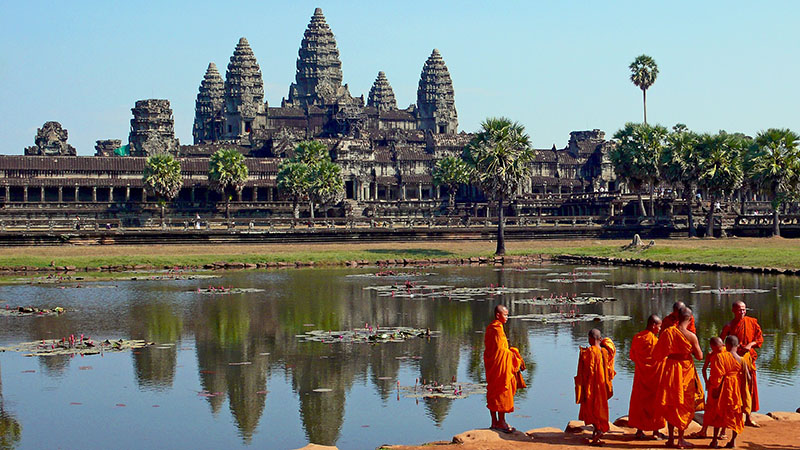
Southeast Asian state that was founded in 802 CE and declined in 1431 CE. At its height, the Khmer empire encompassed modern-day Cambodia, Thailand, Laos and southern Vietnam. Maritime trade with India deeply influenced its material and spiritual culture — Shaivism, Vaishnavism and Buddhism were favoured by Khmer royalty, and Khmer art often reflects a composite Hindu-Buddhist iconography. For most of the empire’s history, its capital was located in the city of Angkor, where Khmer kings commissioned the construction of the elaborate, sprawling Hindu-Buddhist temple Angkor Wat, the world’s largest religious complex.
More Definitions
Vijayanagara Kingdom
Established in 1336, it was one of the dominant kingdoms of southern India in the late medieval and pre-modern periods,…
Muhammad bin Tughlaq
Muhammad bin Tughlaq (r. 1325–51) was the second sultan of the Tughlaq dynasty (r. 1320–1413), under whom the Delhi Sultanate…
Khanzada Begum
Khanzada Begum (b. c.1478; d. 1545) was the elder sister of the Mughal emperor Babur. She finds mention in his…
Dhamma Mahamatta
A class of officers instituted by the Indian emperor Ashoka during his reign in the third century BCE whose chief…
Rajamalla IV
Rajamalla IV (b. n.d. ; d. n.d.) was a ruler of the Western Ganga dynasty, which governed parts of present-day…
Sri Lankan Civil War
Violent conflict from 1983 to 2009 between the Sinhala-majority Sri Lankan government and the Liberation Tigers of Tamil Eelam (LTTE),…
Firuz Shah Tughlaq
Firuz Shah Tughlaq (b.1309; d.1388) was a Tughlaq dynasty ruler who reigned over the Sultanate of Delhi from 1351–88 CE.…
Venkatapatiraya
Venkatapatiraya (b. n.d.; d. 1614) was a ruler of the Aravidu dynasty, the fourth and last dynasty that ruled over…