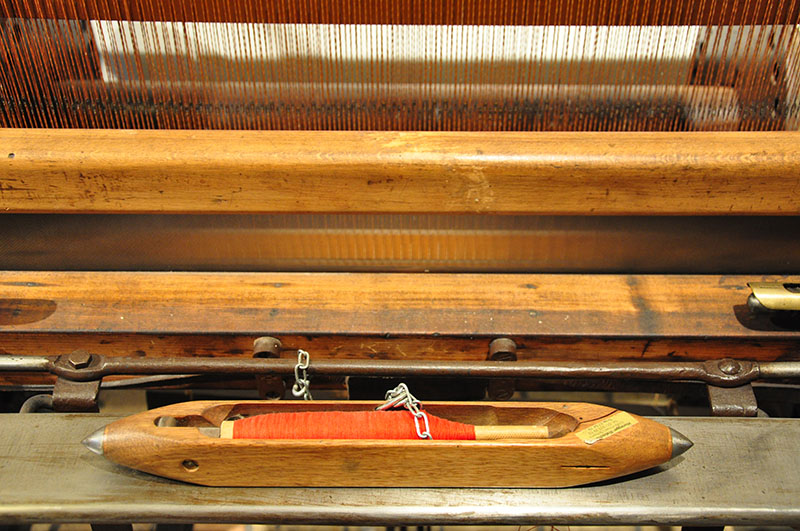
Mechanical tool installed on a loom for textile weaving, which enables the weft thread to be drawn through the warp more quickly and easily across wider spans. It is an oblong piece of wood with pointed metal ends, a central space with a spool for the thread, and wheels on its underside. A single weaver can propel it back and forth along a track by pulling a cord, eliminating the need for two or more weavers to throw and catch it at either side of the loom — as previously needed for making textiles wider than an arm span. Devised by British engineer John Kay in 1733, it was a major early landmark in the Industrial Revolution and the subsequent automation of weaving, and was soon incorporated into handloom industries beyond Britain and Europe.
More Definitions
Bageshwari charkha
Treadle-operated charkha or spinning wheel used in the Indian subcontinent to spin carded wool, cotton, silk, nettle or hemp into…
Pirn
A wooden or plastic rod on which weft yarn is wound for use in a loom. The pirn is fixed…
Magic Lantern Projector
An early image projector developed in the seventeenth century, where pictures were showcased through transparent plates, typically made of glass.…
Naksha
Also known as a jala, it is an arrangement of threads that maps the desired design and is attached to…
Paper Negative
A photographic negative created on paper, rather than on modern cellulose film or a glass plate. William Henry Fox Talbot's…
developer
In photography, a chemical solution used to reveal the latent image that has been captured on the photographic film, as…
ground glass
Glass that has been given a coarse surface finish, usually with a fine abrasive, to be used as the viewfinder…
Brownie Camera
Also known as the Kodak brownie, it is a series of box cameras with a meniscus lens and roll film,…