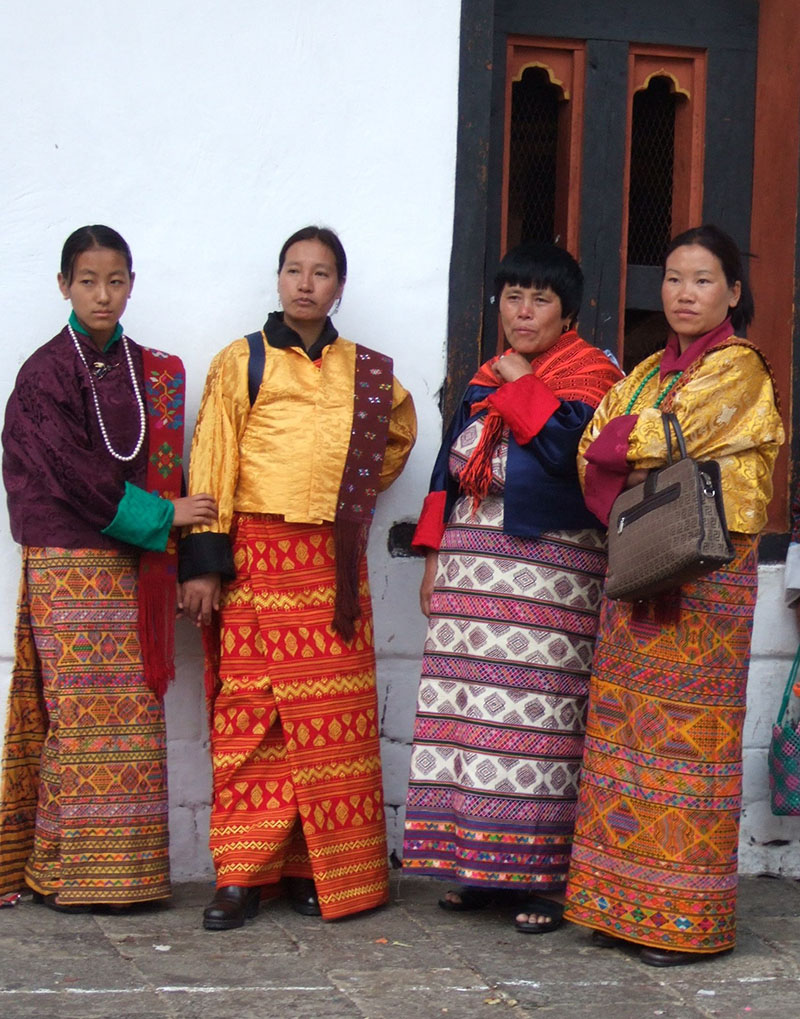
Short, loose jacket for women, with broad lapels and cuffs, worn over the kira as part of traditional Bhutanese attire. It is often paired with a wonju or undershirt of a contrasting colour, whose collar and elongated sleeves are folded over those of the toego to create an accent. It can be closed with a brooch (koma), and is formally topped with a ceremonial shoulder-cloth (kabne or rachu). Traditionally made using indigenous silk, toegos for the elite have also used brocaded Hong Kong silk and Thai silk, while others use cotton or polyester. Some recent adaptations include a slimmer fit, and an integrated contrasting collar and cuff to eliminate need for the wonju. Also spelled tögo or tego, and not to be confused with the Bhutanese men’s undershirt of the same name.
More Definitions
Khapa Sari
Also known as patiya sari, it is a tussar silk sari characterised by extra weft rib weaves in the pallu…
Uttariya
A scarf-like item of clothing originating in ancient India, it is worn on the upper body, draped around the back…
Safa
Also known as pagri, it is a traditional turban worn by Rajasthani men. It is made using the resist-dyeing techniques…
Khombi
An odhani (veil) worn by brides of the Khatri community and Muslim communities in Gujarat. Made using the tie-and-dye bandhani…
Chadar
A length of cloth worn by women as a loose veil or wrap to cover the head and shoulders, and…
Himation
A type of garment worn by men and women in ancient Greece, it was an unstitched piece of rectangular cloth…
Half-and-Half Style
A sari style characterised by contrasting colours or patterns in its two half-lengths. The length of one segment of the…
Mola
Meaning “shirt” or “clothing,” it is a traditional textile made in reverse-applique technique by women of the Guna community of…