-
ChicagoImpart Encyclopedia of Art. "Chamunda." November 22, 2023. https://imp-art.org/articles/chamunda/.
-
MLA"Chamunda." Impart Encyclopedia of Art, Nov. 22, 2023, https://imp-art.org/articles/chamunda/.
-
HarvardImpart Encyclopedia of Art (2023) Chamunda. Available at: https://imp-art.org/articles/chamunda/ (Accessed: 16 October 2026).
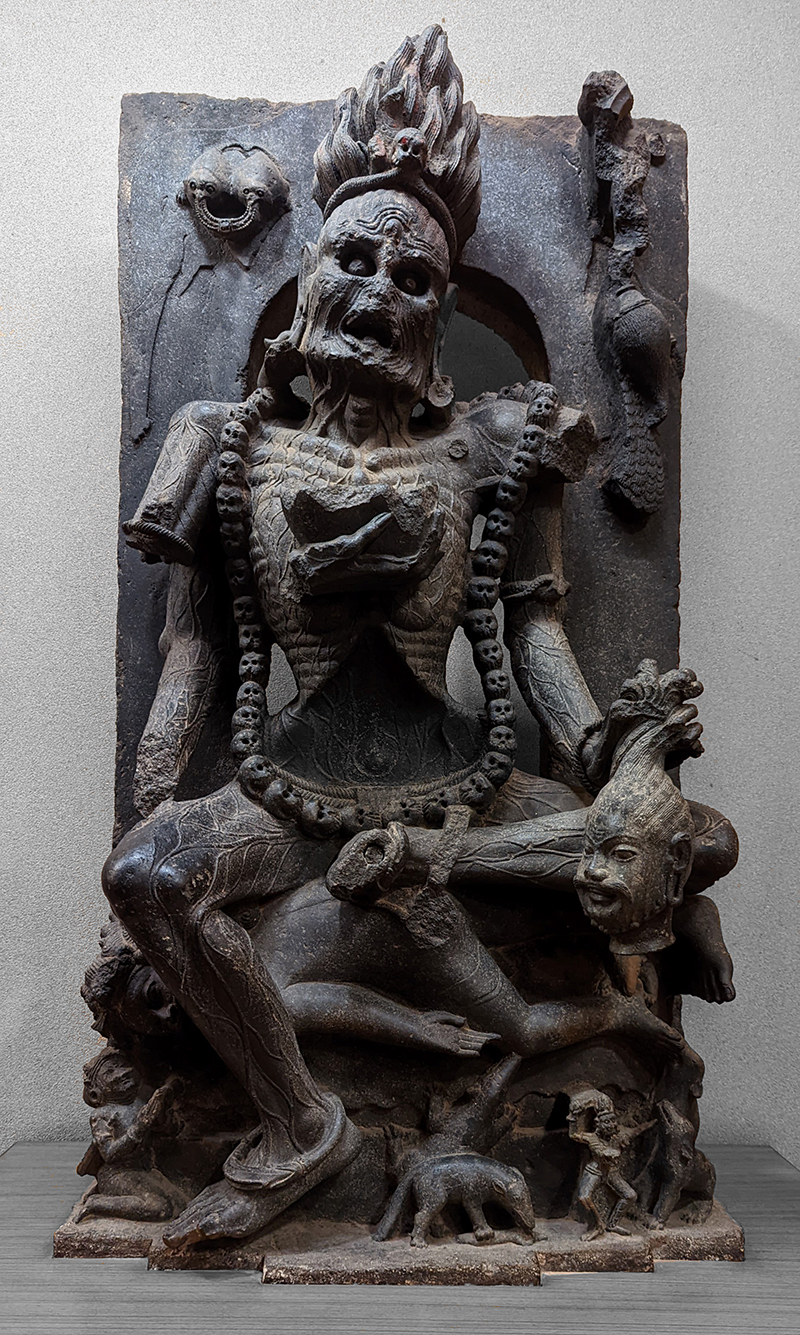
A fierce aspect of Devi or the Great Goddess, Chamunda is an important deity within the tantric traditions of Shaktism. She is the consort of Bhairava, a fierce manifestation of Shiva, and is one of the Saptamatrikas. Also known as Chamundi, Chamudeshwari and Charchika, she symbolises death, destruction and disease, and is believed to be the destroyer of evil.
Some scholars believe that Chamunda was a folk deity originally worshipped by indigenous communities in central India. She subsequently became a major deity in Tantrism, as well as Shaktism. In texts such as the Markandeya Purana, and the Devi Mahatmya, she takes the form of the goddess Kali to slay the demons Chanda and Munda, after which she is given the name Chamunda. In other textual traditions, she is listed as a manifestation of Durga.
In visual iconography, Chamunda is mostly seen as a part of Saptamatrika imagery on the exterior walls of temples or in shrines. Of the seven goddesses, she is the only one who is not the female counterpart of a male god, but is a manifestation of Shakti herself. She is also the only goddess within the Saptamatrikas who is also worshipped individually.
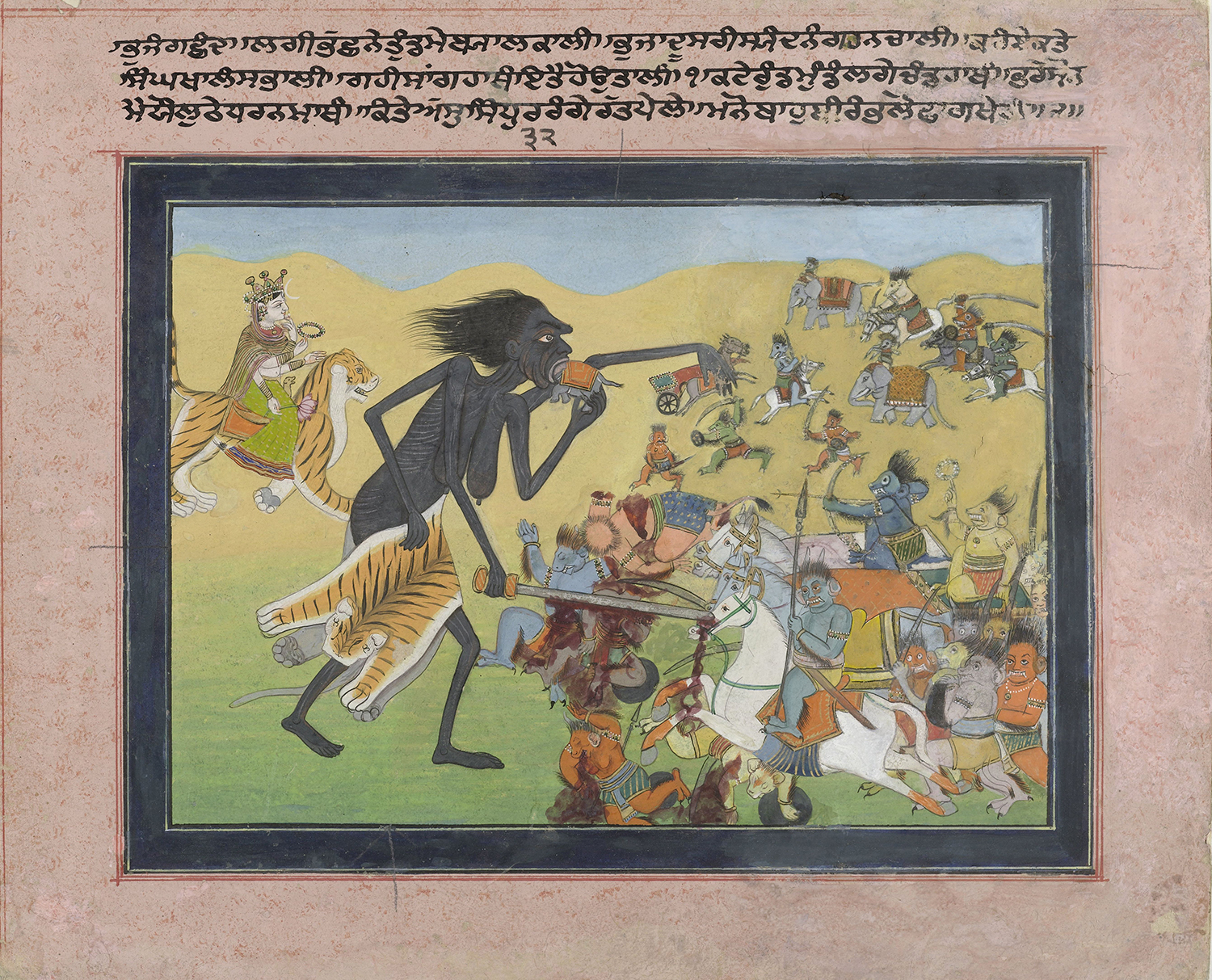
In early representations of Chamunda, she is given a ferocious visage, but with a feminine figure and elegant features. However, in later representations she is generally depicted as a skeletal old woman, with several arms and a dark blue or black complexion, wearing an elephant or tiger hide. She is shown to have sunken eyes, dishevelled hair and fangs, and is adorned with ornaments made of bones, skulls, serpents and scorpions. She carries a damaru, or double sided hand drum, a trident, a sword, and a skull cup filled with blood or wine. Her vahana is either a corpse, a jackal, an owl or a lion.
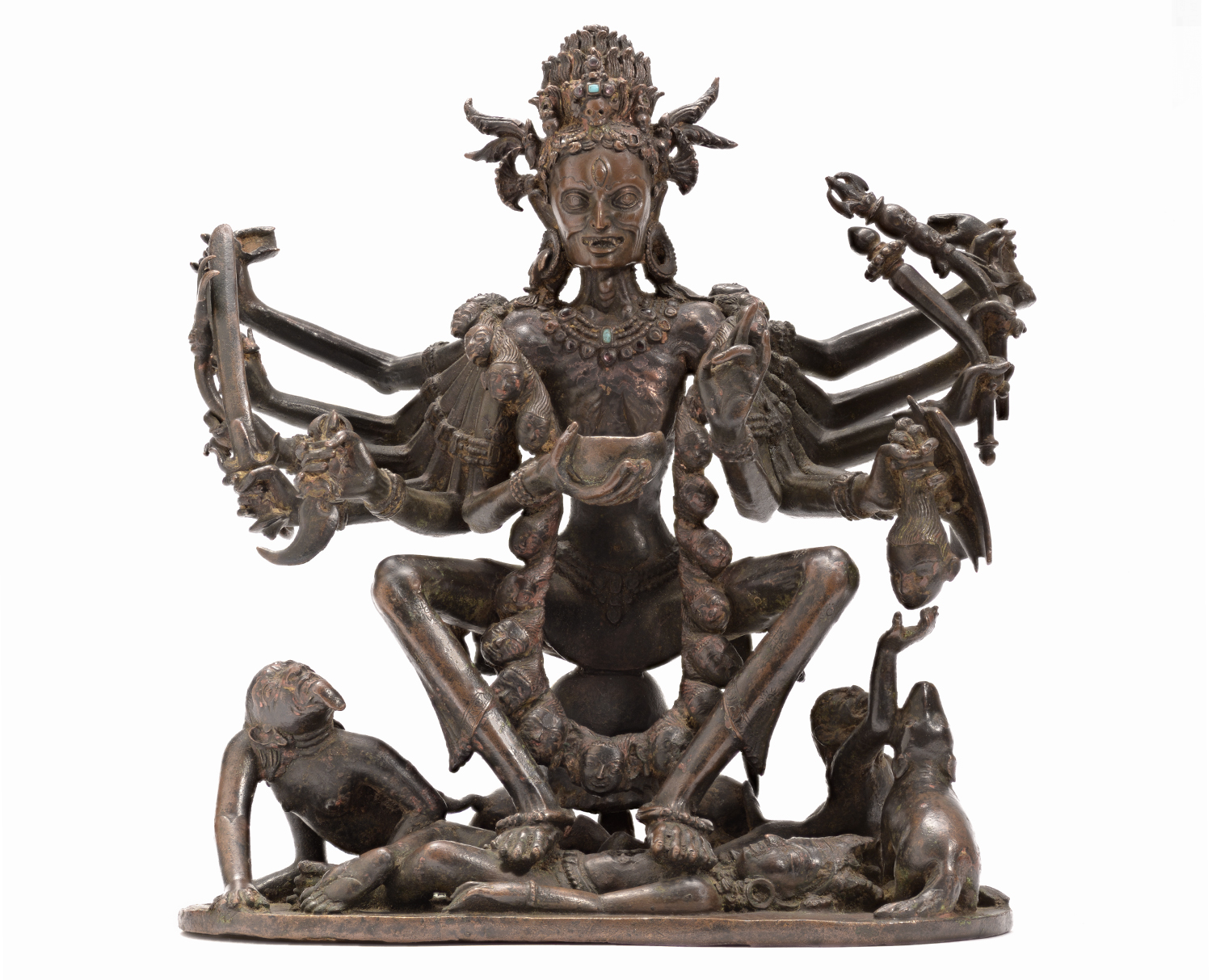
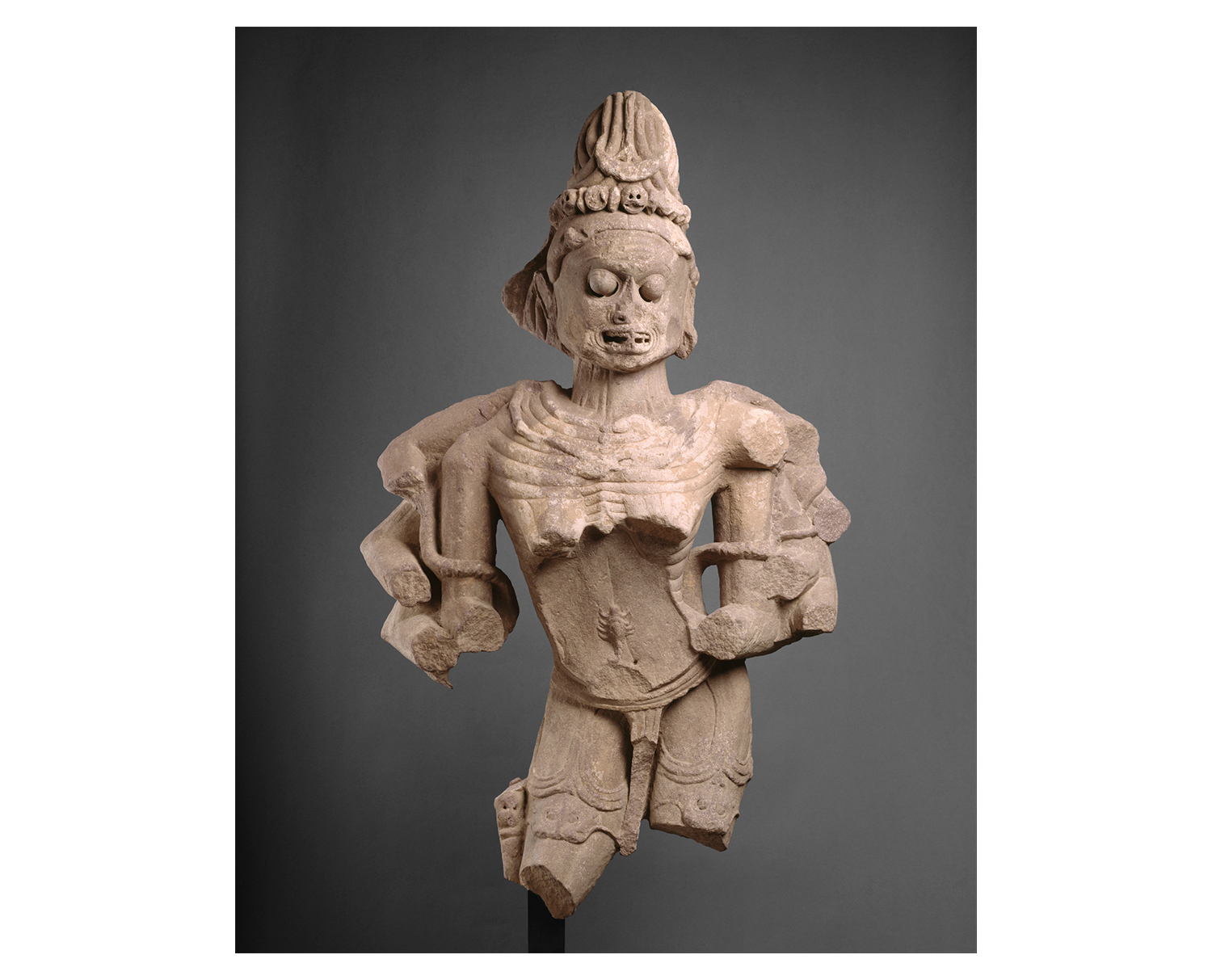
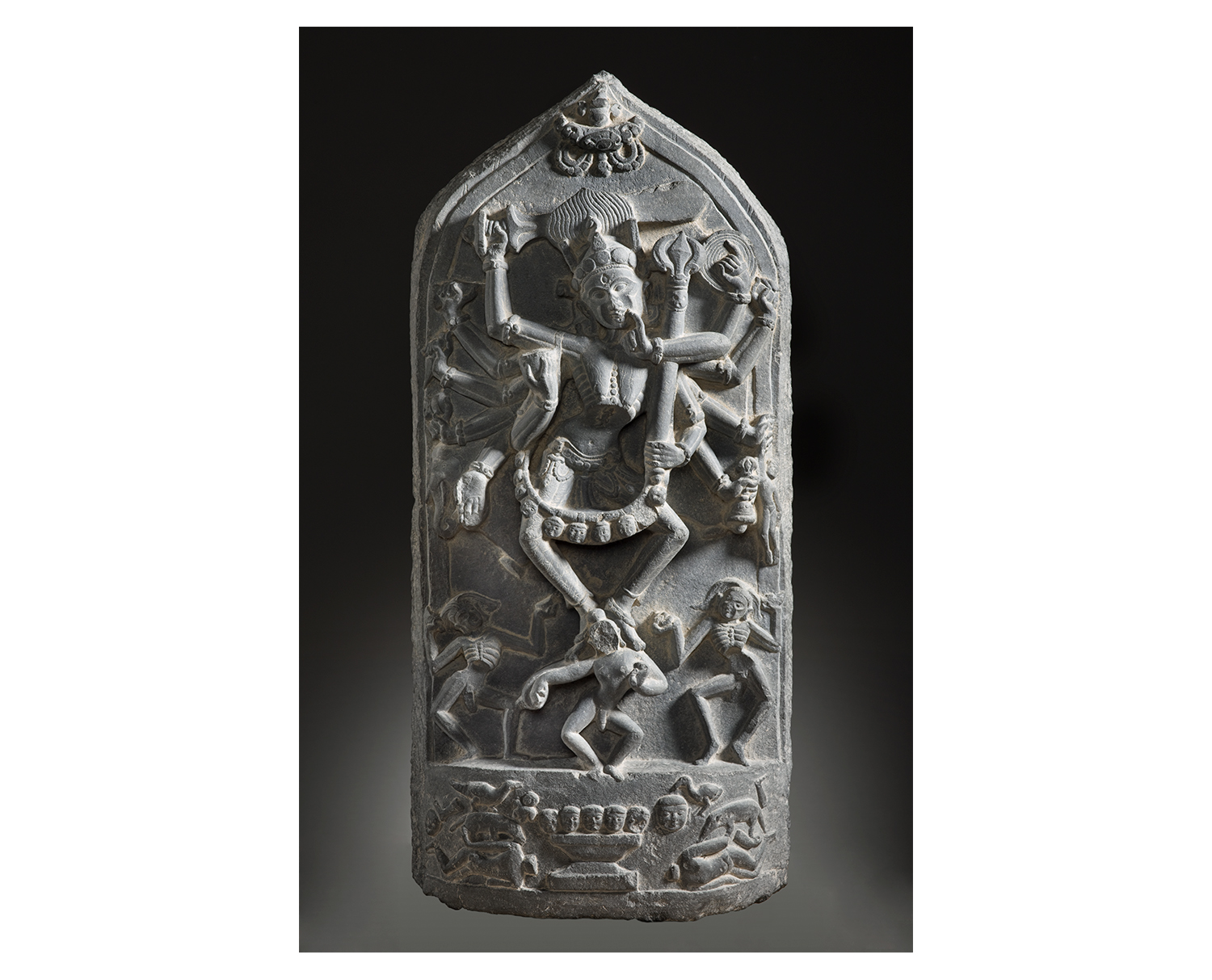
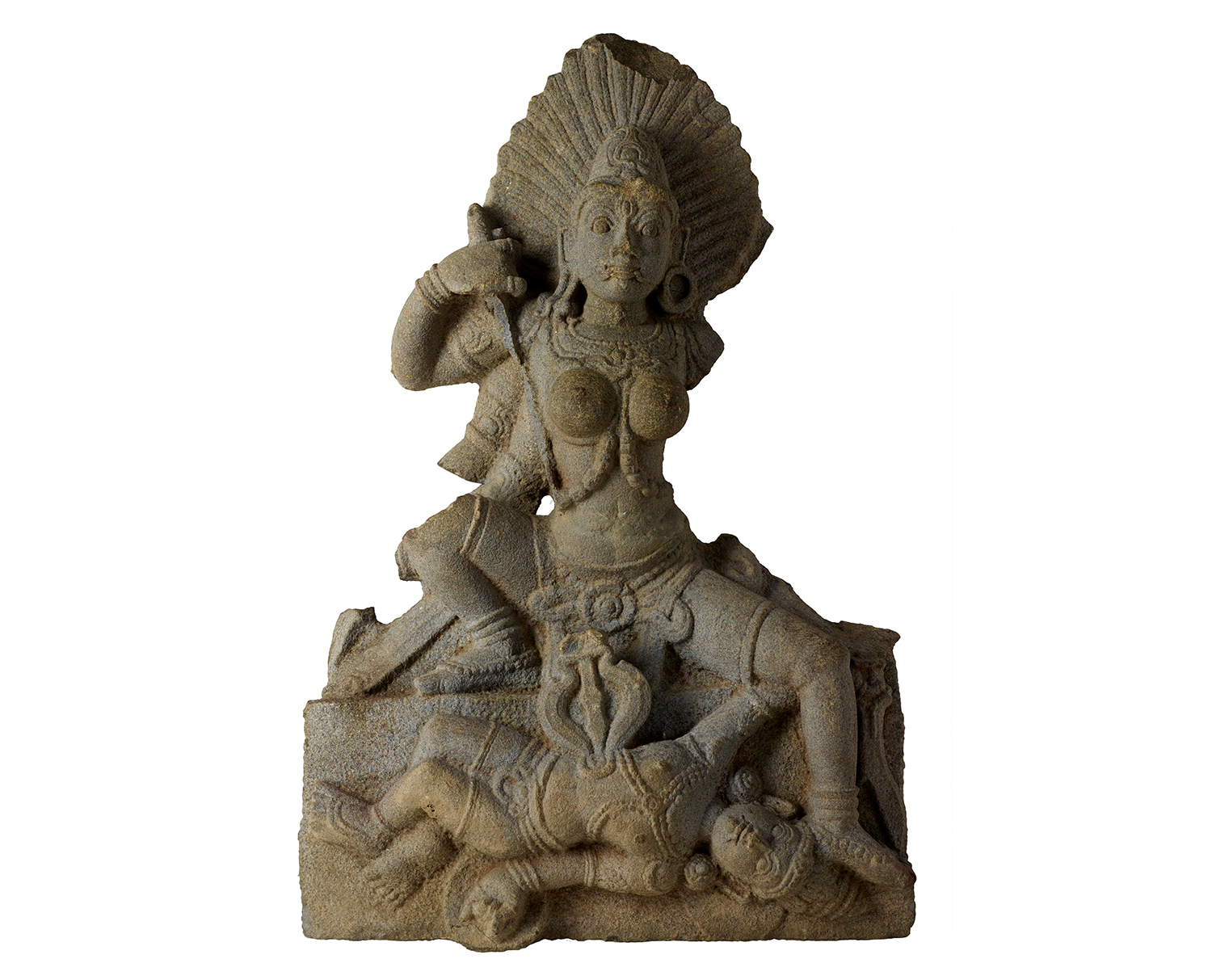
There are several temples and shrines dedicated solely to Chamunda, with the sixteenth-century Chamunda Devi Temple in Kangra, Himachal Pradesh being a notable one. Others include the Kichakeswari Temple and the Baitala Deula in Odisha; the Chamundeshwari Temple in Mysuru; the Chamunda Temple at the Mehrangarh Fort in Jodhpur; and two temples in Chotila and Panera, Gujarat. She also appears as a minor goddess on wall murals in several temples in Nepal dated to the fourteenth and fifteenth centuries.
Illustrations of Chamunda appear in illustrated folios of the Devi Mahatmya, in Mughal manuscripts and in Pahari and Rajput paintings, as well as in paintings from Nepal. She is often depicted eating corpses in battlegrounds, carrying a severed head or drinking the blood of demons.
First published: 22 November 2023
Image Gallery
Bibliography
Dallapiccola, Ann. Dictionary of Hindu Lore and Legend. London: Thames & Hudson (2002).
Elgood, Heather. Hinduism and the Religious Arts. London, New York: Cassell (1999).
Harveen Bhandari, “Sacred Landscape: A documentation of the Chamunda Devi Temple Complex, Himachal Pradesh.” Compiling Records, Vol 10, Issue 1 (2013).
Rushal Unkule, Gopal Joge and Veena Mushrif‐Tripathy, “Early Medieval Representation of Human Anatomy: A Case Study of Chamunda Stone Image from Dharamsala, Odisha.” Heritage: Journal of Multidisciplinary Studies in Archaeology (2017).
The Metropolitan Museum of Art. “Chamunda, the Horrific Destroyer of Evil.” Accessed January 20, 2023. https://www.metmuseum.org/art/collection/search/38152.
Feedback